Hierarchy tags¶
Every block carries its sender→recipient edge. A tier ingests a block only if the edge terminates at it.
[INVARIANT — the wire format] · [TUNABLE — exact tag names]
New here? This page explains the little "address label" that gets stamped on every message agents pass to each other — who it's from, who it's for. That label is what stops a message from being read by the wrong agent. If you're routing work between tiers and want to know why messages can't get crossed, this is the page for you.
Hierarchy-edge tags are the addressing layer of the bus protocol — the shared messaging system tiers use to pass work back and forth. Every paste-ready block — and every inbox file's content — is wrapped in a tag naming the edge it travels (an "edge" here just means the directed link from one tier to another): which tier sent it, which tier it is for. The tag is what makes routing auditable — you can always trace where a message came from and where it was headed — and what powers tag-gated ingestion: before a tier acts on a message, it checks the tag to confirm the message was actually addressed to it.
This defends against a specific failure: a block that sounds right (voice-match across relay hops) being ingested by the wrong tier. Voice-match is signal, not authorization. Only the edge authorizes.
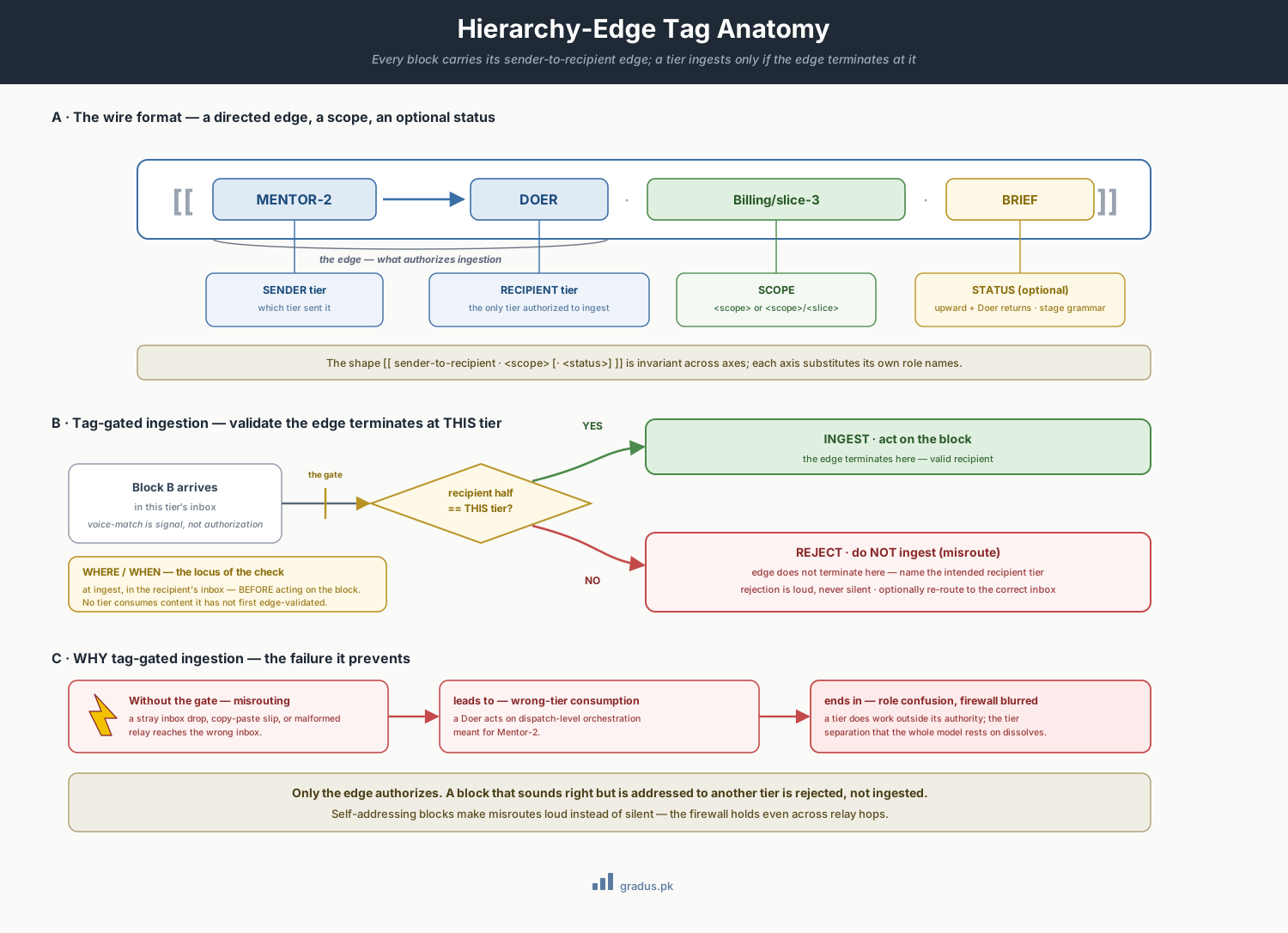
Every bus message is wrapped in an edge tag; the recipient validates the edge terminates at its own tier before ingesting — misrouted tags are rejected.
The wire format¶
A tag names a directed edge between two tiers, plus a scope, plus (for upward returns) a status.
| Direction | Open tag | Close tag |
|---|---|---|
| Down (mentor → sub-tier) | [[MENTOR-1→MENTOR-2 · <scope>]] |
[[/MENTOR-1→MENTOR-2]] |
| Up (sub-tier → mentor) | [[MENTOR-2→MENTOR-1 · <scope> · <status>]] |
[[/MENTOR-2→MENTOR-1]] |
| Mid → Doer | [[MENTOR-2→DOER · <scope>/<slice>]] |
[[/MENTOR-2→DOER]] |
| Doer → Mid | [[DOER→MENTOR-2 · <scope>/<slice> · <status>]] |
[[/DOER→MENTOR-2]] |
| Cross-axis (rare) | [[<AXIS_A>→<AXIS_B> · <scope>]] |
[[/<AXIS_A>→<AXIS_B>]] |
Anatomy of a tag:
[[  MENTOR-2 → DOER   ·   Billing/slice-3   ·   BRIEF  ]]
    └─sender─┘ └recip┘     └────scope────┘      └status┘
    └──── the edge ────┘
- Sender / recipient — the two tiers the block travels between. Generic names shown; each axis substitutes its own role names (the rules are stated in the generic vocabulary).
- Scope — the unit of work.
<scope>for dispatch-level,<scope>/<slice>for slice-level. - Status (upward + Doer-return tags) — the return's disposition, drawn from the stage grammar (e.g.
WIP-CP2,CP-FREEZE,BRIEF-INCOMPLETE,READY-FOR-GATE).
Per-axis substitution¶
The framework speaks MENTOR-1 / MENTOR-2 / DOER; each axis declares its own role names and uses them on the wire. A federation operating a build axis (roles, say, Mentor-1/Mentor-2/Doer) and a doctrine axis (its own three role names) would see edges named for each axis's roles — but the shape ([[<sender>→<recipient> · <scope> [· <status>]]]) is invariant across axes.
Tag-gated ingestion (validate-then-reject)¶
The rule a tier applies before consuming any block:
ON receiving a block B:
  1. Parse B's edge tag.
  2. IF the recipient half of the edge == THIS tier:
        ingest and act.
  3. ELSE:
        REJECT. Do NOT ingest.
        Name the intended recipient tier in the rejection.
        (Optionally re-route the block to the correct recipient's inbox.)
Three rules make this load-bearing:
- Edge must terminate at the consuming tier. A
[[MENTOR-1→MENTOR-2]]block is for Mentor-2 only. A Doer that sees it rejects it. - Voice-match is not authorization. A block can be relayed through several hops and still read as if it came from a trusted tier. The content carrying a trusted voice does not authorize ingestion — only the edge does.
- On mismatch, name the intended tier. Rejection is not silent. The rejecting tier states which tier the block was actually for, so the founder (or a re-route) can correct the path.
Why this matters¶
Without tag-gating, a misdirected inbox drop, a copy-paste error, or a malformed relay could feed one tier instructions meant for another — for instance a Doer acting on dispatch-level orchestration meant for Mentor-2, blurring the firewall. Tag-gating makes every block self-addressing and makes misroutes loud instead of silent.
Worked examples¶
Downward brief (Mentor-1 → Mentor-2):
[[MENTOR-1→MENTOR-2 · Billing]]
Dispatch the Billing module Phase 3. Base commit a1b2c3d. Slice as you see fit.
Gate on §13 1-4. Surface any charter-tier proposal as a founder-call.
[[/MENTOR-1→MENTOR-2]]
Upward return with status (Mentor-2 → Mentor-1):
[[MENTOR-2→MENTOR-1 · Billing · CP-FREEZE]]
All 4 slices frozen. Gates 1-4 green. 2 leftovers onboarded (LO-114, LO-119).
Finding tally reconciles. Requesting GO-TAG.
[[/MENTOR-2→MENTOR-1]]
Doer escalation (Doer → Mentor-2):
[[DOER→MENTOR-2 · Billing/slice-3 · BRIEF-INCOMPLETE]]
Operational precondition unfilled: base commit SHA missing from brief.
Halting per brief-completeness rule. Not improvising. Awaiting concrete value.
[[/DOER→MENTOR-2]]
A misroute being rejected (Doer receives a mentor-level block):
[[DOER→MENTOR-2 · Billing/slice-3 · REJECT-MISROUTE]]
Received a block tagged [[MENTOR-1→MENTOR-2 · Billing]] in my slice inbox.
Edge does not terminate at DOER — intended recipient is MENTOR-2. Not ingesting.
[[/DOER→MENTOR-2]]
Relationship to inbox file naming¶
The tag lives inside the file; the bus protocol names the file from-<sender-tier>-<event-class>[-<discriminator>].md. The filename tells you (and the audit log) who wrote it and why; the inner tag is what the consuming tier validates before acting. Both must agree — a file named from-mentor1-brief.md should contain a [[MENTOR-1→…]] tag.
→ Bus protocol · Stage grammar · Dispatch brief template · Firewall
Remember this¶
- Every message wears an address label. The tag names who sent it and who it's for — that's the "edge" it travels along.
- The recipient checks the label before acting. If the message isn't addressed to this tier, it gets rejected, not silently obeyed.
- Sounding right isn't the same as being authorized. A message can read like it came from a trusted tier and still be for someone else — only the edge decides.
- Misroutes get caught out loud. A rejected message names who it was actually for, so the path can be corrected. For how this fits the bigger picture, see the mental model.