Brownfield Onboarding
Adopting CompassAlpha over a codebase you already have. A pre-existing project walks in with code, culture, obligations, and tooling — but no doctrine layer. This is the phased journey for extracting one.
In plain terms: this page is for when you already have a working project — real code, real users, real history — and you want to start running it the CompassAlpha way without stopping everything to rebuild from scratch. It walks you through doing that gradually, one piece at a time.
Throughout this section, "component" and "module" are used interchangeably — a component of your project is a module you onboard.
Most real adoptions are brownfield. You don't get to start from a blank slate; you have a running system with users, history, and tribal knowledge. The rules that govern your codebase already exist — its Charter (the project-wide constitution), its module boundaries, its invariants (the things that must always stay true) — but they're buried in code and people's heads, not written down as doctrine: the explicit, agreed-on rules a CompassAlpha federation works to.
Extracting that doctrine is the hard, valuable work brownfield onboarding does. CompassAlpha treats it as a first-class, phased journey — not an afterthought. You will not boil the ocean. You'll onboard one or two pilot modules first, prove the rhythm, and expand from there while the rest of the project keeps running on your existing workflow.
Greenfield is simpler
If you're starting from nothing, you don't need any of this — go to greenfield setup. Brownfield is the path for a codebase with existing weight.
Evaluate freely first
Non-commercial and evaluation use is free — explore the framework, run a pilot, prove the rhythm at no cost. A license is only needed once you move to commercial/production use of a real codebase. When you get there, see COMMERCIAL.md for the details.
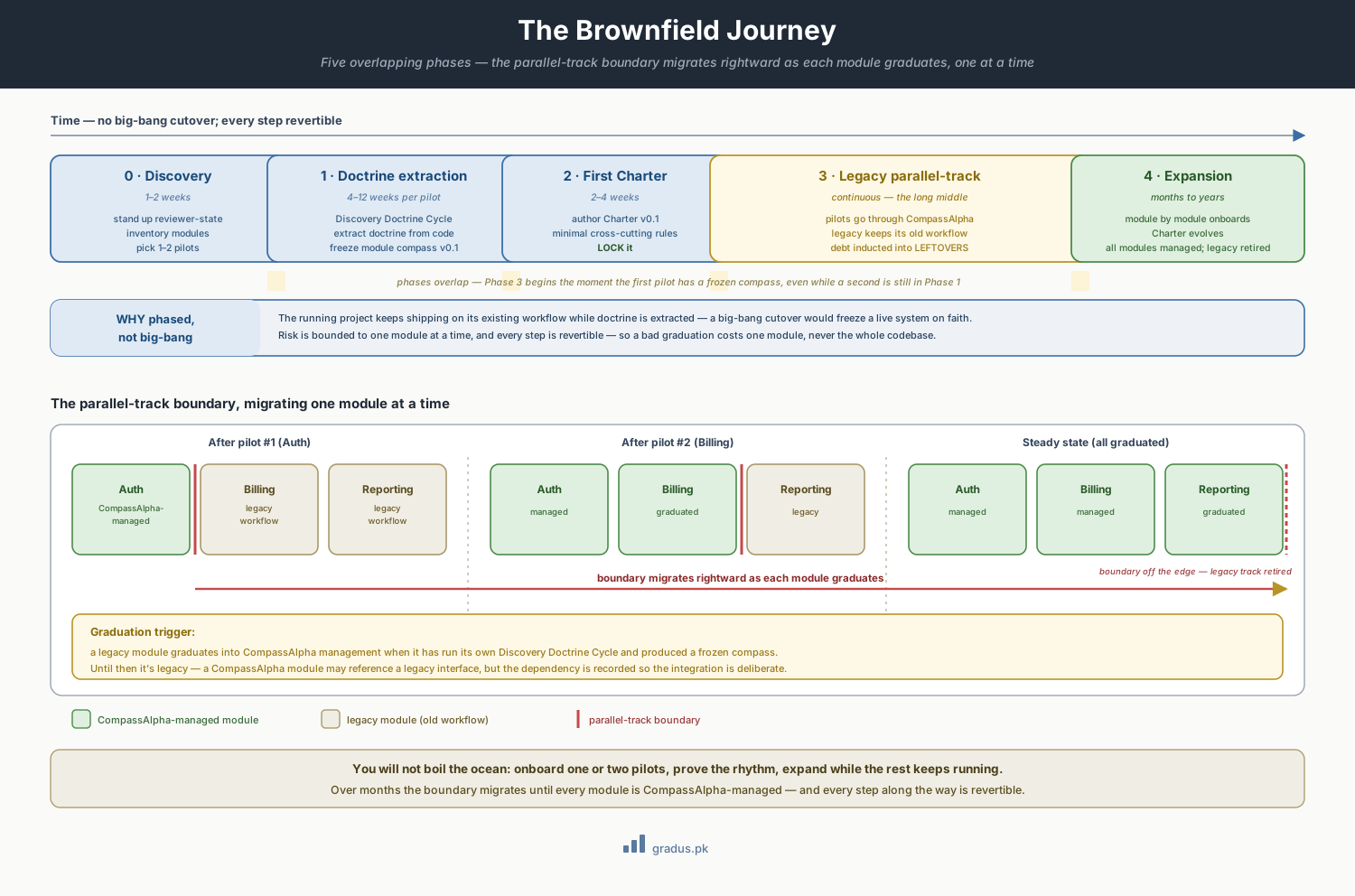
Brownfield adoption is phased, not big-bang: modules graduate one at a time as the managed/legacy boundary migrates rightward.
The five-phase journey
| Phase | Typical duration | What happens |
|---|---|---|
| 0. Discovery | 1–2 weeks | Stand up the reviewer-state repo · pick a host · install the AI harness · inventory modules · pick 1–2 pilot modules. |
| 1. Doctrine extraction | 4–12 weeks per pilot module | Run the Discovery Doctrine Cycle — extract doctrine from existing code rather than amend existing doctrine. |
| 2. First charter | 2–4 weeks | Author Charter v0.1 with the minimum cross-cutting rules. LOCK it. |
| 3. Legacy parallel-track | continuous | Pilot modules go through CompassAlpha; everything else keeps using your pre-CompassAlpha workflow. Legacy debt is inducted into LEFTOVERS. |
| 4. Expansion | months → years | More modules onboard · Charter evolves · eventually all modules become CompassAlpha-managed. |
The phases overlap in practice. Phase 3 begins the moment your first pilot module has a frozen doctrine, even while a second module is still in Phase 1.
What month one roughly looks like
A rough estimate, not a guarantee — your numbers depend on module size and how well-understood the code is (the phase ranges above are the real bounds). But the shape is reassuring: in the first few weeks you stand up the skeleton (Phase 0) and begin the pilot module's Charter extraction and ratification (Phases 1–2). Shortly after that first compass freezes, you build your first new feature on the pilot under CompassAlpha. From there you expand module by module while the rest of the project keeps running untouched. The cost is bounded to one module at a time, not the whole codebase up front.
Phase 0 — Discovery
Goal: a working federation skeleton and a chosen pilot.
- Stand up the infrastructure. Create the substrate and reviewer-state repos as siblings, drop in the master, author canonical state artifacts, lay out the bus tree, stamp the tiers. This is mechanically identical to greenfield setup steps 1–6 — do those first. The difference is that your substrate repo already has code in it.
- Inventory the modules. List every module / service / bounded area in the codebase. For each, note: rough size, how well it's understood, how much it changes, what depends on it, and what it depends on.
- Pick 1–2 pilot modules. Choose modules that are:
- Self-contained enough to reason about without dragging in the whole system.
- Active enough that extracting their doctrine pays off soon.
- Not on fire — don't pilot on the module that's mid-incident.
- A worked example set: Auth, Billing, Reporting. Auth is a good first pilot — well-bounded, widely depended-on, with clear invariants worth writing down.
Phase 0 ends when you have a skeleton federation and one pilot module selected.
When there are no clean seams (the tangled monolith)
Steps 2–3 quietly assume your codebase has well-bounded modules to inventory and pick from. Many don't. A tangled monolith — shared mutable state, circular dependencies, no enforced boundaries, "everything imports everything" — offers no self-contained module to point at. This is common, and it is not a reason you can't adopt; it just means you do a seam-finding step before you pick a pilot.
The goal is not to untangle the monolith first (that's a years-long project, and you'd be boiling the ocean). The goal is to find the smallest defensible boundary you can reason about and govern — even if it isn't a "module" in the code's current structure:
- Look for a vertical slice, not a package. A single user-facing capability or workflow (one endpoint family, one job, one screen's data path) often has a more findable boundary than any folder does. Govern the slice, not the directory.
- Draw the boundary by contract, not by file layout. Define the pilot as "everything reachable through this interface / this set of entry points." The boundary is the contract you can name and defend, even while the code behind it still sprawls.
- Pick the slice with the fewest inbound surprises. Trace what calls into your candidate. The best first pilot is the slice whose callers you can actually enumerate — so the doctrine you extract isn't immediately undermined by an unseen path.
- Treat the boundary itself as the first piece of doctrine. "Here is the line around the pilot, and here is what crosses it" is a legitimate — often the most valuable — first thing the Discovery Doctrine Cycle writes down. Naming a seam where there was none is real coherence work.
If you genuinely cannot draw any defensible boundary, that finding is itself a founder-call: the honest first step may be a small, deliberate refactor to create one seam, run as its own bounded piece of work — not a blind attempt to onboard the whole tangle at once.
Phase 1 — Doctrine extraction (the Discovery Doctrine Cycle)
A standard doctrine cycle amends existing doctrine. A brownfield project has none — so it runs a variant whose input is existing code rather than an existing Charter.
The Discovery Doctrine Cycle stages
| Stage | Input | Output |
|---|---|---|
| SURVEY | The module's code, READMEs, ADRs, commit history, and human interviews | A raw inventory of what the module does and the rules it implicitly enforces |
| DRAFT | The survey | A first compass — the doctrine document for this one module, tiered at three altitudes (a ~60K overview, a ~30K mid-level, a ~10K detail layer) |
| CROSS-REFERENCE | The draft + the actual code | Every doctrine claim checked against the code that implements it. Discrepancies flagged. |
| REVIEW | The cross-referenced draft | Substance review + factual-correctness review by the founder and the tiers; cite-by-substrate (provenance law) |
| FREEZE-AS-v0.1 | The reviewed draft | The module's compass v0.1 — frozen, tagged, the first piece of written doctrine the project has ever had |
How it runs on the tiers
The Discovery Doctrine Cycle flows through the same three tiers as any other work:
- Mentor-1 owns the cycle, ratifies the frozen compass, surfaces founder-calls (e.g. "the code does X but the team says the rule is Y — which is doctrine?").
- Mentor-2 orchestrates the extraction of one module, slicing it into Doer-sized survey/draft chunks.
- The Doer does the actual reading of code and drafting — it's the only tier that touches substrate, even when "touching" means reading the existing code to extract its rules.
Doctrine must match reality, not aspiration
The single biggest brownfield trap is documenting how the system should work instead of how it does. The CROSS-REFERENCE stage exists to catch exactly this. Every claim in the extracted doctrine must cite the code that backs it. Where code and intent disagree, that's a founder-call — surface it, don't paper over it.
The Discovery Doctrine Cycle, repeated
Run this once per pilot module. After Auth, run it for Billing, then Reporting. Each produces one frozen compass. The cycle is the same; only the module changes.
Phase 2 — First Charter
Once you have one or two frozen module compasses, you have enough to write the project's first Charter — the master constitutional document. Keep v0.1 minimal:
- Only the cross-cutting rules that genuinely span modules (e.g. "all modules authenticate through Auth", "money values never use floating point", "every external call is logged for the Reporting axis").
- Module-specific rules stay in module compasses, not the Charter.
- Resist completeness. A 5-rule Charter you can defend beats a 50-rule Charter half of which is aspirational.
When the Charter v0.1 is reviewed and ratified, LOCK it. A LOCKED Charter is the precondition for the build axis to run (see the alternation state machine). You now have a doctrine layer where there was none.
Phase 3 — Legacy parallel-track operating mode
This is the long middle of brownfield onboarding. Some modules are CompassAlpha-managed; most are not yet. You run a hybrid mode with explicit boundary rules.
Boundary rules
- CompassAlpha modules (Auth, once piloted) take all changes through the federation: dispatches, the bus, gates, frozen tags.
- Legacy modules (Billing, Reporting, until onboarded) keep using your existing workflow — your old pull-request process, your existing CI, your current review culture.
- A CompassAlpha module referencing a legacy interface is allowed, but the dependency is recorded. When a Doer working on Auth has to call into legacy Billing, the brief notes the legacy boundary so the integration is deliberate, not accidental.
Graduation
A legacy module graduates into CompassAlpha management when it has run its own Discovery Doctrine Cycle and produced a frozen compass. Until then it's legacy. Define your graduation trigger explicitly so "when does this module become CompassAlpha-managed?" has a written answer.
Legacy debt induction
A pre-existing codebase carries pre-existing tech debt. Don't lose it — induct it into LEFTOVERS.md with metadata so it's visible and triageable:
| Field | Brownfield meaning |
|---|---|
| Type | PRE-EXISTING (debt that predates CompassAlpha) vs DEFERRED (deliberately deferred under CompassAlpha) |
| Origin | "pre-CompassAlpha" for inherited debt |
| Target | the cycle / module / "never" when it gets addressed |
| Status | ACTIVE / BLOCKED-ON-<id> / READY / RESOLVED |
This keeps inherited debt from being silently forgotten and gives you a forward-looking picture of what the federation will work on next.
Phase 4 — Expansion
Repeat the loop. Each module:
- Runs its Discovery Doctrine Cycle (Phase 1).
- Produces a frozen compass.
- Graduates into CompassAlpha management (Phase 3 boundary updated).
- Surfaces any cross-cutting rule it implies → the Charter evolves (a doctrine cycle, now a standard one, amends the Charter; UNLOCK → amend → re-LOCK).
Over months, the parallel-track boundary moves until every module is CompassAlpha-managed and the legacy workflow is retired. There is no big-bang cutover — the boundary migrates one module at a time, and every step is revertible.
The team dimension
Brownfield onboarding is also a people change. Decide explicitly:
- Who is the founder? One person (or a small team as one role) on the bus + lost+found.
- Who plays each Mentor tier? Humans, AI sessions, or a mix. The framework cares about the positions, not whether a human or a session fills them.
- Lost+found discipline. Keep the founder out of per-decision arbitration; the most common brownfield failure is the founder becoming a bottleneck.
- Onboarding new team members mid-project. A new joiner reads the frozen compasses to learn the system — which is exactly why extracting doctrine pays off. The doctrine layer is the onboarding material.
Brownfield readiness checklist
[ ] infrastructure stood up (greenfield steps 1–6, over your existing substrate)
[ ] all modules inventoried
[ ] 1–2 pilot modules chosen (well-bounded, active, not on fire)
[ ] Discovery Doctrine Cycle run for pilot #1 → frozen compass v0.1
[ ] Charter v0.1 authored from extracted compasses → LOCKED
[ ] parallel-track boundary rules written (CompassAlpha vs legacy)
[ ] graduation trigger defined
[ ] legacy debt inducted into LEFTOVERS with PRE-EXISTING metadata
[ ] founder + tier roles assigned
For a concrete, revertible, step-by-step walkthrough of moving an existing project under CompassAlpha — using Auth / Billing / Reporting as the worked example — see Cutover from a pre-AI project.
Remember this
- You don't have to convert everything at once. Pick one or two well-bounded modules, prove the rhythm there, and let the rest of the project keep running the way it already does.
- Your rules already exist — you're writing them down, not inventing them. Brownfield onboarding is mostly the work of extracting the rules already living in your code and your team's heads into explicit doctrine.
- Document how the system actually works, not how you wish it worked. When the code and the team's story disagree, that's a decision to surface, not a gap to paper over.
- Keep your first Charter small. A handful of rules you can genuinely defend beats a long list that's half wishful thinking. New here? Start with the mental model.