Retrieval Discipline¶
Retrieval narrows where to look; it never decides what is true. The index is a finding-aid, not a source of truth.
[INVARIANT — retrieval constraints] [TUNABLE — the mechanism, see the retrieval surface]
When an AI agent needs one fact buried in a big file, it's tempting to let a search tool fetch it automatically — this page explains how to use that kind of search safely, so the agent finds where to look without accidentally reading things it shouldn't, trusting outdated copies, or quoting the search result as if it were the truth.
TL;DR¶
In short: "Search" here means a retrieval system (RAG, or a lighter keyword version) that pulls the one relevant slice of a file instead of the whole thing. Used carelessly, it quietly re-creates three mistakes the framework already bans. The fix is three rules, spelled out below.
The minimal-sufficient bus says the detail stays in substrate, pulled only on demand — but it never specifies how a receiver pulls. Left unspecified, "pull on demand" degrades into reading the whole LEDGER, the whole return, the whole history to find the one slice a decision turns on — and that full-read is itself a pollution event. Retrieval (RAG, or its leaner lexical cousin) is the mechanization of the pull: retrieve the minimal-sufficient slice, not the whole file. It is powerful — and it opens a new failure surface, because a naïve retrieval index re-implements three pathologies the constitution already forbids: auto-reading across the firewall, treating a stale snapshot as live, and citing recall over substrate. This page names that failure class — the retrieval back-door — and fixes the three [INVARIANT] constraints that keep retrieval honest. Which retrieval mechanism a project uses is [TUNABLE] — see the retrieval surface.
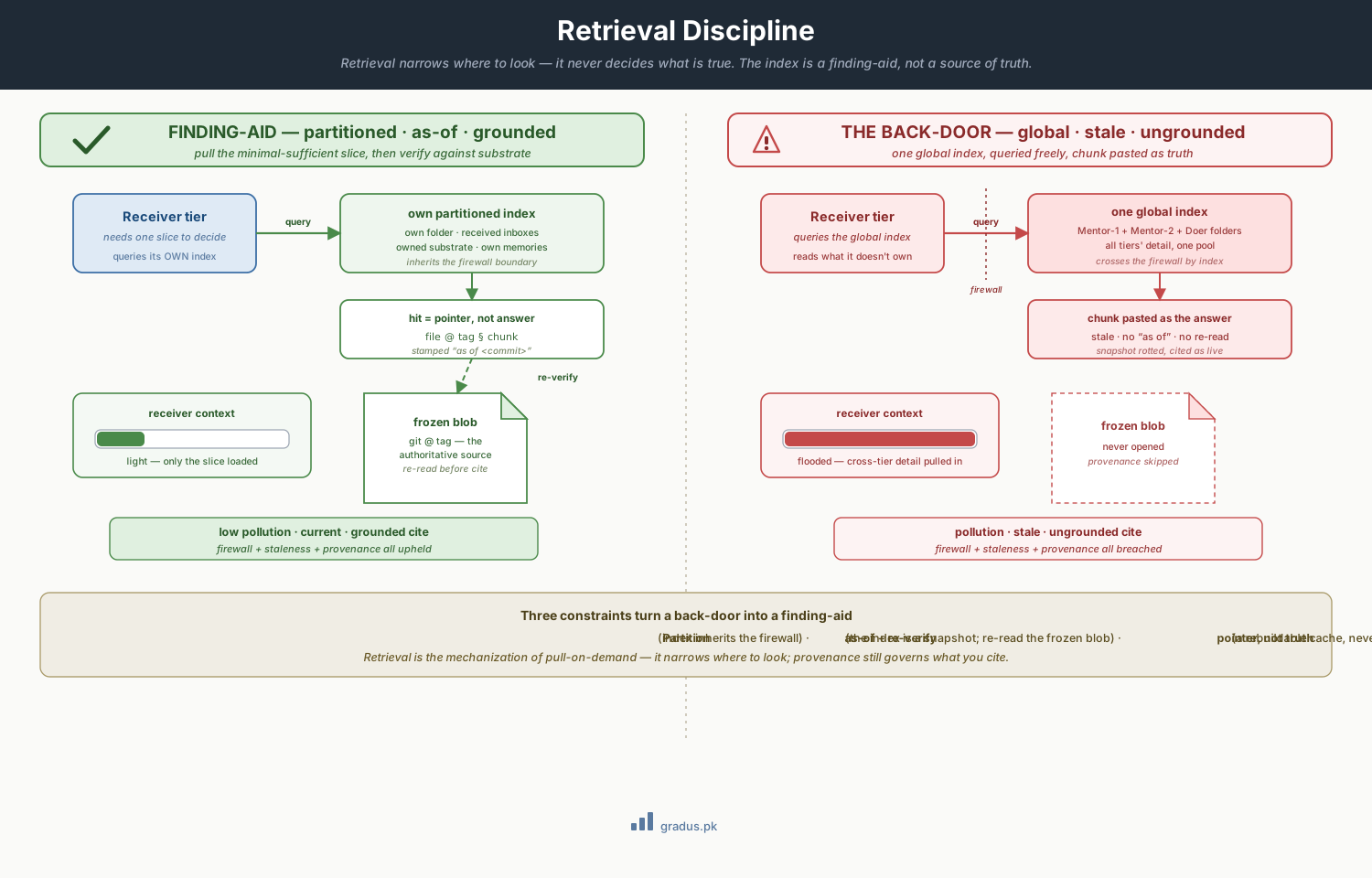
Left: disciplined retrieval — the tier queries its own partitioned index, gets back an as-of pointer, and reads the frozen blob to ground the claim. Light context, grounded cite. Right: the back-door — one global index any tier queries crosses the firewall, returns a stale chunk, and the tier cites the chunk verbatim. Polluted, stale, ungrounded — all three axioms breached at once.
The failure it prevents: the retrieval back-door¶
Retrieval is seductive precisely because it is useful — it makes the right slice appear without a full-text dredge. The danger is that the easiest index to build is the one that breaks the framework: a single global index over everything, queried freely, whose hits are pasted straight into the reasoning. Each of those three conveniences is a pathology the axioms already outlaw:
- One global index, any tier queries it → a tier reads what it does not own. That is exactly auto-reading a sub-tier's folder — the firewall breached, by index instead of by
ls. - The index is computed once and reused → every hit is a snapshot. A hit retrieved today and acted on tomorrow is the firewall leak, mechanized and scaled across every query.
- The retrieved chunk is treated as the answer → the tier cites recall, not substrate. That is the provenance law violated with extra steps; the chunk is a hypothesis, no more authoritative than a memory.
The discipline is not "don't use retrieval." It is: use it as a finding-aid only, bound by the three constraints below.
The three constraints¶
1. Tier-partitioned scope — the index is not a back-door past the firewall¶
Retrieval is partitioned per tier. Each tier's index covers only what that tier is entitled to read — its own folder, the inboxes it receives, its own memories, and the substrate it owns or reviews. There is no global index that any tier can query. A Mentor-1 cannot retrieve a Doer's slice-level detail any more than it can ls the Doer's folder during routine flow; the index inherits the firewall's boundary exactly.
A forensic descent across the firewall remains what it always was — a deliberate, narrow, transient, un-mirrored act on a real trigger (escalation, exit-study). It is not mechanized into routine retrieval. The moment retrieval becomes the standing way a tier sees across the boundary, the firewall is gone.
This holds regardless of harness. A vector store wired in through a single MCP server that every tier queries is the same global-index back-door, just behind a protocol — give each tier its own namespace or endpoint. A local model that bakes retrieval into its own loop is bound identically. The partition is a property of the index, not of the agent that queries it.
2. As-of stamping + re-verify against the frozen blob — the index is a snapshot¶
Every index is a snapshot by construction: it is computed at index-time, and the substrate advances afterward. So every retrieval hit carries an as of <commit> watermark, and for any load-bearing use the tier re-reads the frozen blob at the relevant tag before citing or acting (provenance law; stale-snapshot detection). Retrieval tells you where to look; provenance still governs what you cite. A hit is a lead, never a verdict.
This is the same discipline the firewall already demands of every sub-tier snapshot — "current" means "as of the last tagged return, re-verified," never "live." Retrieval does not earn an exemption; it earns the strictest application of the rule, because it produces snapshots in bulk.
3. Pointer, not truth — the index is a rebuildable cache, never a state-of-record¶
The framework's durability layer is git, and the framework runs on no specialized databases. A retrieval index — lexical or vector — is therefore a rebuildable cache derived from substrate: drop it entirely and it regenerates from git. It holds locations (pointers: file @ tag § chunk) and, optionally, embeddings over content — but the authoritative content stays in the commit history. The index never becomes a parallel source of truth, and nothing load-bearing lives only inside it.
The boot-light echo — don't relocate pollution into the index¶
The same trap that the minimal-sufficient bus warns of — don't move the pollution from the bus into the boot — applies here. If building or refreshing the index is itself a heavy context event for a tier, or if a query returns oversized chunks, the pollution has simply moved into the retrieval step. So: index-build runs off the tiers' context budget (server-side, on the host), and the retrieved slice is itself minimal-sufficient — the least the receiver needs to act, no more. Trim the load, not the knowledge.
What violating it looks like¶
Violation 1 — The global index that crosses the firewall¶
An adopter builds one embeddings index over the entire reviewer-state repo "so any tier can find anything." A Mentor-1, deciding a cycle-level question, queries it and retrieves slice-level reasoning from a Doer's folder. Its context now carries detail it does not own — the pollution the firewall exists to prevent, delivered by query.
Fix: partition the index per tier. Mentor-1's index covers Mentor-1's folder + received inboxes + owned substrate only. Slice detail reaches it via tagged return or a deliberate forensic descent — never via standing retrieval.
Violation 2 — The stale hit cited as live¶
A tier retrieves a chunk describing a module "at stage S2a," computed when the index last ran a week ago. It acts on S2a. The module reached S4 days ago. The index produced an honest snapshot that rotted — the firewall leak, now arriving through retrieval.
Fix: the hit is stamped as of <commit>; before acting, the tier re-reads the frozen blob at the current tag (or requests an interim tagged return). The index narrowed the search; provenance grounded the decision.
Violation 3 — The chunk pasted in place of the substrate¶
A mentor retrieves a chunk of a spec and cites it directly in a brief — never opening the file. The chunk was a near-duplicate from an older revision the index hadn't dropped. The brief now carries stale doctrine, cited confidently. This is citing by recall with a retrieval step bolted on.
Fix: treat the chunk as a pointer. Open file @ tag, read the frozen blob, cite that. Retrieval output is a hypothesis until the substrate confirms it.
Detection and recovery¶
Detection. Audit the retrieval setup against the three constraints: Is there a global index any tier can hit? (back-door) · Do hits carry an as of watermark, and does load-bearing use re-read the blob? (staleness) · Are chunks ever cited without opening the substrate? (ungrounded). Any "yes / no / yes" is a leak. A retrieval layer with no partition, no watermark, or no re-verify step is a leak by construction, not just in practice.
Recovery. Re-partition the index to the firewall boundary; add as of <commit> stamping and a mandatory frozen-blob re-read before any load-bearing cite; re-anchor any decision made on a bare chunk. The cure is never "stop retrieving" (that returns you to whole-file dredging and bus flooding) — it is to make the pull obey the three constraints.
Variations / tunables on top¶
| Tunable | Default | Range |
|---|---|---|
| Retrieval mechanism | lexical / grep-grade | lexical / embeddings-vector — the retrieval-surface dial |
| Re-verify strictness | strict (re-read blob for every load-bearing cite) | strict / spot-check (anti-pattern for regulated work) |
| Index refresh cadence | per-commit to substrate it indexes | per-commit / scheduled / on-demand |
The constraints — tier-partitioned scope, as-of + re-verify, pointer-not-truth — are [INVARIANT]. The mechanism that satisfies them is [TUNABLE] and lives on the retrieval surface.
Remember this¶
- Search tells you where to look, never what is true. A hit is a lead to chase, not an answer to quote — open the real file at the right version and cite that.
- Each tier searches only its own stuff. One shared search index that everyone can query is a back-door around the boundaries the framework draws — see the mental model for why those tier boundaries exist.
- A search index goes stale the moment it's built. Treat it like a cache you can throw away and rebuild from git — never the official record of anything.
How this connects to other axioms and guardrails¶
- The minimal-sufficient bus specifies that detail is pulled on demand; this page disciplines how the pull is mechanized so it stays light and honest.
- Firewall + state-tracking scope supplies the partition boundary the index must inherit — retrieval must not become the back-door past it.
- Stale-snapshot detection is the failure an unstamped index reproduces at scale; the
as of+ re-verify constraint is its rule applied to retrieval. - Provenance law makes the pull safe: the hit is a pointer, the frozen blob is the truth, the cite is the substrate.
- Git foundations keeps the index a rebuildable cache, never a specialized parallel database.
- The retrieval surface is the tunable mechanism — grades, corpus, chunking, cadence — that this guardrail bounds.