Sample Doctrine Cycle — authoring the Billing compass¶
The heaviest lane. Cross-module structural work runs the full doctrine axis: S1 → S5, freeze, gate-check, sub-bump, ratify. This walkthrough produces a 60K/30K/10K compass for Northwind's Billing module.
New here? This page follows one team, step by step, as they write down everything their billing system is — its rules, its shape, its connections — into a single trusted document. It's the fullest, most careful job CompassAlpha asks for, so it's the best one to read slowly: every lighter task in the framework is just a shorter version of what you'll see here.
A few words you'll meet along the way: a compass is that canonical "this is what this part of the system is" document, written at three zoom levels (60K = big-picture why, 30K = how the pieces fit, 10K = the exact tables and code). The doctrine cycle is the act of producing one. Tiers are the roles doing the work — a senior coordinator (Mentor-1), a per-area lead (Mentor-2), and a worker (Doer). Don't worry about memorizing these; each is reintroduced when it shows up.
This is the worked example for the Doctrine Cycle lane (see Work Granularity Lanes). It is the most ceremonious thing CompassAlpha does, and the example most worth reading slowly — every other lane is a relaxation of this one.
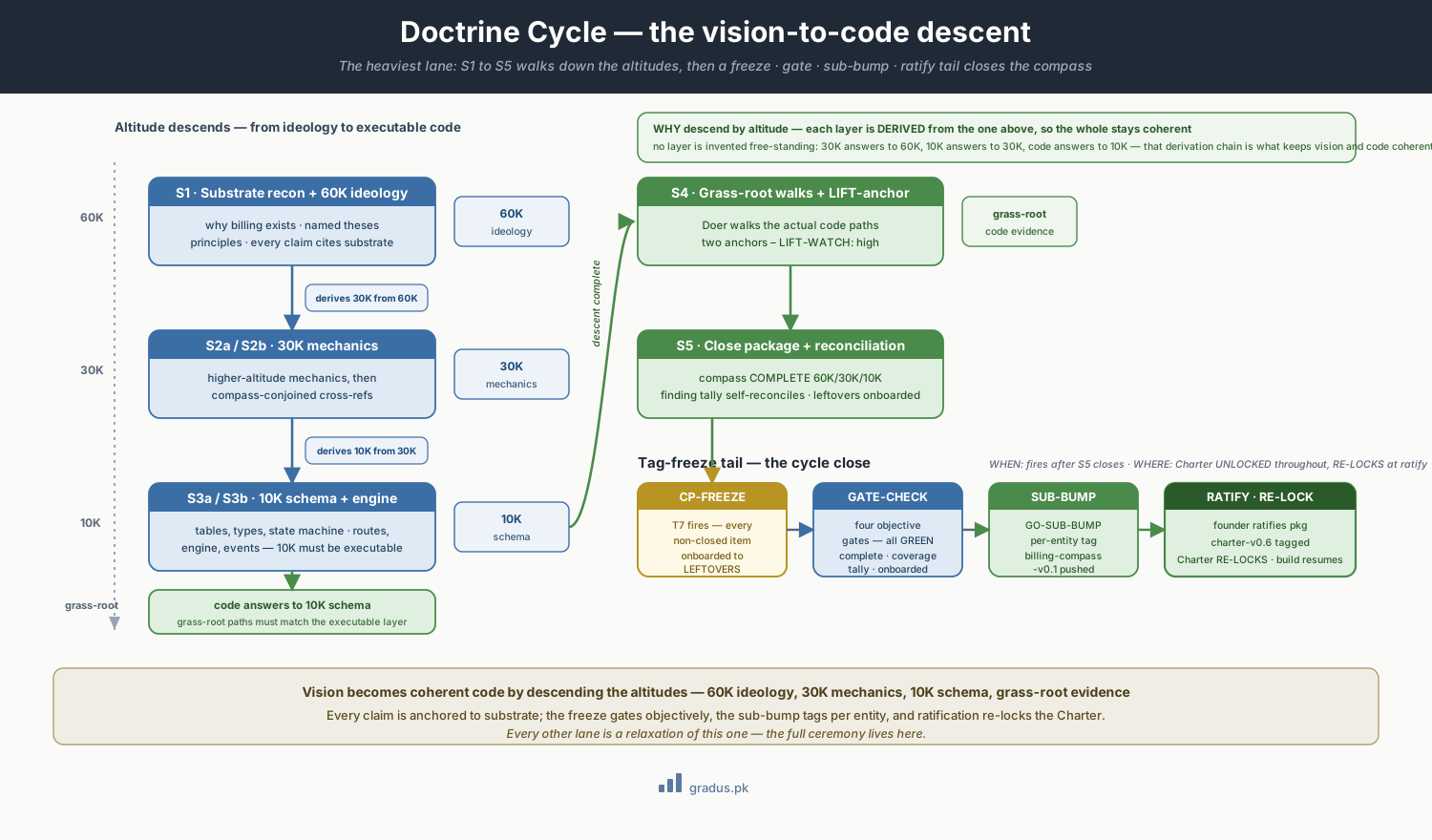
A doctrine cycle elaborates the vision downward — 60K ideology to 30K mechanics to 10K schema to code — then freezes and tags.
Setup¶
Northwind has shipped its first few modules but never wrote down what Billing actually is — its invariants live in tribal knowledge and in code. The founder wants a compass: the canonical doctrine document for Billing, structured at three altitudes (see Compass tier system, §19).
- Charter posture: UNLOCKED for the duration (doctrine axis active; build axis dormant — see Axis declarations).
- Tiers in play (doctrine axis): Mentor-1 (long-lived for the cycle) · Mentor-2 (per-entity orchestrator) · Doer (fresh-per-slice).
- Deliverable:
/path/to/substrate/docs/compass/billing.md— the Billing compass. - Tag plan: per-entity sub-bump
billing-compass-v0.1+ cycle-endcharter-v0.6.
Cycle activation¶
Before any tier boots, the cycle is activated, not started ad-hoc:
- The §9 queue holds deferrals from earlier build cycles tagged to Billing (e.g. "the proration rule isn't written down anywhere").
- The founder does a walk — a pre-cycle review — and writes observations to
WALK_FEEDBACK.mdbefore the cycle boots (persistence law: nothing load-bearing in chat).
/path/to/reviewer-state/cycles/billing-compass/WALK_FEEDBACK.md
  - "proration on mid-cycle upgrade is undocumented and I'm not sure it's right"
  - "invoice numbering must be gapless for the tax authority — capture as an invariant?"
  - "dunning retry schedule lives only in a cron config"
The walk feedback + the §9 queue are the cycle's primary input.
Stage-by-stage walkthrough¶
Northwind uses the default doctrine stage taxonomy: WIP-S1 → WIP-S2a → WIP-S2b → WIP-S3a → WIP-S3b → WIP-S4 → WIP-S5 (see Stage taxonomies).
S1 — Substrate recon + 60K Ideology¶
Mentor-1 stamps a launch brief into Mentor-2's inbox; the founder relays one trigger ping; Mentor-2 boots and dispatches a Doer to read the Billing code.
/path/to/reviewer-state/tier-2-orchestrator/billing/inbox/from-mentor1-launch.md
  [[FROM-MENTOR1→TO-MENTOR2 · billing-compass · launch]]
  Engage Billing compass. Begin S1: substrate recon + 60K ideology.
  Cite by substrate (§23). Surface any founder-calls.
  [[/FROM-MENTOR1→TO-MENTOR2]]
The Doer reads /path/to/substrate/billing/**, then returns a tagged digest. Mentor-2 triages it into the 60K view of the compass — the ideology: why billing exists, the named theses (e.g. "invoices are immutable once issued"), the principles.
Gate at this stage: every claim cites a substrate file/line. A 60K assertion with no anchor is parked as an open question, not written as fact.
S2a / S2b — 30K mechanics¶
S2a is the higher-altitude mechanics; S2b is the compass-conjoined pass — explicit cross-references to sibling compasses. Billing depends on Auth (who can be billed) and feeds Notifications (dunning emails), so S2b writes those edges down:
## Federation Contract (30K)
Billing OFFERS:  invoice-issued events, subscription-state queries
Billing REQUIRES: account identity + entitlement from Auth
Cross-Compass refs: → Auth (billable-entity definition), → Notifications (dunning template trigger)
This is where the invoice-numbering-must-be-gapless observation from the walk becomes a candidate LIFT-WATCH item — it may be a cross-scope invariant, not just a Billing rule.
S3a / S3b — 10K schema + routes + engine + events¶
The strictest substance gate. 60K can be aspirational; 10K must be executable. S3a documents tables, types, and the subscription state machine; S3b documents route handlers, the proration engine, and the events emitted.
## 10K — State machine (S3a)
subscription: trialing → active → past_due → canceled
  (past_due entered by failed charge; exits to active on retry success or canceled on dunning exhaustion)

## 10K — Engine (S3b)
proration: charge = remaining_days/period_days × (new_plan − old_plan), floored at 0
  anchored: /path/to/substrate/billing/proration.ts:L40–L72
The walk's proration concern is resolved here: the rule is now written down and anchored, and the Doer flags one discrepancy (the floor-at-0 wasn't applied on downgrades) as a build-axis leftover.
S4 — Grass-root walks + LIFT-anchor evidence¶
The Doer walks the actual code paths to gather evidence anchoring the LIFT-WATCH candidate. By S4 close, the gapless-numbering invariant has two independent anchors (a DB constraint + a service check), enough to mark it LIFT-WATCH: high.
S5 — Close package + reconciliation¶
Mentor-2 assembles the close package directly: the finished compass, the finding tally, and the leftover roster.
/path/to/reviewer-state/tier-1-mentor/inbox/billing-compass/from-mentor2-close-package.md
  [[FROM-MENTOR2→TO-MENTOR1 · billing-compass · close-package]]
  Compass COMPLETE across 60K/30K/10K. Coverage: all declared scope dims addressed.
  Finding tally self-reconciles (12 anchored, 0 dangling).
  LEFTOVERS onboarded: proration-downgrade-floor (build), LIFT-WATCH:gapless-numbering (high).
  [[/FROM-MENTOR2→TO-MENTOR1]]
Freeze → gate-check → sub-bump¶
At CP-FREEZE, trigger T7 fires: every non-closed item must be onboarded to LEFTOVERS.md before the freeze is reported as ratification-ready (see Persistence Law, flush triggers).
Mentor-1 then runs the four objective gates (see §13 in Stage taxonomies and the Guardrails):
| Gate | Check | Result |
|---|---|---|
| 1 · Deliverable COMPLETE | compass across all three altitudes | GREEN |
| 2 · Coverage at target | every scope dimension + substance review | GREEN |
| 3 · Finding tally self-reconciles | 12 anchored, 0 dangling | GREEN |
| 4 · Every non-closed item onboarded | 2 leftovers in LEFTOVERS.md |
GREEN |
Gates GREEN → Mentor-1 issues GO-SUB-BUMP. Mentor-2 applies the per-entity tag and pushes:
This creates an annotated tag — a permanent, named bookmark on the current commit, carrying a message. git -C /path/to/substrate means "run this git command inside that repository folder" without first moving into it. The tag billing-compass-v0.1 marks the exact code state where the Billing compass was frozen, so you can always return to it.
This uploads that tag to origin — the shared remote copy of the repository (typically on GitHub) that the whole team and every agent see. Until you push, the tag exists only on this machine; pushing makes the frozen marker official and visible to everyone.
This asks the remote to list all its tags, then grep filters that list down to lines containing billing-compass-v0.1. If the tag name comes back, the push genuinely landed on the remote — a quick proof rather than an assumption.
The founder is out of the mechanical tag loop — veto only.
Cycle-end ratification¶
This is a doctrine cycle, so it produces a ratification package for the founder (see §21 in Stage taxonomies):
- Triage table — each walk/§9 item → FOLD-IN / DEFER / DROP.
- Per-scope sub-bump list —
billing-compass-v0.1@ exit SHA. - Cross-cutting primitives lifted — the gapless-numbering invariant, promoted to the Charter.
- Charter diff — one new invariant added.
- Protocol-amendment candidates — none this cycle.
- Open founder-calls — the proration-downgrade bug: fix now (Polish) or defer?
The founder ratifies — in this single-team cycle, the founder is the ratification council collapsed to its one lead. On ratification:
git -C /path/to/substrate tag -a charter-v0.6 -m "Cycle close: Billing compass + gapless-numbering invariant"
Charter RE-LOCKS. Build axis resumes; doctrine axis goes dormant until the next walk.
What the status grid shows at close¶
STATUS GRID — 2026-06-09 · END · Mentor-1 · MODE: RELAY · cycle stage CLOSED
GATE        Charter v0.5 UNLOCKED → v0.6 LOCKED · gates closed · 1/1 entity done
DISPATCH    none — last: billing-compass-v0.1
LEFTOVERS   1 open  (top: proration-downgrade-floor → routed to Polish)
NEXT        re-lock confirmed; build axis resume
DISK        4 state artifacts · read-back ✓ · no unflushed state · GH-sync 0/0 @ 9f3a1c2
Outcome¶
- Billing now has a canonical compass at three altitudes, every claim anchored to code.
- One latent bug (proration on downgrade) was surfaced and routed to a lighter lane.
- One cross-cutting invariant (gapless invoice numbering) was lifted into the Charter, so every module now inherits it.
- The whole cycle is reconstructable from git: the walk, the inbox messages, the compass, the tags.
This is the heaviest lane. Notice that the next example does less of all of this — and the one after that, less still.
Remember this¶
- A doctrine cycle turns scattered, in-someone's-head knowledge into one written document (a compass) that the whole team — and every AI agent — can trust.
- It moves from the big why (60K) down to exact code and tables (10K), and every claim has to point at a real line of code. No anchor, no fact.
- Nothing is "done" until it's safely written to disk and frozen with a git tag — so the entire story can be replayed later from git alone.
- This is the most ceremonious lane on purpose. Every other lane is a lighter version of it, so understanding this one teaches you all the rest. If the roles or stages feel like a lot, the mental model is the gentler place to start.