Sample Day-2 QA axis — verifying the scheduled-exports release¶
A DECOUPLED Day-2 axis. QA runs parallel to Build and Doctrine, never competing for Charter state, on its own cadence: per-build-closure plus periodic full regression.
New here? This page follows a quality-assurance (QA) team as it checks a finished feature before it ships — running alongside the people still building, never getting in their way. It is a worked example of how testing fits into CompassAlpha without slowing development down.
A quick vocabulary note before we start. An axis is one team working one kind of job. A Charter is the shared lock that says "this work is in progress, don't touch it." DECOUPLED (you'll see it in capitals) just means an axis that runs on its own track and never grabs that lock — so it can never block anyone else.
The four lanes (Doctrine, Phase 3, Polish, Surgical) cover building. Once a product ships, building isn't enough — you have to operate it: test it, watch it, keep it compliant. CompassAlpha's answer is a set of Day-2 axes — teams that handle that ongoing work. They reuse the same building blocks the build teams use (the same tier structure, the same message bus, the same write-it-to-disk persistence law), but they run DECOUPLED: parallel to Build and Doctrine, never waiting on them.
This is the worked example for the QA axis.
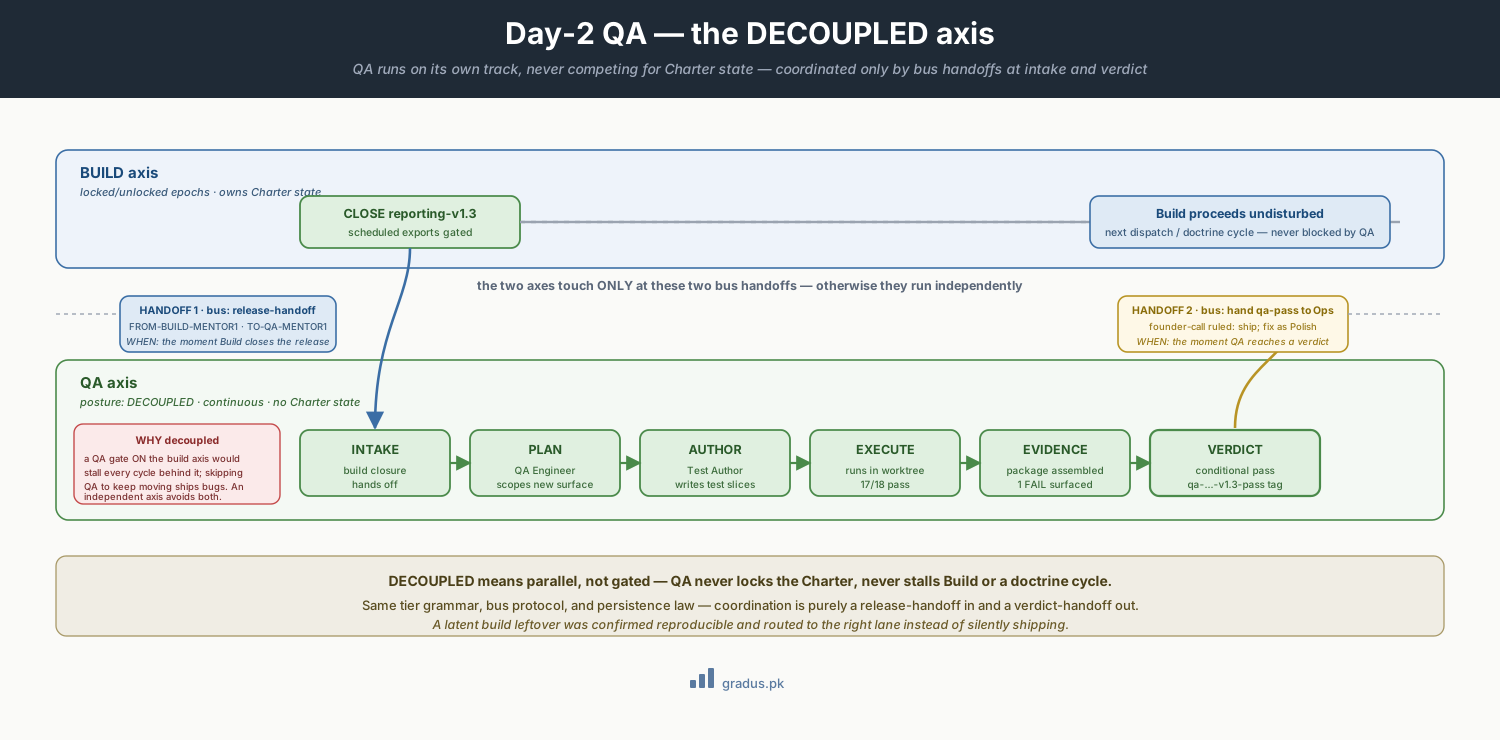
A Day-2 axis runs on its own track, coupled to the build axis only by bus handoffs at intake and verdict.
The DECOUPLED posture¶
A normal Build/Doctrine axis alternates Charter state (LOCKED ↔ UNLOCKED — see Axis declarations). A DECOUPLED axis does not:
- It runs continuously, not in locked/unlocked epochs.
- It does not compete for Charter state — it never blocks Build or Doctrine.
- It shares infrastructure — the same master rules, bus protocol, and persistence law.
QA, Ops, and Compliance are all DECOUPLED axes. They are declared like any other axis (§4 axis declarations extend naturally), just with posture: DECOUPLED.
Setup¶
The Phase 3 dispatch just closed reporting-v1.3 (scheduled exports). Before that release reaches production, the QA axis verifies it. The QA axis has its own three tiers:
| Generic tier | Northwind QA role | Does |
|---|---|---|
| Mentor-1 | QA Lead | owns the test charter; ratifies release approval; surfaces founder-calls |
| Mentor-2 | QA Engineer (per dispatch) | orchestrates verification of one release; triages results |
| Doer | Test Author / Validator | writes + runs tests; gathers pass/fail evidence |
- Deliverable: test coverage + pass/fail evidence + a release-approval decision.
- Cadence: per-Build-closure (this case) plus periodic full regression.
- Tag plan:
qa-reporting-v1.3-passon the evidence commit.
Stage-by-stage walkthrough¶
QA declares its own stage taxonomy — Northwind uses INTAKE → PLAN → AUTHOR → EXECUTE → EVIDENCE → VERDICT.
INTAKE — Build closure hands off¶
When the Build axis closed reporting-v1.3, its status grid NEXT line said "hand to QA axis." That handoff is a bus message into the QA Lead's inbox — DECOUPLED axes coordinate through the same bus, never by blocking each other:
/path/to/reviewer-state/qa/tier-1-lead/inbox/from-build-handoff.md
  [[FROM-BUILD-MENTOR1→TO-QA-MENTOR1 · reporting-v1.3 · release-handoff]]
  reporting-v1.3 closed (scheduled exports). EXIT_REPORT attached. Request release verification.
  Known build leftovers: retry-on-email-failure (untested path), cron-cadence (§9, out of scope).
  [[/FROM-BUILD-MENTOR1→TO-QA-MENTOR1]]
PLAN — QA Lead dispatches a QA Engineer¶
The QA Lead stamps a QA Engineer (Mentor-2) for this release. The engineer plans coverage against the new surface only — schema, CRUD routes, the runner, the Notifications wiring.
AUTHOR / EXECUTE — Test Author writes + runs¶
A fresh Doer (Test Author) writes the test slices and runs them in a worktree:
/path/to/reviewer-state/qa/tier-2-engineer/reporting-v1.3/s1/inbox/from-engineer-brief.md
  [[FROM-QA-MENTOR2→TO-DOER · reporting-v1.3/s1 · brief]]
  Author + run tests for scheduled-export CRUD + runner.
  Cover: create/list/delete schedule · runner fires at next_run_at · CSV emailed via Notifications.
  Explicitly probe the build leftover: behaviour when the delivery email fails.
  [[/FROM-QA-MENTOR2→TO-DOER]]
The Doer commits the tests + an evidence file to substrate (data plane), returns the result digest to the QA Engineer (control plane):
EXECUTE results:
  CRUD: 9/9 pass
  Runner fires at next_run_at: pass
  CSV delivered via Notifications: pass
  Email-failure path: FAIL — runner marks export "sent" even when Notifications returns an error
EVIDENCE — QA Engineer assembles the package¶
The QA Engineer reconciles results into an evidence package and surfaces the failure to the QA Lead:
/path/to/reviewer-state/qa/tier-1-lead/inbox/reporting-v1.3/from-engineer-evidence.md
  [[FROM-QA-MENTOR2→TO-QA-MENTOR1 · reporting-v1.3 · evidence]]
  17/18 pass. One FAIL: email-failure path mismarks export as sent (the known build leftover, now confirmed reproducible).
  Recommendation: conditional approval — ship CRUD + runner, gate the failure as a fast-follow.
  [[/FROM-QA-MENTOR2→TO-QA-MENTOR1]]
VERDICT — QA Lead ratifies + founder-call¶
The confirmed failure is a judgment call, so the QA Lead surfaces a founder-call: ship now with a tracked fast-follow, or hold the release? The founder rules "ship; fix the email-failure path as a Polish item." The QA Lead records the verdict and tags the evidence:
git -C /path/to/substrate tag -a qa-reporting-v1.3-pass -m "QA conditional pass: 17/18; email-failure fast-follow tracked"
This creates an annotated tag — a permanent, named bookmark on the current commit — called qa-reporting-v1.3-pass, with a message recording the verdict. git -C /path/to/substrate tells git to run inside that repository folder without first changing directory into it. The tag marks exactly which version of the work QA approved, so anyone can find that point later.
This uploads that tag to the shared remote repository (origin is the default name for it), so the approval bookmark is visible to everyone, not just on this one machine.
The email-failure fix is onboarded to LEFTOVERS.md (trigger T7 discipline applies to DECOUPLED axes too).
What the QA status grid shows at close¶
STATUS GRID — 2026-06-09 · END · QA-Mentor-1 · MODE: RELAY · axis QA (DECOUPLED) · stage VERDICT
GATE        no Charter state (DECOUPLED) · release CONDITIONAL-PASS · 17/18
DISPATCH    none — last: qa-reporting-v1.3-pass
LEFTOVERS   1 open  (top: email-failure-mismark → Polish fast-follow)
NEXT        hand qa-pass to Ops axis for deploy
DISK        2 state artifacts · read-back ✓ · no unflushed state · GH-sync 0/0 @ e92b117
Why DECOUPLED matters here¶
Notice what didn't happen: QA never locked the Charter, never blocked the Build axis, never stalled a future doctrine cycle. It ran on its own track, coordinated purely through bus handoffs, and produced an auditable verdict. If a doctrine cycle had been running concurrently, QA would have proceeded undisturbed — that's the entire point of the DECOUPLED posture.
Outcome¶
reporting-v1.3got a real verification pass with durable, tagged evidence.- A latent bug (the build leftover) was confirmed reproducible and routed to the right lane instead of silently shipping.
- The release is now ready for the Ops axis to deploy.
- QA ran in parallel with everything else, competing for nothing.
Remember this¶
- Building a feature and operating it are different jobs. Day-2 axes (like QA) handle the operating part, using the same playbook as the build teams.
- DECOUPLED means "never blocks." A QA axis runs continuously on its own track and never grabs the shared lock, so it can verify a release without freezing the people still building. That separation is the whole point.
- Teams coordinate by passing notes, not by waiting. The build team hands off to QA through a bus message; QA hands its verdict to Ops the same way. Each team keeps moving.
- Hard calls go up, evidence stays on disk. When a real failure showed up, the QA Lead surfaced a founder-call instead of guessing — and the test results were committed and tagged so the decision is auditable later. For why "write it down" runs through everything here, see the mental model.