Single-Live-Writer¶
One writer holds jurisdiction at a time. Everyone else fetches before they push, and no one ever clobbers the live writer.
[INVARIANT]
This page explains the simple rule that stops two AI sessions from quietly overwriting each other's saved work: at any moment, only one of them is allowed to write the shared "official record," and anyone else must catch up before they save. You care because without it, a decision or update can vanish with no error to warn you.
TL;DR¶
In plain terms: when several sessions share one source of truth, you need exactly one to be the "writer" at a time so they don't stomp on each other's saves. Here's how that works in detail.
The clobber is the failure where two sessions write the state-of-record concurrently and one silently overwrites the other's work — a decision, a ledger update, a ratification, gone without a trace. CompassAlpha prevents it with single-live-writer: only the tier currently holding jurisdiction writes the state-of-record repo while it holds it. A rotation transfers jurisdiction; it does not create a second writer. Any out-of-jurisdiction party (an outgoing tier kept as backstop, a sibling parallel worker) fetches before it pushes and never clobbers the live writer. Combined with path-partitioned writes, this makes file-level conflicts structurally impossible and reduces the whole problem to ref-races that a fast-forward handles.
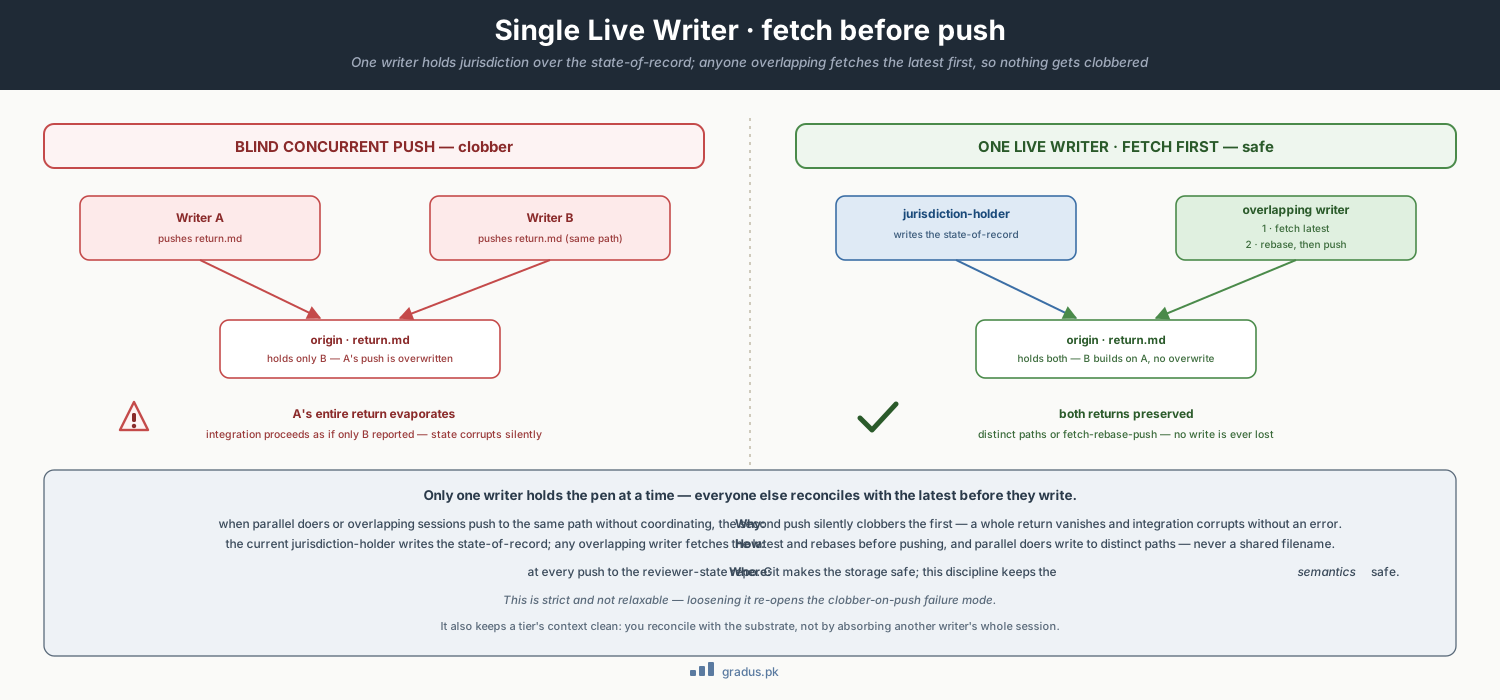
Two writers pushing the same path blindly: the second clobbers the first and a whole return vanishes silently. One jurisdiction-holder — with any overlapping writer fetching and rebasing before it pushes, and parallel doers on distinct paths — loses nothing. Git keeps the storage safe; this keeps the semantics safe.
The failure it prevents¶
A "persistent single-writer anti-pattern" is the naïve alternative: one long-lived session that never rotates, writing everything, because "then there's only one writer and nothing can clobber." It avoids clobber by accumulating unbounded context — and so it rots into pollution and stale snapshots instead. CompassAlpha wants the opposite: aggressive session refresh and rotation, which means many sessions over time and sometimes overlapping ones. That only stays safe if writing is governed.
Two clobber shapes are the targets:
- Rotation overlap. An incoming tier takes jurisdiction, but the outgoing session is still alive as a backstop. If both push, the outgoing session can overwrite the incoming session's fresh state with its now-stale view.
- Parallel workers. Multiple doers run simultaneously (parallel slices). If they push to overlapping paths without coordination, returns collide and integration state corrupts silently.
The harm is worse than a crash: a clobber leaves no error. The losing write simply vanishes, and the federation proceeds believing a decision was recorded that is no longer on disk — a direct hit to trust.
What violating it looks like¶
Example 1 — The backstop that clobbered the new holder¶
A Mentor-1 rotates. The incoming Mentor-1 takes jurisdiction, ratifies a checkpoint, and pushes. The outgoing Mentor-1 — still open in another window "just in case" — flushes a leftover note from before the rotation and pushes without fetching first. Its push cannot fast-forward and overwrites instead. The incoming holder's ratification is gone, and nobody sees an error.
Example 2 — Two doers, one path¶
Two Doers work Billing slices in parallel. Both write their return into tier-2-billing/inbox/return.md — the same filename. The second push clobbers the first. One slice's entire return evaporates; the orchestrator integrates as though only one slice reported.
Example 3 — Crossing the two planes¶
A Doer about to git add stages files from both the substrate deliverable repo and the reviewer-state repo in one command. The control-plane return and the data-plane deliverable risk landing on the wrong remote — a clobber across the structural firewall between the two repos.
How it's enforced¶
Rule 1 — Jurisdiction is single and transferable¶
Only the current jurisdiction-holder writes the state-of-record repo while holding it. A rotation is the only way the write-holder changes, and it is a clean transfer: outgoing emits END-certification + push, incoming completes Layer-B grounding + countersign, then jurisdiction moves. There is never a moment of two equal writers — only a handoff with a defined seam.
Rule 2 — Fetch-before-push for everyone¶
Before any push, the session runs git pull --ff-only (or git fetch + git merge --ff-only). This catches updates from a sibling or a just-rotated-in holder:
- If a fast-forward is possible, the push proceeds.
- If it is not, the session pauses, reconciles (rebases its local change onto the new tip), and retries.
An out-of-jurisdiction backstop that fetches first will see the live writer's commits and rebase onto them rather than over them — the clobber becomes impossible by construction.
Rule 3 — Path partitioning¶
Different writers touch different paths. Parallel doers write distinct filenames into a shared inbox (return-slice-1.md, return-slice-2.md), never a shared file. Combined with fetch-before-push, this is the key result:
File-level conflicts are structurally impossible — different writers touch different paths — so only ref-level races remain, and fast-forward handles those.
Multi-writer safety is emergent: no single mechanism provides it. Single-live-writer governs the judicial folders, fetch-before-push handles ref-races, and path partitioning eliminates file collisions. Remove any one and the guarantee weakens.
Rule 4 — Two planes, never cross-commit¶
The state-of-record repo and the substrate deliverable repo are physically separate — different directories, different remotes, different .git/ databases. A tier about to git add across that boundary halts. Data-plane commits use git -C /path/to/substrate ...; control-plane commits use git -C /path/to/reviewer-state .... Because the git contexts differ, a control-plane commit cannot land on a substrate branch — the firewall is enforced by the tooling, not by care.
Parallelism is safe by construction, or not at all
The payoff of these four rules together is that you can run many parallel doers and the framework's correctness scales linearly with their count — each commits its deliverable from an isolated index to its own branch and writes a uniquely-named return. Without the rules, the same parallelism silently corrupts cross-worker state. The choice is not "parallel or safe"; it is "structured-and-safe-and-parallel" or "unstructured-and-corrupt."
Detection and recovery¶
Detection. A push that succeeds without a fetch on an out-of-jurisdiction session is the smell. So is any two writers sharing a path, or any git add that spans the two repos. At the history level, a force-style overwrite or an unexpected non-fast-forward warning indicates a contended ref.
Recovery. If a clobber is suspected, the lost write is recoverable from git's reflog and the loser's local objects — fetch the overwritten commit by sha and re-apply it onto the current tip. Going forward, restore the discipline: confirm a single jurisdiction-holder, enforce --ff-only before every push, and re-partition any colliding paths. If two planes were crossed, audit both remotes for misplaced commits and move them to the correct repo.
Remember this¶
- One writer at a time, on purpose. Only the session currently "holding the pen" writes the official record. Handing the pen to another session is a clean transfer, not a free-for-all — there are never two equal writers at once.
- Always catch up before you save. Anyone not holding the pen fetches the latest first, so they build on top of the live writer's work instead of over it. This is what makes a silent clobber impossible.
- Keep different writers in different files. Parallel workers write to their own uniquely-named files, never a shared one — so their saves can't collide.
- The danger is the silence. A clobber doesn't crash; the lost work just disappears with no error. That's why these rules are structural, not "be careful." For how this fits the bigger picture, see the mental model.
How this connects to other axioms and guardrails¶
- Persistence law §single-live-writer is the axiom this guardrail operationalizes; fetch-before-push is part of flush discipline.
- Git foundations supplies the mechanics — per-session
GIT_INDEX_FILE,commit-tree, explicit refspec push — that make isolated, partitioned writes possible. - Pollution containment is why we rotate aggressively instead of using one immortal writer — which is exactly what makes write-governance necessary.
- Failure modes §rotation mid-flight is the rotation seam at which jurisdiction transfers cleanly.