Axiom 1: Tier Grammar
Three tiers per axis. Mentor-1 / Mentor-2 / Doer. Names tunable; positions invariant.
[INVARIANT — number of tiers] [TUNABLE — names]
This page explains the basic shape of every CompassAlpha team: three layers of agents — one who reviews, one who coordinates, and one who actually does the work. Get this shape right and everything else in the framework clicks into place.
TL;DR
In short: every line of work in CompassAlpha is run by a three-person chain — a reviewer at the top, a coordinator in the middle, and a worker at the bottom.
CompassAlpha specifies exactly three tiers per axis (an axis is one line of work, like building features or writing docs): a top mentor, a middle orchestrator, and a doer at the bottom. The names are project-specific; the positions and their distinct responsibilities are inviolable. This is the foundational structural rule from which all other axioms derive.
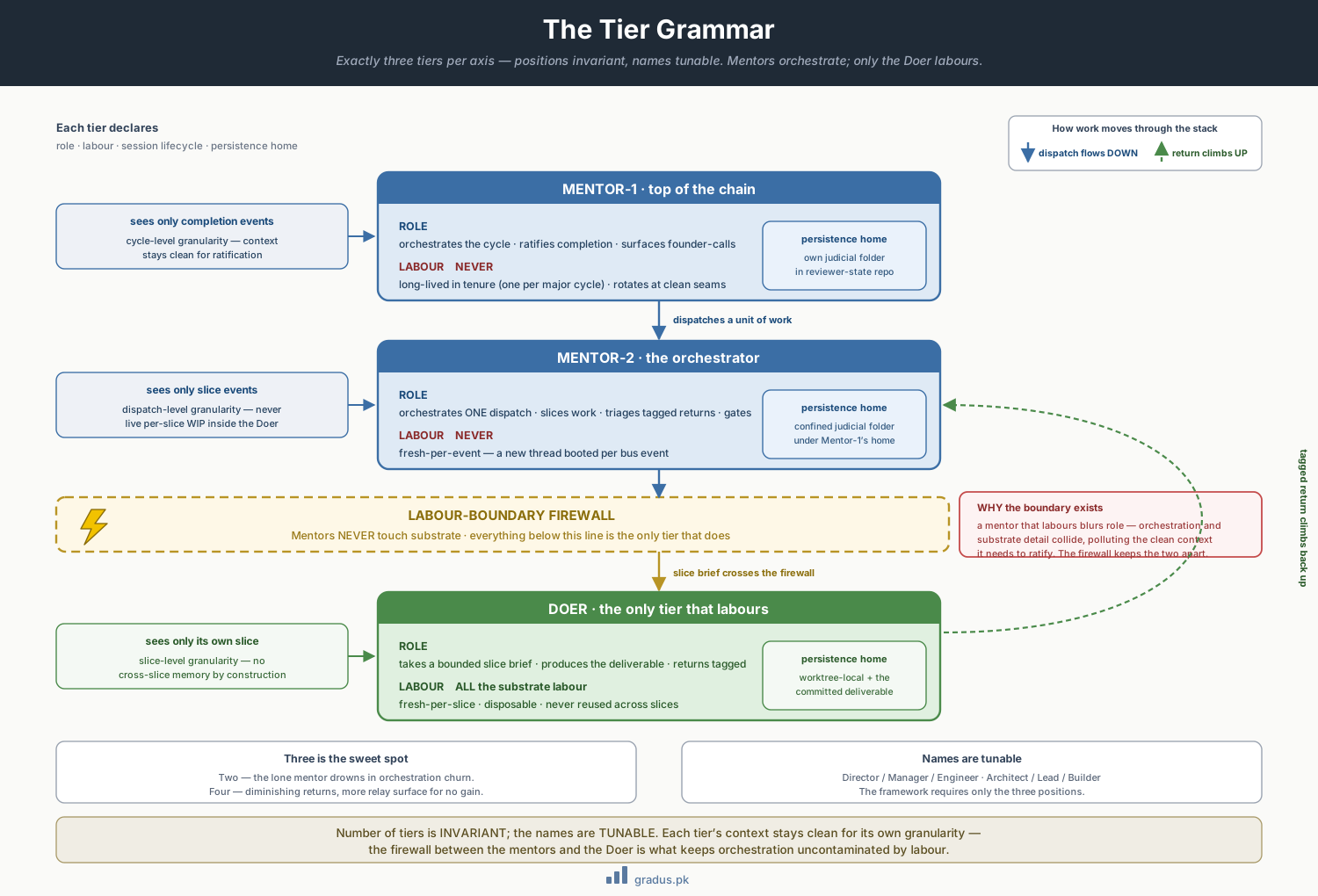
The tier stack: mentors orchestrate and never touch substrate; the Doer does all substrate labour. The labour-boundary firewall sits between them.
The rule
| Generic name | Role | Labour? | Session lifecycle | Persistence home |
|---|---|---|---|---|
| Mentor-1 | Top of the chain; mentors at the granularity of the axis's unit of work; ratifies completion; surfaces founder-calls. | NEVER | Long-lived in tenure (one per major cycle); rotates at clean seams. | Own judicial folder (rooted in reviewer-state repo). |
| Mentor-2 | Orchestrator of ONE unit of work (dispatch/entity/etc.); slices work into Doer-sized chunks; triages tagged returns; applies ratification gates. | NEVER | Per-dispatch. Fresh thread per event (see bus protocol). | Own confined judicial folder under Mentor-1's home. |
| Doer | The only tier that touches substrate. Takes a bounded slice brief; produces the deliverable; returns tagged. | ALL the substrate labour | Fresh-per-slice; disposable; never reused across slices. | Worktree-local + the deliverable committed under commit-discipline. |
The names "Mentor-1", "Mentor-2", "Doer" are the framework's universal vocabulary. Each axis declares its own role names. The rules speak in terms of Mentor-1 / Mentor-2 / Doer; each axis's reader substitutes its own names.
Why three tiers (not two, not four)
Two tiers (mentor + doer) is insufficient pollution containment. The single mentor absorbs both orchestration churn (slice triage, integration) and high-level ratification. This is the exact pattern CompassAlpha was created to avoid: a single agent context polluted by absorbing every detail.
Four tiers has diminishing returns. Orchestration is already contained in Mentor-2; adding a fourth tier multiplies the relay surface for marginal benefit.
Three is the sweet spot:
- Mentor-1 sees only completion events
- Mentor-2 sees only slice events
- Doer sees only its own slice
Each tier's context stays clean for its appropriate work granularity. [INVARIANT]
Why the names are tunable
Different projects want different tier role names, drawn from whatever metaphor fits their culture. For example:
- Director / Manager / Engineer (corporate)
- Architect / Lead / Builder (construction)
- Strategist / Coordinator / Specialist (military)
- General / Captain / Soldier (military)
The framework requires only the three positions. Names map to your culture.
What violating this looks like
Violation 1: Mentor doing slice work
A Mentor-1 or Mentor-2 directly authors substrate (writes code, edits doctrine docs). This violates Axiom 1 ("NEVER labour") and is the direct mechanism by which mentor context pollutes.
Illustrative incident: a top mentor directly ran a recon Bash session during a module's preparation, accumulating substrate detail in mentor context. The findings were correct, but the method violated tier grammar. Result: a hardened version of the rule — mentor tiers never labour — encoded into the protocol.
Violation 2: Doer accumulating across slices
A Doer session is reused across multiple slices. The session accumulates context from earlier slices that biases the current slice. This violates the implicit "fresh-per-slice" rule that derives from tier grammar.
Illustrative incident: early pre-bus cycles used long-running Doer sessions. Each Doer accumulated cross-slice context that occasionally caused integration errors. Fix: fresh-per-slice mandated.
Violation 3: Adding a fourth tier mid-cycle
A team decides to add a "Quality Reviewer" tier between Mentor-2 and Doer mid-cycle. This is structurally not an axis violation, but operationally creates relay surface where bus protocol expects three hops.
Note: Adding a tier should be done at axis-declaration time (rare, would amount to forking the framework). Doing it mid-cycle violates Axiom 1's three-tier rule.
Implementation details
When you adopt CompassAlpha, you declare each axis's tier names exactly once, in the axis declaration:
After declaration, every reference in your federation uses these names. Status grids, inbox files, stamped CLAUDE.md files, tags — all use your project's tier names. The framework's documentation uses Mentor-1/Mentor-2/Doer; your project's documents use your declared names.
Variations / tunables on top
While the three positions are [INVARIANT], the following are [TUNABLE]:
| Tunable | Default | Range |
|---|---|---|
| Tier role names | Project-specific declaration | Any strings |
| Mentor-1 session lifecycle | per-cycle long-running | per-cycle / per-epoch / fresh-per-event |
| Mentor-2 session lifecycle | fresh-per-event (bus) | fresh-per-event / per-dispatch |
| Doer session lifecycle | fresh-per-slice | fresh-per-slice (mandatory; only direction is more-frequent) |
| Number of axes | 2 (Build + Doctrine) | 1 to N |
→ Concurrency modes for how parallel-doer mode operates within this axiom.
→ Context patterns for Mentor session lifecycle choices.
Cross-reference
- This axiom defines what tiers are; subsequent axioms specify what tiers do:
- Firewall — how tiers' contexts are isolated
- Persistence law — how tiers' state is durable
- Hard labour rule — what mentors can and can't do
- Bus protocol — how tiers communicate
- Hierarchy tags — how messages between tiers are marked
Remember this
- Every line of work runs on three layers: a reviewer (Mentor-1), a coordinator (Mentor-2), and a worker (Doer). No more, no less.
- Only the Doer touches the actual files — the two mentors think, plan, and check, but never do the hands-on work themselves. That separation is what keeps each layer focused and uncluttered.
- The names are yours to choose (Director/Manager/Engineer, Architect/Lead/Builder, whatever fits) — but the three positions never change.
- If you're new, this is the backbone of the mental model: three layers, one worker at the bottom, clean boundaries between them.