Work Granularity Lanes — the four lanes
Match the ceremony to the size of the change. The same federation handles a Charter amendment and a "make this button blue" — at very different weights.
[TUNABLE — per-lane policies + which lanes a preset enables]
This page explains how CompassAlpha sizes the process to fit the job — so a tiny "make this button blue" request doesn't get the same heavyweight treatment as a major design change, and you don't have to choose between a framework that's too formal for small work or too loose for big work.
TL;DR
A "lane" here is just a level of process ceremony — how many review steps, sign-offs, and paperwork a change goes through. CompassAlpha supports work at four granularity levels — Doctrine Cycle, Phase 3, Polish Lane, Surgical Strike — each with a ceremony level matched to the size of the change. Lane choice is a triage decision made at incoming-request time. All four lanes share the same load-bearing rules (firewall, hard labour, bus, persistence, commit discipline) and differ only in ceremony and gating. This is what makes CompassAlpha usable for every daily request, not just big projects — the difference between "an academic ideal for large work" and "the smartest tooling the project has." Which lanes a project enables is [TUNABLE]; that all four exist is [INVARIANT].
The dial
Every project has all four lanes available structurally. The tunable is which lanes a preset enables and the per-lane policies (gate strictness, tag ceremony, status-grid requirements). Get the lane-set wrong — too few enabled — and the framework feels like over-engineering; get it right and it feels like the project's smartest tooling.
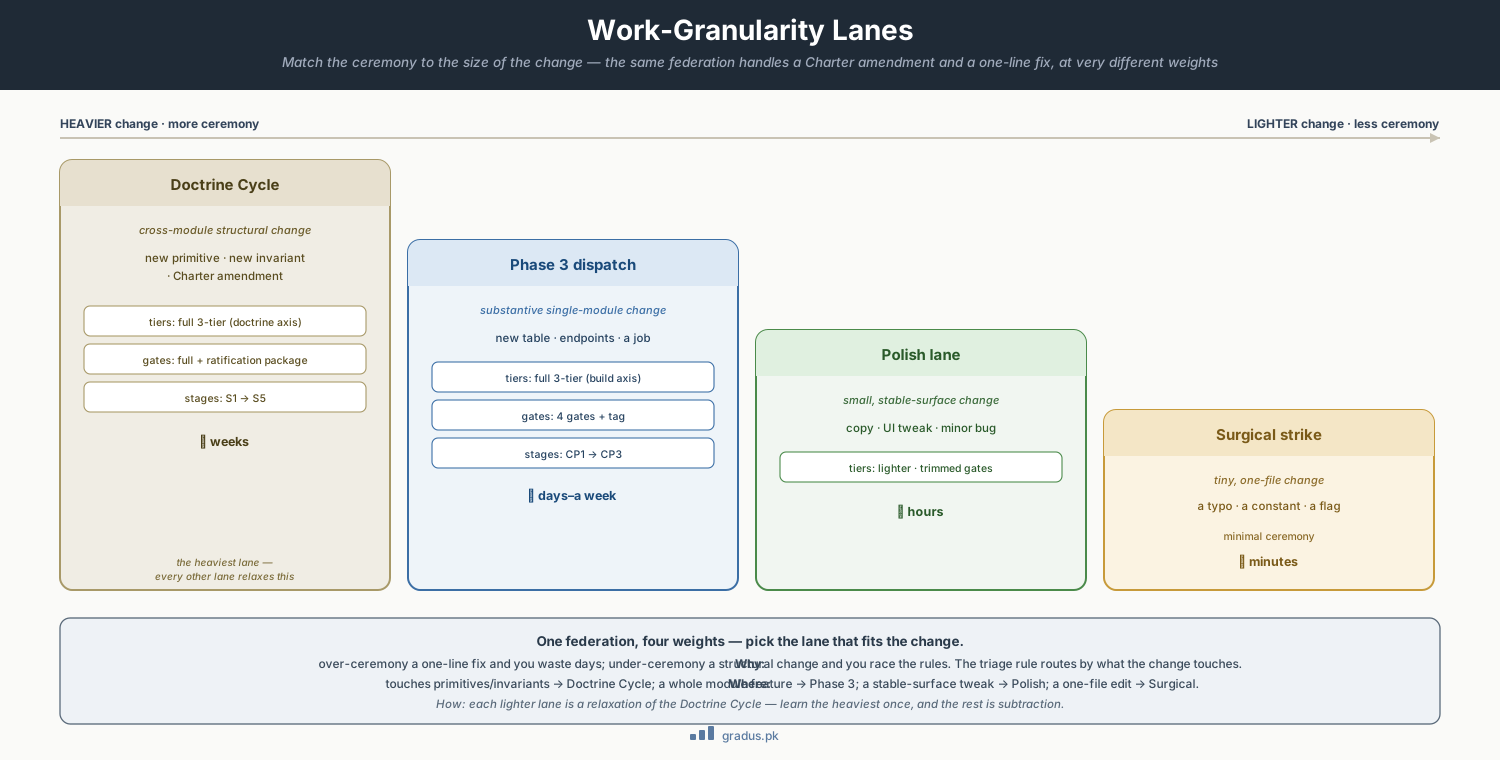
Match the ceremony to the change. Heaviest at left (Doctrine Cycle — weeks, full gates), lightest at right (Surgical — minutes). Over-ceremony a one-line fix and you waste days; under-ceremony a structural change and you race the rules. Each lighter lane is a relaxation of the Doctrine Cycle.
The four lanes
| Lane | Granularity | Examples | Tier ceremony | Gates | Tag | Turnaround |
|---|---|---|---|---|---|---|
| Doctrine Cycle | Cross-module structural change | new primitive · new invariant · Charter amendment | Full 3-tier (doctrine axis) | full gates + ratification package | major bump | Weeks |
| Phase 3 (substantive build) | Single-module substantive change | new schema · new routes · multi-stage rollout · audit-chain rework | Full 3-tier (build axis) | full gates 1–4 | <module>-v<x.y> |
Days to weeks |
| Polish Lane | Cosmetic / bounded behavioral | datatable column add · microcopy tweak · modal layout fix · dropdown filter | Mentor-1 → slim Mentor-2 → Doer · single-CP | smoke + regression + UX critic | polish-<topic>-v<x.y> |
Hours to a day |
| Surgical Strike | Single-concern, single-file | "make this button blue" · "change this copy" · "fix this margin" | Mentor-1 → Doer (Mentor-2 skipped) · single-turn | smoke pass + commit discipline | (no tag; commit on trunk) | Minutes to hours |
The stages each lane runs through are detailed in Stage taxonomies.
Triage — which lane gets which request
Every incoming request is triaged at the top mentor:
IF  touches primitives / invariants / Charter            → DOCTRINE CYCLE queue
ELIF schema change / new API / cross-module              → PHASE 3 dispatch
ELIF bounded behavior change / new column / single
     feature in one module                               → POLISH LANE
ELIF single-concern cosmetic / copy / margin             → SURGICAL STRIKE
ELSE (ambiguous)                                          → escalate to founder for triage
Triage is founder-eligible, because founder requests are the most common source of Polish and Surgical work — the small day-to-day wishes. For those lanes the founder can request directly; the top mentor triages, picks the lane, and dispatches.
What's preserved across all lanes (the invariant floor)
Lighter lanes do not relax these:
- Firewall + state-tracking scope — even a surgical strike goes through a tier, never a founder-direct edit.
- Provenance law — changes remain traceable to substrate.
- Persistence law — commit-and-push for durability.
- Hard labour rule — the founder never authors code; the Doer does. This holds even in Surgical Strike.
- Flush-before-disclose — state on disk before it is discussed.
- Bus protocol — even a one-line surgical brief goes through the inbox.
- Commit discipline — isolated index + commit-tree + refspec push, on every lane.
What's relaxed for lighter lanes
| What | Heavy lanes | Polish | Surgical |
|---|---|---|---|
| Doer freshness | fresh-per-slice | fresh-per-slice | fresh-per-turn (one request, then dies) |
| Mid-tier (Mentor-2) | full | slim (no CP ceremony) | skipped entirely |
| CP gating | CP1→CP3 | single-CP | none (just commit) |
| Brief depth | full operational brief | bounded | one-liner (change + file + line range) |
| Tag ceremony | full tag | lightweight tag | no tag (commit on trunk) |
| Status grid | mandatory | mandatory (Tier 1) | optional |
Charter-state interaction
- Charter LOCKED epoch (build axis active): all four lanes available; the founder picks per request.
- Charter UNLOCKED epoch (doctrine cycle running): Phase 3 is dormant (build axis dormant), but Polish and Surgical can still run — by definition they don't touch the primitives the doctrine cycle is amending.
This is why the triage rule "touches primitives/invariants → doctrine queue" matters: it keeps Polish and Surgical work confined to stable surfaces (UI polish, copy, minor bugs) that don't race the amendment.
Anti-patterns
- Surgical-striking a schema change — schema touches primitives; belongs at Phase 3 minimum, possibly a Doctrine Cycle.
- Doctrine-cycling a microcopy tweak — wastes a multi-week cycle; Surgical Strike is the right lane.
- Polish-Lane'ing a cross-module change — Polish is bounded to a single module; cross-module is Phase 3.
- Founder authoring directly — even in Surgical Strike, the founder requests via inbox and the Doer executes. The hard labour rule holds.
Per-preset lane policies
Operating presets enable or restrict lanes:
| Preset | Doctrine Cycle | Phase 3 | Polish | Surgical |
|---|---|---|---|---|
| Conservative | ✓ | ✓ | ✓ | ✓ (with caution) |
| Balanced | ✓ | ✓ | ✓ | ✓ |
| Throughput | ✓ | ✓ | ✓ (encouraged) | ✓ (encouraged) |
| Cost-optimized | ✓ | ✓ | ✓ (preferred when ambiguous) | ✓ |
| Risk-averse / regulated | ✓ | ✓ | ✓ (full audit despite the name) | ✗ (even cosmetic goes Polish) |
| Research / high-churn | ✓ (frequent) | ✓ | ✓ | ✓ |
| Bootstrap / first-cycle | ✓ | ✓ | ✓ (sparingly) | ✗ (until first cycle close) |
Defaults
| Setting | Default | Notes |
|---|---|---|
| Lanes enabled | all four | [INVARIANT] that they exist; enablement is tunable. |
| Surgical Strike before first close | disabled | Enable once the rhythm is proven. |
| Triage tier | top mentor (founder-eligible) | Founder may request Polish/Surgical directly. |
How to choose
- Enable all four early unless you're risk-averse/regulated (then forbid Surgical and route even cosmetics through Polish with full audit).
- Hold Surgical until first close on a new adoption — prove ceremony before relaxing it.
- When a request is ambiguous between two lanes, pick the heavier one. Under-ceremony is the more expensive mistake.
Remember this
- Match the ceremony to the size of the change. A button-colour tweak and a Charter amendment go through the same federation, but at very different weights — that's the whole point of lanes.
- The lighter lanes drop ceremony, never the safety rules. Even a one-line "Surgical Strike" still routes through a tier, goes on the bus, and is executed by the Doer (never the founder) — only the review steps and paperwork shrink.
- When in doubt, pick the heavier lane. Doing too little process is the costlier mistake; you can always relax later.
- New here? Start with the mental model to see how these lanes sit inside the wider federation.
How this connects
- Stage taxonomies — the stage vocabulary each lane runs through.
- Hard labour rule (axiom) — holds on every lane, including Surgical.
- Firewall (axiom) — even surgical strikes route through a tier.
- Operating presets — each preset's lane-set.
- Axis declarations — an axis declares which lanes it hosts.