GitAI category
State of the federation = state of git.
New here? This page names the kind of thing CompassAlpha is. Just as "GitOps" became the shorthand for "run your servers from git," GitAI is the shorthand for "run a team of AI agents from git" — and understanding the category helps you place everything else you'll read.
CompassAlpha is the reference framework for a new operational category: GitAI — using git (the version-control system most projects already use to track code) as the coordination, durability, and audit layer for multi-agent AI operations. In plain terms: many AI agents work together, and git is the shared notebook they all read from and write to.
Lineage
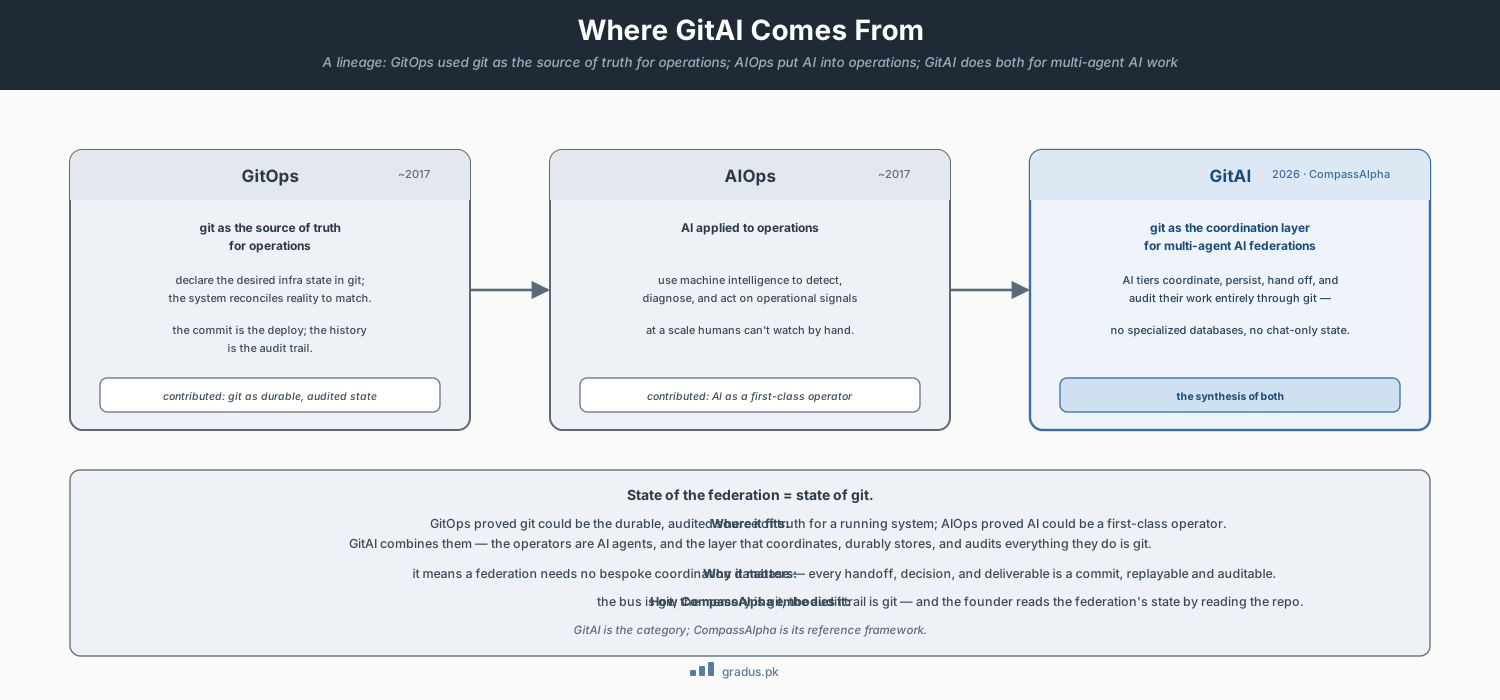
GitOps proved git could be the durable, audited source of truth for a running system; AIOps proved AI could be a first-class operator. GitAI combines them — the operators are AI agents, and git is the layer that coordinates, stores, and audits everything they do. State of the federation = state of git.
| Category | Era | Core insight | Reconciler |
|---|---|---|---|
| GitOps | ~2017+ | State of infrastructure = state of git. PRs + automated reconcilers. | k8s operators, Flux, ArgoCD, etc. |
| AIOps | ~2017+ | AI augments IT operations (monitoring, alerting, anomaly detection). | AI models + IT ops platforms. |
| GitAI | 2026+ | State of AI agent federation = state of git. Tiers + inbox bus + reconcilers. | The AI tiers themselves, via pull → read → act. |
The GitAI insight
GitOps' core insight — "git is the source of truth, automation reconciles state" — applies just as cleanly to AI agent orchestration:
- State of the federation = state of the reviewer-state repo. Every tier's judicial state is committed + pushed; any session can be recreated from git.
- Coordination via inboxes (→ bus protocol) — sender writes file, commits, pushes; recipient pulls and reads. No proprietary message bus.
- Audit trail = git log. Every inbox file is persistent; every state change is a commit; the federation's full history is reconstructable from git.
- Reconciliation via pull + read + act — recipient turn =
pull→ read own inbox → act → commit + push. The AI tier IS the reconciler. - Disaster recovery =
git pull. Power-down? Pull origin. State of record was always at origin.
Why GitAI now
Three converging trends made GitAI inevitable around 2026:
- AI agents got capable enough to do substantive work — Claude, GPT-4+, others can author code, doctrine, audits at production quality.
- Multi-agent coordination became necessary — single agents hit context limits on substantial projects; collaboration patterns were ad-hoc and failure-prone.
- Git remained the universal substrate — every project already has git. No new infrastructure needed.
The pattern was sitting there waiting for someone to formalize it. CompassAlpha is the formalization.
What GitAI is NOT
| GitAI is NOT | But GitAI is |
|---|---|
| AIOps | AIOps assists human operators with AI. GitAI orchestrates AI tiers using a thin human relay. |
| MLOps | MLOps manages ML model lifecycles. GitAI manages AI agent federations doing knowledge work. |
| RAG | RAG is a retrieval pattern for one agent. GitAI is a coordination pattern for many agents. |
| ChatOps | ChatOps automates operations via chat. GitAI uses git as the coordination, not chat. |
| Agent frameworks (LangChain, AutoGen, etc.) | Those are libraries to build agents. GitAI is a protocol for agents to collaborate via git. |
GitAI is complementary to all of the above — it doesn't replace them. An agent built with LangChain can participate in a GitAI federation. RAG can be used within a GitAI Doer's context. AIOps tools can monitor a GitAI federation's health.
CompassAlpha's role in GitAI
CompassAlpha is to GitAI what Kubernetes operators are to GitOps — a reference framework that other projects can adopt or fork.
CompassAlpha provides:
- The tier grammar (Mentor-1 / Mentor-2 / Doer) + the protocols
- Reference implementations of state artifacts, stamp templates, memory systems
- A battle-tested production federation example (~12 months of cycles, multiple build-axis closes, doctrine cycles spanning many entities)
Other GitAI frameworks may emerge in 2026+. CompassAlpha's source-available release is intended to seed the ecosystem with a battle-tested reference. Convergence on shared protocols (bus inbox conventions, marker tag grammar) would benefit the whole category.
What a GitAI federation looks like (in 30 seconds)
Reviewer-state repo (state of record):
  ├── tier-1-mentor/
  │   ├── CLAUDE.md           ← top-tier mentor's identity
  │   ├── LEDGER.md           ← live cycle state
  │   ├── inbox/              ← messages from sub-tiers
  │   └── tier-2-orchestrator/ (per-dispatch)
  │       ├── CLAUDE.md
  │       ├── LEDGER.md
  │       ├── inbox/
  │       └── slice-N/
  │           └── inbox/      ← doer's brief lands here
  ├── HANDOVER_PROTOCOL.md    ← shared doctrine
  ├── memory/                 ← cross-cycle learnings
  └── ...

Substrate repo (the project being built/governed):
  └── (your project's actual codebase)

Founder (human):
  - Spawns tier sessions on a host
  - Delivers one-line trigger pings: "pull + read your inbox"
  - Does NOT carry message content
Sessions read their inbox, do their work, write to recipient inboxes, commit + push, ping founder. The founder routes pings. Git is the substrate. Everything else is convention.
Why "framework" and not "platform"
A platform would own the infrastructure (compute, storage, identity). CompassAlpha owns none of those. You bring your own git host, your own AI agent, your own compute. CompassAlpha is the protocol the federation runs on, not the infrastructure it runs on.
This is the same shape as: - HTTP (protocol; you bring your servers, your clients) - TCP/IP (protocol; you bring your network) - IMAP (protocol; you bring your mail server, your client)
Calling CompassAlpha a platform would be a category error. It's deliberately stack-portable.
The category position post-v1.0
CompassAlpha's v1.0 release is intended to establish GitAI as a recognized category. Once GitAI is recognized:
- Other implementations will emerge (CompassBeta, CompassGamma, alternative GitAI frameworks)
- Tooling will emerge to support GitAI federations (dashboards, validators, etc.)
- Best practices will accumulate
- AI agent providers may add GitAI-native features
This is the same trajectory GitOps took: ArgoCD and Flux competed; the category matured; the pattern became standard.
CompassAlpha's bet: a category exists here, and a clean reference implementation will accelerate its emergence.
Reading recommendations
If you want to understand the surrounding categories:
- GitOps: opengitops.dev — the canonical GitOps definition (4 principles)
- AIOps: Gartner's category definition (search "Gartner AIOps")
- MLOps: ml-ops.org — community-maintained MLOps reference
If you want to understand CompassAlpha's specific GitAI implementation:
- Axioms — the inviolable rules
- Bus protocol — the core coordination mechanism
Remember this
- GitAI is a category, not a product. It's the name for "coordinate a team of AI agents using git as the shared source of truth" — the way GitOps named "run infrastructure from git."
- Git is the shared notebook. Every agent's state, every message, and the full history all live in git, so any session can be rebuilt from it and "disaster recovery" is just a
git pull. - CompassAlpha is a framework, not a platform. It's the protocol agents follow — like HTTP or IMAP. You bring your own git host, AI agent, and compute. For how the pieces fit together, see the mental model.
- It plays well with others. GitAI complements RAG, agent libraries (LangChain, AutoGen), and AIOps — it doesn't replace them.