First Boot
Booting your first tier session: the T0 boot-integrity ritual, the reading order, and the START status grid that doubles as a drift check. Every session, every tier, every time — this is how a CompassAlpha session begins.
New here? This page is the start-up checklist an AI session runs before it does any work — a short, fixed routine that proves the session is looking at the real, current state of the project (not stale memory) before it touches anything.
You've set up your repos and stamped your tiers (greenfield or brownfield). Now you boot a session for the first time. This page is the boot ritual — it applies to every tier session you will ever run, so it's worth getting into your bones now.
A session that skips boot is a session operating on assumptions instead of disk. The boot ritual is what makes "state of the federation = state of git" trustworthy at the start of every turn.
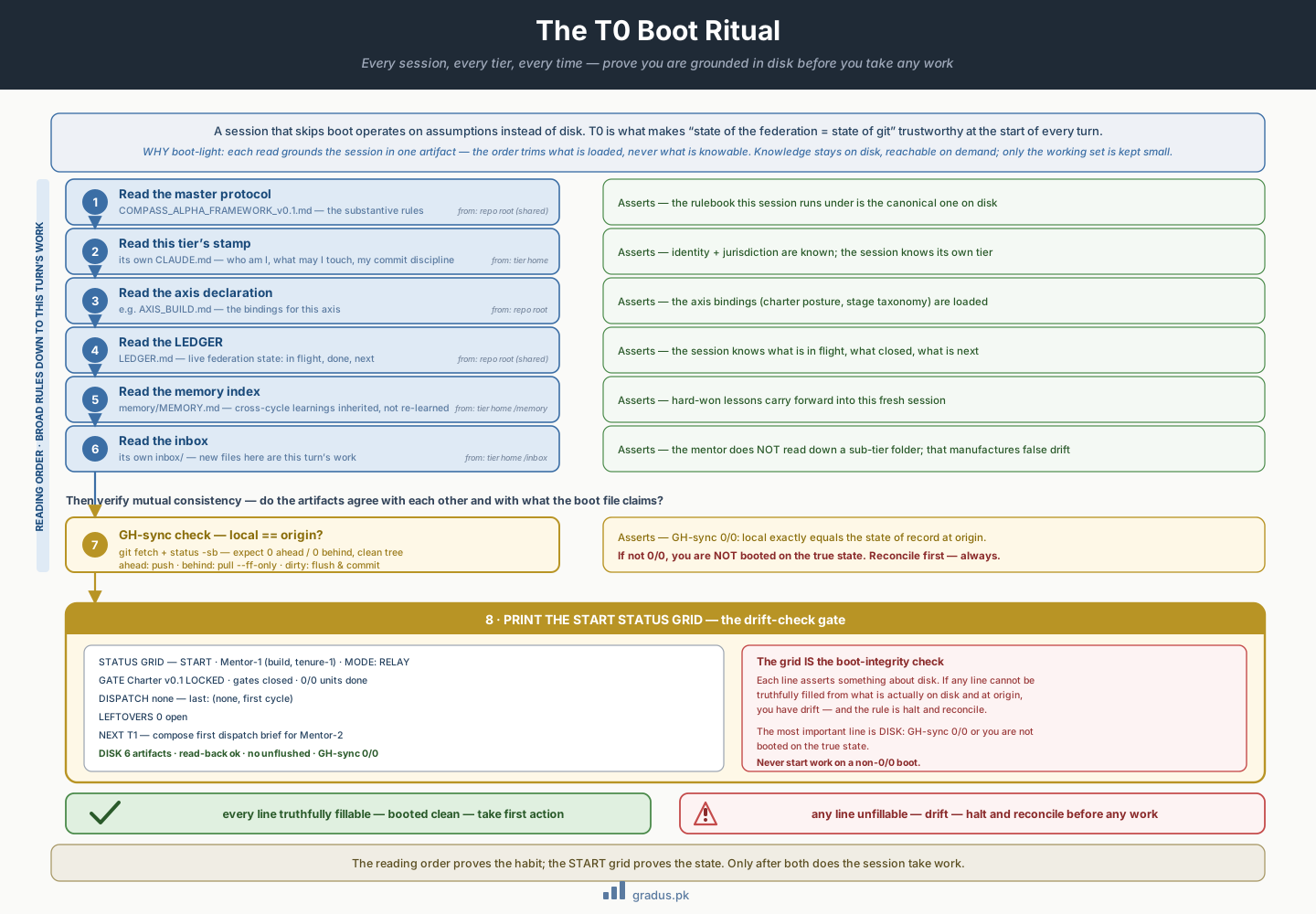
A fresh session boots light and in order — master, stamp, axis, ledger, memory, inbox, sync check — then prints the START grid as a drift gate.
What "boot" means
When the founder spawns a fresh AI session in a tier's home folder and the session reads its stamped CLAUDE.md, that session boots. Boot is the T0 flush trigger — a "flush" is the moment a session syncs itself with disk, and T0 is the very first one, before any other (the full set is the flush triggers T0–T7). At T0 the session does not start working. First it proves it is grounded in reality — that what it believes matches what is actually written down.
The T0 contract, in order:
- Read all canonical state artifacts in the prescribed reading order.
- Verify mutual consistency — do the artifacts agree with each other and with what the boot file claims?
- Print the START status grid (the Tier 1 six-line grid).
- Run the GH-sync check — is local exactly equal to origin?
Only after all four does the session take work.
The reading order
A booting tier reads, in this order:
- The master —
COMPASS_ALPHA_FRAMEWORK_v0.1.md. The substantive rules. - This tier's stamp — its own
CLAUDE.md. Who am I, what may I touch, my commit discipline. - The relevant axis declaration — e.g.
AXIS_BUILD.md. The bindings for this axis. LEDGER.md— the live federation state. What's in flight, what's done, what's next.memory/MEMORY.md— cross-cycle learnings, so the session inherits hard-won lessons without re-learning them.- Its own
inbox/— new files here are this turn's work.
For a brand-new federation, the LEDGER and memory are near-empty and the inbox has nothing yet — that's expected. The reading order still runs; you're proving the habit, not just consuming content.
The mentor does not read down
A Mentor never auto-reads a sub-tier's folder during routine boot. Auto-reading manufactures false drift, because a sub-tier's fine-grained snapshot contradicts the mentor's higher-altitude snapshot by design. A mentor descends only on a deliberate trigger (escalation, exit-study) — narrowly, transiently, never mirrored into its own state. See the firewall.
The START status grid
After reading, the session prints the Tier 1 six-line grid. This is mandatory at session START and END. The shape:
STATUS GRID — <UTC date> · START · <tier-instance> · MODE: RELAY · cycle stage <CYCLE-STAGE>
GATE        Charter v<x> <LOCKED|UNLOCKED> → v<y> · gates closed · N/M units done
DISPATCH    <unit @ stage @ commit  |  "none — last: <tag>">
LEFTOVERS   <N open>  (top: <ids>)
NEXT        <single immediate next action — one T# event>
DISK        <K state artifacts · read-back ✓ · no unflushed state · GH-sync 0/0 @ <SHA>>
A first-boot grid on a brand-new build-axis federation looks like:
STATUS GRID — 2026-06-09 · START · Mentor-1 (build, tenure-1) · MODE: RELAY · cycle stage ENGAGED
GATE        Charter v0.1 LOCKED · gates closed · 0/0 units done
DISPATCH    none — last: (none, first cycle)
LEFTOVERS   0 open
NEXT        T1 — compose first dispatch brief for Mentor-2
DISK        6 state artifacts · read-back ✓ · no unflushed state · GH-sync 0/0 @ <SHA>
The grid IS the boot-integrity check
The START grid is not decoration — it is the drift detector. Each line asserts something about disk. If any line cannot be truthfully filled from what's actually on disk and at origin, you have drift, and the rule is halt and reconcile before doing any work:
| Grid line | What it asserts | Drift if… |
|---|---|---|
GATE |
The Charter version and lock state | …the LEDGER says a different version than the Charter file |
DISPATCH |
The in-flight unit and its commit | …the named commit doesn't exist at origin |
LEFTOVERS |
Open deferred items | …the count disagrees with LEFTOVERS.md |
DISK |
Disk == understanding, GH-sync 0/0 | …git status is dirty or local ≠ origin |
The most important line is DISK. GH-sync 0/0 means your local copy has zero commits ahead and zero behind origin (the shared remote on GitHub) — in plain terms, your copy is an exact match for the official, shared one. If it's not 0/0, you are not booted on the true state, and anything you do risks building on a stale picture.
The GH-sync check in practice
This downloads the latest commits from origin (the shared copy of the repo on GitHub) into your local repo without changing any of your files yet. The -C /path/to/reviewer-state part just tells git which folder to operate in, so you don't have to be standing inside it. It's the "go see what's changed upstream" step — after it, your local view of origin is up to date.
git -C /path/to/reviewer-state status -sb
# expect: "## main...origin/main"  with nothing ahead/behind and a clean tree
This prints a short summary of how your local copy compares to origin: whether you have changes that haven't been saved (a "dirty" tree), and whether you're ahead or behind the shared copy. The -sb flags ask for the short format with a branch-tracking header. You want to see ## main...origin/main with no "ahead"/"behind" note and no listed files — that confirms you're an exact match for the shared state.
If you're ahead: a prior session flushed but didn't push — push it (pull --ff-only then refspec push) before proceeding. If you're behind: pull (--ff-only) to pick up sibling writers. If the tree is dirty: there's unflushed state — flush and commit it before you trust the grid.
Never start work on a non-0/0 boot
A GH-sync that isn't 0/0 means the session's understanding and the state of record disagree. Working from there compounds the drift. Reconcile first — always.
First-boot walkthrough
For your very first session (Mentor-1, build axis):
- Founder spawns a fresh session in
/path/to/reviewer-state/tier-1-mentor/. - Founder pings: "boot — you are Mentor-1, build axis, tenure 1."
- Session reads the master → its stamp →
AXIS_BUILD.md→LEDGER.md→memory/MEMORY.md→ itsinbox/. - Session verifies the artifacts agree (on a fresh setup: empty but consistent).
- Session runs the GH-sync check; confirms
0/0. - Session prints the START grid (like the example above).
- Session is now booted and may take its first action — composing the first dispatch brief, which begins first dispatch.
First-boot checklist
[ ] session spawned in the correct tier home folder
[ ] master + stamp + axis declaration + LEDGER + memory + inbox read, in order
[ ] artifacts mutually consistent (no contradictions)
[ ] GH-sync confirmed 0/0 (local == origin, tree clean)
[ ] START status grid printed; every line truthfully fillable from disk
[ ] no drift — or drift reconciled before any work
Once a session boots clean, it's ready to move work. That's the next page.
Remember this
- Boot before you work. Every session, every tier, starts by reading the same artifacts in the same fixed order — then proves they all agree before it touches anything.
- The START grid is a smoke alarm, not a formality. If any of its six lines can't be filled truthfully from what's on disk, that's drift — stop and reconcile first.
GH-sync 0/0is the green light. It means your copy exactly equals the shared one. Anything else means you're not on the true state yet.- This ritual is how CompassAlpha keeps "the state of the project is whatever git says" honest. If the routine feels heavy at first, see how it fits the bigger picture in the mental model.