Disaster Reconciliation
Whatever the disaster, its implication on the substrate is bounded — and verified. After any unclean event, every persisted plane is reconciled in full before a single tier boots.
[INVARIANT — dual-plane reconciliation after any unclean event] [TUNABLE — the exact recon + repair commands]
This page is about what happens when the lights go out mid-work — a crash, a power cut, a force-kill — and how CompassAlpha makes sure that costs you almost nothing. The short version: anything already saved to the shared remote is safe, and a careful checkup runs and repairs every storage area before any agent is allowed to start working again.
TL;DR
In plain terms: a crash can leave your git storage in a half-broken state, but the framework is built so the damage can only ever reach the small bit of work that hadn't been saved yet — and a thorough, look-don't-touch checkup confirms that and fixes the rest before anyone resumes.
An unclean event — power loss, a hard kill, a host crash, a disk fault — can leave a federation's git planes damaged: zeroed objects, a truncated index, a broken ref, an interrupted pre-commit artifact. CompassAlpha's posture is that the disaster's implication on the substrate is minimized by design: flush-before-disclose plus push-to-origin bound the loss to the genuinely-unflushed, and an aggressive, read-only reconciliation across every persisted plane — run before any tier boots — verifies the bound held and repairs within it. The recovery is not improvised; it is a rehearsed protocol that ends with the federation booting at the seam the control-plane LEDGER dictates, with loss never exceeding the in-flight sliver.
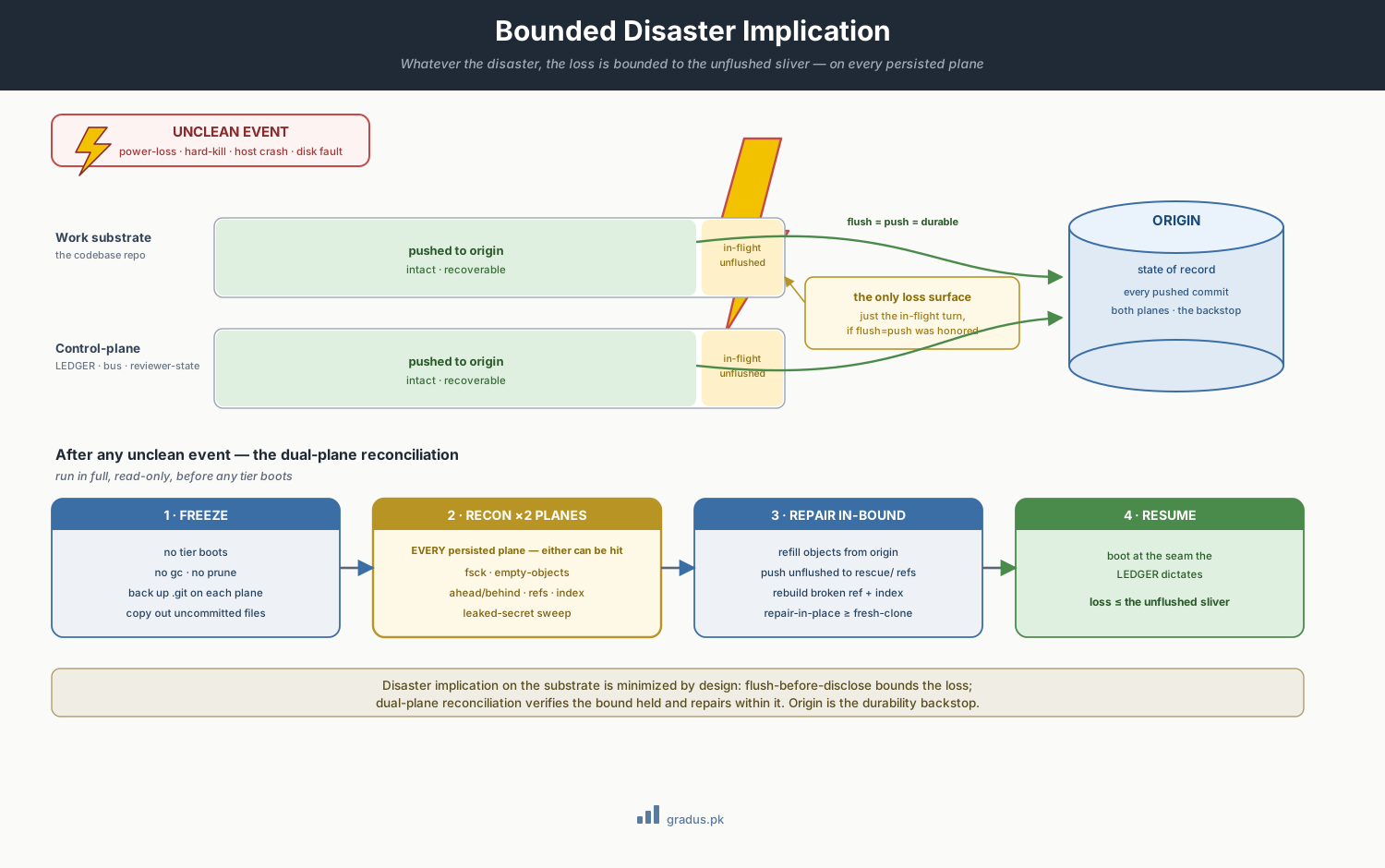
The blast radius is bounded by construction: everything pushed to origin is intact; only the in-flight, unflushed sliver is ever at risk. The dual-plane reconciliation — freeze → recon ×2 → repair-in-bound → resume — confirms the bound and recovers within it.
The principle: bounded implication, by design
This guardrail is the operational payoff of the persistence law. Because every load-bearing artifact is committed and pushed to origin before it is disclosed or acted on, the state-of-record always lives on a remote that the local crash cannot touch. Local corruption is therefore recoverable, and the only thing a disaster can genuinely destroy is work that was still in-flight — uncommitted, unpushed — at the instant the power dropped.
That is the whole claim: a power-down is a shrug, not a catastrophe, and it is a shrug by design, not by luck. The reconciliation protocol exists to prove the bound held on every plane and to repair the damage without ever exceeding it.
Why every plane, always
A federation persists to more than one git-backed plane: at minimum a work substrate (the codebase repo) and a control-plane (the reviewer-state repo holding the LEDGER, the bus inboxes, and judicial state). Each axis you declare may add further planes.
The load-bearing lesson: either plane can be damaged independently, and a single event can damage a different plane each time. A reconciliation that inspects only the substrate — because that is "where the code is" — will sail past a corrupted control-plane and boot the federation onto a broken LEDGER. The rule is therefore unconditional: reconcile every persisted plane the federation writes to, every time. Checking one is the trap.
The reconciliation protocol
Run in full, read-only first, before any tier boots.
1 · Freeze
Do not boot a tier onto a damaged repo, and do not run git gc / prune — garbage-collecting a corrupted object store can turn recoverable damage into permanent loss. Back up each plane's .git directory first (cp -a .git .git.bak), and copy out any uncommitted working files — they are plain files, independent of object-store corruption, and copying them makes every later step reversible.
2 · Recon — every plane
For each persisted plane, run the read-only inventory:
| Check | What it tells you |
|---|---|
git fsck --full |
Corrupt vs. merely dangling objects; broken refs |
| empty-object scan | Zero-byte loose objects — the classic power-loss signature |
git ls-remote origin |
Is origin reachable and complete? (the durability backstop) |
| ahead / behind per branch | Unpushed local commits — the only thing a fresh clone would drop |
| ref + index integrity | A truncated index or an emptied ref file blocks later operations |
| leaked-secret sweep | A token embedded in a remote URL is compromised the moment it is seen |
The ahead/behind answer is the one that decides the repair path — so reconcile before you act.
3 · Repair, in-bound
- Repair-in-place is preferred when origin is complete and there is unpushed local work: clear the damaged objects, refill from origin, restore the broken ref, rebuild the index. Fresh-clone only when nothing is unpushed — it is cleaner but silently abandons any local-only commits, which is why step 2's ahead/behind check gates the choice.
- Preserve unpushed work first. Push fast-forwardable branches; push diverged branches to a
rescue/namespace so origin's real branches are never clobbered. Durability first, triage later. - A truncated index and a broken ref are disposable — both rebuild from a sound object store and the reflog; only a staging snapshot is ever lost, never file contents.
A surviving commit does not mean a sound history
A power cut can zero an object that a commit still references — the commit reads fine, but its trees or blobs are gone. A plain git fetch will not refill them: git sees the commit present locally and assumes it already holds everything reachable from it. Force a full re-fetch (or backfill the objects from a fresh mirror) so the missing reachable objects actually return. Re-run fsck until it reports dangling-only.
4 · Resume — at the LEDGER seam
Boot at the seam the control-plane LEDGER dictates — not the substrate's session-state trail, which can be days stale. The LEDGER is the authority on where the federation actually stood. A tier that had already stood down is not rebooted; the tier that holds the next move boots first and consumes the pending state.
The recovery flush
A disaster frequently catches a complete artifact mid-commit — a finished return package or close-of-turn integration written to disk but not yet committed and pushed. Completing that commit is recovery, not authoring: the work product already exists and is verified concordant against its source; the only thing the crash interrupted was the commit + push.
The judgment of whether the artifact is complete and may be flushed belongs to a booted tier that owns that jurisdiction — never to the founder relay (who must not compose or arbitrate, per brief completeness) and never blind-committed on someone else's say-so. The booting tier verifies, then flushes verbatim. Single-live-writer and the bounded-loss guarantee hold throughout.
What violating it looks like
Example 1 — Booting onto a damaged plane
A tier is rebooted immediately after a host cycle, onto a substrate with zeroed objects. It reads a half-corrupt tree, "repairs" it by committing over the gap, and pushes — propagating the corruption to origin and destroying the clean backstop. The freeze step exists precisely to prevent this.
Example 2 — Reconciling only one plane
The substrate fscks clean, so the federation boots — but the control-plane's LEDGER ref was the one that broke. Tiers resume from a stale or unreadable seam, and the cycle's actual position is lost. Both planes take the hit; checking one is not reconciliation.
Example 3 — Fresh-clone over unpushed work
Faced with local corruption, an operator reclones from origin "to be safe." Origin was behind; several branches held unpushed commits. The reclone is pristine — and silently drops every unpushed commit. The ahead/behind check would have caught it; skipping reconciliation in favour of a clean-looking shortcut is how bounded loss becomes real loss.
Variations / tunables on top
| Tunable | Default | Range |
|---|---|---|
| Recon depth | full fsck --full + empty-scan + ref/index + secret sweep, every plane |
full / fast-triage (origin-complete + ahead/behind only) |
| Repair path | reconcile-then-choose (repair-in-place vs clone) | repair-in-place / fresh-clone / mirror-backfill |
| Unpushed-work handling | rescue/ namespace push before any destructive step |
rescue-namespace / branch-local tag / operator review |
| Resume authority | control-plane LEDGER seam | LEDGER seam (recommended) / last-clean-checkpoint |
The principle — every plane reconciled before any boot, loss bounded to the unflushed — is [INVARIANT]. The commands and depth are [TUNABLE].
Remember this
- A crash is a shrug, not a catastrophe — by design. Anything pushed to the shared remote (origin) survives any local mishap; only work that was still in-flight is ever at risk.
- Check every storage area, not just the obvious one. A federation writes to more than one git repo (the code, plus a control-plane that tracks who's doing what). Either can break on its own, so you reconcile all of them before booting anything.
- Look before you touch. Run the read-only checkup first, never
git gcon a damaged repo, and let the "ahead/behind" answer decide how to repair — that's what keeps a bounded loss from becoming a real one. - This guardrail is the safety net under the mental model: durable state lives on the remote, so the local machine is always disposable.
How this connects to other axioms and guardrails
- Persistence law is the axiom this guardrail pays off: flush-before-disclose + push-to-origin is what makes the loss bounded in the first place.
- Failure modes — power-down names the failure class in one line; this page is its full treatment, generalized from a single plane to every plane.
- Provenance law is why resume trusts the LEDGER on disk over any tier's recollection of where things stood.
- Single-live-writer and brief completeness govern the recovery flush: the owning tier completes the interrupted commit; the relay never composes it.
- Git foundations is the two-planes-never-cross-commit discipline that keeps each plane independently reconcilable.