Operating Presets
Named bundles of settings. Pick one to start, then tune from there — and avoid the anti-presets.
[TOGGLES — named preset bundles]
Think of this page as a menu of ready-made setups. Instead of hand-picking dozens of individual settings, you pick the one bundle that fits your situation — like choosing a camera's "Sport" or "Night" mode instead of dialing in every exposure setting yourself — and adjust from there.
TL;DR
A preset is a starter pack of settings that are known to work well together. Rather than setting every tunable individually and then reasoning about every flip-timing class (when each setting is safe to change), a project can start from a named preset — a coherent bundle of toggle values that have been chosen to work together. Pick the preset that matches your context, adopt its values, then tune from there.
Each preset locks certain settings (you commit to them for the project's posture — its overall stance on speed, cost, and risk) and leaves others flippable (you adjust them as you learn). There are also three anti-presets — combinations that look tempting but trade away CompassAlpha's correctness guarantees for marginal gains. Don't use them.
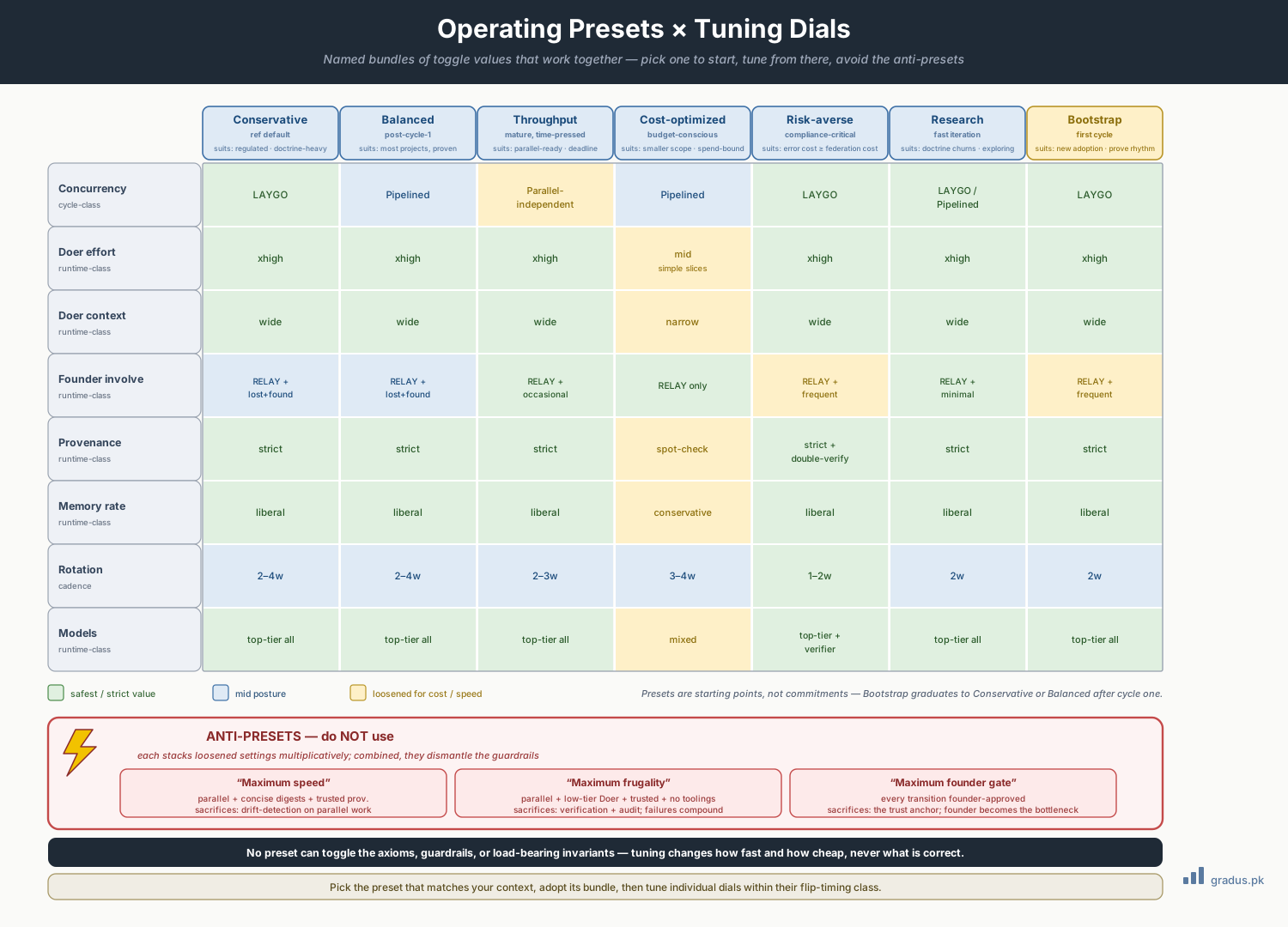
Named bundles of toggle values that work together — pick one as a starting point, tune from there, and avoid the anti-presets that dismantle the guardrails.
The seven presets
| Preset | When to use | Concurrency | Doer effort | Doer context | Founder involve | Provenance | Memory | Rotation | Models |
|---|---|---|---|---|---|---|---|---|---|
| Conservative (reference default) | Multi-tenant, regulated, doctrine-heavy | LAYGO | xhigh | wide | RELAY + lost+found | strict | liberal | 2–4w | top-tier all |
| Balanced | Most projects after first cycle | Pipelined | xhigh | wide | RELAY + lost+found | strict | liberal | 2–4w | top-tier all |
| Throughput | Mature project, time-pressured | Parallel-independent | xhigh | wide | RELAY + occasional | strict | liberal | 2–3w | top-tier all |
| Cost-optimized | Smaller project, budget-conscious | Pipelined | mid (simple slices) | narrow | RELAY only | spot-check | conservative | 3–4w | mixed |
| Risk-averse | Compliance-critical, high-stakes | LAYGO | xhigh | wide | RELAY + frequent | strict + double-verify | liberal | 1–2w | top-tier + verifier |
| Research | Doctrine churns fast, rapid iteration | LAYGO or Pipelined | xhigh | wide | RELAY + minimal | strict | liberal | 2w | top-tier all |
| Bootstrap | Brand-new CompassAlpha adoption | LAYGO | xhigh | wide | RELAY + frequent | strict | liberal | 2w | top-tier all |
Presets are starting points, not commitments. A project that starts Conservative graduates to Balanced once the first cycle proves the rhythm; a Bootstrap project sheds its training wheels and becomes whatever its steady-state posture demands.
What each preset locks vs flips
Reading this against the flip-timing classes: a preset's runtime values you can revisit any turn; its cycle values move only at a seam; nothing here touches lifecycle settings (those are fixed at adoption regardless of preset).
Conservative (the reference default)
- Locks (cycle-class): LAYGO concurrency, strict cycle-tail. One unit at a time; everything closes before the cycle does.
- Flips freely (runtime-class): none, by design — every runtime dial is already at its safest value. This is the maximally-correct baseline.
- Use it when correctness dominates and you're early. It's deliberately slow.
Balanced
- Locks: Pipelined concurrency — dispatches overlap at their seams, but the firewall and git foundations keep them isolated.
- Flips freely: founder lean-in per request; provenance stays strict but spot-checks are acceptable on trivial returns.
- Use it when the rhythm is proven and you want throughput without parallel-execution risk.
Throughput
- Locks: Parallel-independent concurrency — multiple independent units run at once. Requires mature git-foundations discipline (per-session index, isolated worktrees, explicit refspec push).
- Flips: rotation can tighten to 2–3w to manage the higher session churn.
- Use it when mature and time-pressured. Not for first cycles.
Cost-optimized
- Locks: Pipelined concurrency, conservative memory rate.
- Flips freely: Doer effort drops to mid-tier for simple slices (flip back to xhigh per hard slice — this is a runtime toggle, use it), context narrows, models go mixed, provenance to spot-check.
- Use it when budget-bound. Watch the correctness cost of loosened provenance — see anti-presets.
Risk-averse
- Locks: LAYGO, strict + double-verify provenance, a dedicated verifier model tier, frequent rotation (1–2w).
- Flips: founder leans in frequently — and here that elevated involvement is a justified standing posture, the one context where it doesn't count against the hard-labour rule.
- Use it when the cost of an error dwarfs the cost of the federation. Slow and thorough on purpose.
Research
- Locks: minimal toolings/agents/invariants — the doctrine surface churns too fast to ossify them.
- Flips: concurrency between LAYGO and Pipelined as iteration speed demands; founder involvement minimal.
- Use it when you're exploring doctrine, not hardening it.
Bootstrap (first-cycle)
- Locks: LAYGO, minimal toolings/agents, no specialized agents yet, frequent founder involvement.
- Flips: nothing aggressively — the whole point is to prove the rhythm before tuning.
- Use it when you're brand-new to CompassAlpha. Graduate to Conservative or Balanced after cycle one. See Getting started.
The anti-presets — what NOT to do
These are real combinations adopters reach for. Each trades a structural guarantee for a marginal gain. Do not use them.
| Anti-preset | The tempting bundle | Why it's a trap |
|---|---|---|
| "Maximum speed" | Parallel-doer + concise digests + trusted provenance + minimal founder + per-dispatch Mentor-2 | Trades 2–3 correctness dimensions for a marginal speed gain. The trusted-provenance + concise-audit combination removes your ability to catch the drift that parallel execution makes more likely. |
| "Maximum frugality" | Parallel-doer + low-tier Doer + trusted provenance + no toolings | Minimal cost, maximum risk. Under-powered Doers running in parallel with no verification and no audit trail — the failure modes compound. |
| "Maximum founder gate" | Every transition founder-approved | High founder load, no speed gain, and it undermines the trust anchor — the founder becomes the persistence layer, which is exactly what CompassAlpha exists to spare them. |
The through-line: each anti-preset stacks loosened settings multiplicatively. Any one of those loosenings alone might be a reasonable runtime tune; combined, they dismantle the guardrails that keep the federation honest.
The line presets cannot cross
Presets and tuning operate on the performance / cost / risk surface only. The structural rules — the eight axioms, the guardrails, the load-bearing invariants — remain fixed across every preset and every combination. No preset can toggle the firewall, the hard-labour rule, the persistence law, the bus protocol, or the provenance law. Tuning changes how fast and how cheap; it never changes what is correct.
Remember this
- A preset is a starting setup, not a contract. Pick the one closest to your situation, then tune as you learn — projects routinely graduate from one preset to another.
- When you're brand-new, start with Bootstrap: it keeps things slow and safe so you can prove the rhythm before you optimize anything.
- The anti-presets are real temptations, not strawmen. The danger isn't any single loosened setting — it's stacking several at once, which quietly removes the safety nets that catch mistakes.
- Presets only adjust speed, cost, and risk. They can never weaken the structural rules — the axioms and guardrails stay fixed no matter which preset you pick. If this distinction is fuzzy, revisit the mental model.
Connections
- Each preset is a bundle of values drawn from the Tunables surface.
- The runtime portions of a preset follow Runtime toggle timing; the concurrency/cadence portions follow Cycle toggle timing.
- Bootstrap is the on-ramp described in Getting started.
- For the full per-setting classification behind these bundles, see the Toggle reference.