Cutover from a Pre-AI Project
A concrete, revertible, step-by-step walkthrough for a team moving an existing project under CompassAlpha. Worked end-to-end with Auth / Billing / Reporting as the example modules. No big bang — every step can be undone.
If you already have a working codebase and want to start using CompassAlpha on it without risking your live project, this page shows you exactly how — one small, undoable step at a time, so your team can stop and roll back at any point.
This is the hands-on companion to brownfield onboarding. Where that page describes the five-phase journey, this page is the worked walkthrough: the exact moves a team makes, in order, with the safety property that nothing here destroys or freezes your existing workflow until you choose to retire it.
The example is a small SaaS with three modules — Auth, Billing, Reporting — running on a conventional pull-request workflow with CI. No AI agents, no doctrine layer. We move it under CompassAlpha module by module.
Why revertible matters
A team cannot afford a one-way migration on a production system. Every step below is additive or parallel — you can stop, observe, and roll back at any phase boundary without losing your existing process. CompassAlpha runs alongside your workflow until you're confident enough to retire it.
Commercial use
Cutting a production project over is production use. Confirm your commercial license before you start.
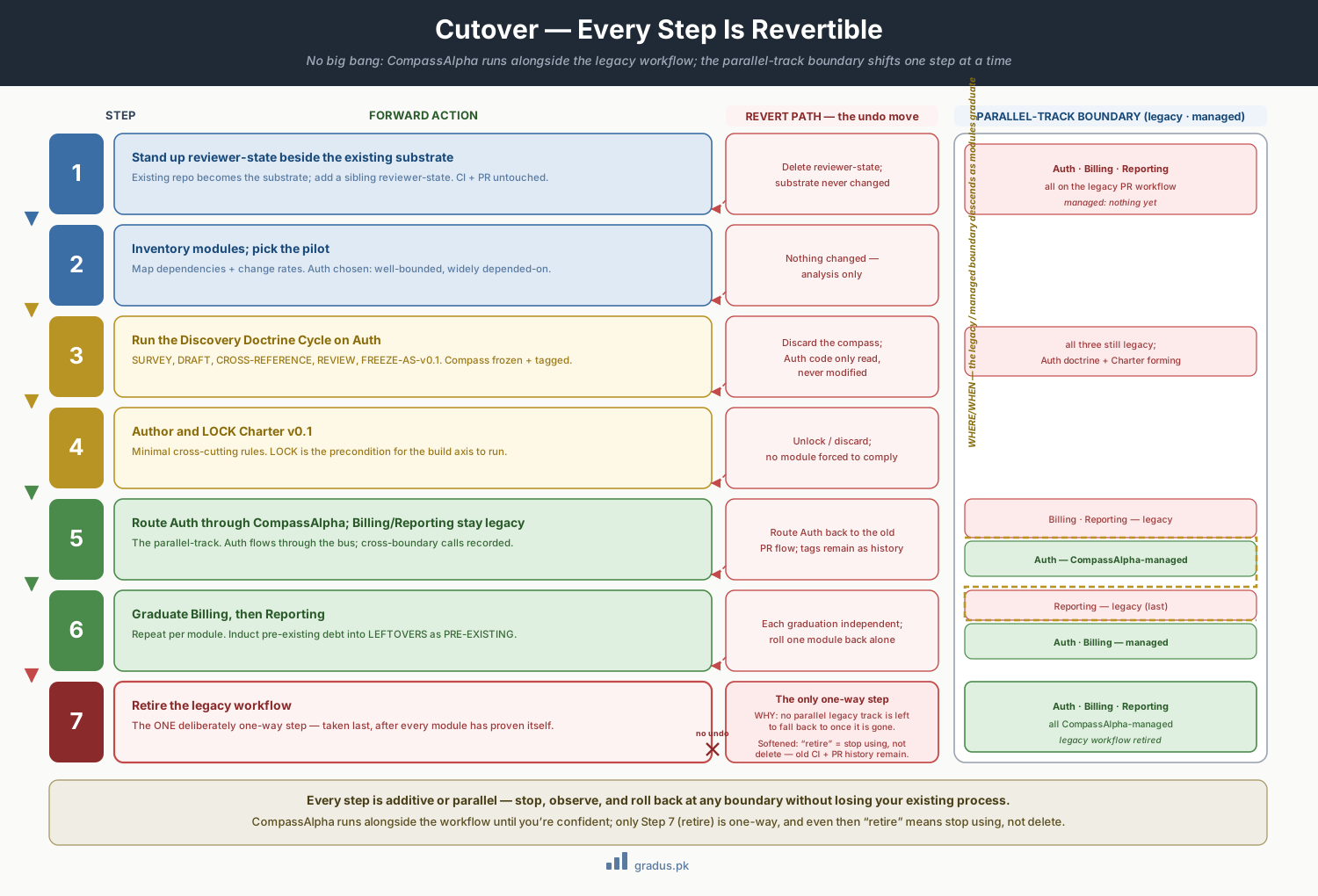
Every cutover step is reversible: each carries a revert path as the managed/legacy boundary migrates — only the final step is one-way.
Cutover at a glance
| Step | Action | Revert by… |
|---|---|---|
| 1 | Stand up reviewer-state alongside the existing substrate | Deleting the reviewer-state repo; substrate untouched |
| 2 | Inventory modules; pick Auth as pilot | No code change yet — nothing to revert |
| 3 | Run Discovery Doctrine Cycle on Auth → frozen compass | Discard the compass; Auth code unchanged |
| 4 | Author + LOCK Charter v0.1 | Unlock / discard; no module forced to comply yet |
| 5 | Route Auth changes through CompassAlpha; Billing/Reporting stay legacy | Route Auth back through the old PR workflow |
| 6 | Graduate Billing, then Reporting | Each graduation is independent and reversible |
| 7 | Retire the legacy workflow | The only one-way step — taken last, deliberately |
Step 1 — Stand up reviewer-state alongside the existing substrate
Your existing project repo becomes the substrate. You don't move or restructure it. You add a sibling reviewer-state repo next to it.
# your existing project is already at /path/to/substrate (with its own remote)
git init /path/to/reviewer-state
This creates a brand-new, empty git repository at /path/to/reviewer-state — the "reviewer-state" repo that will hold CompassAlpha's coordination records. git init just sets up the repository's internal tracking; it doesn't touch your existing project at all.
This tells the new reviewer-state repo where its remote (the shared copy on a server like GitHub) lives, naming that remote origin — the conventional default name. git -C /path/to/reviewer-state means "run this command inside that directory" without having to switch into it first, so you can push and pull the reviewer-state separately from your main project.
Drop in the master, author the canonical state artifacts, lay out the bus tree, stamp the tiers — exactly greenfield setup steps 2–6. Your substrate's existing branches, CI, and PR process keep working untouched.
Revert: delete /path/to/reviewer-state. The substrate never changed.
Step 2 — Inventory and pick the pilot
List the modules and their relationships:
| Module | Depended on by | Depends on | Change rate | Pick as pilot? |
|---|---|---|---|---|
| Auth | Billing, Reporting | (none) | medium | Yes — well-bounded, widely depended-on, clear invariants |
| Billing | Reporting | Auth | high | Later |
| Reporting | (none) | Auth, Billing | low | Last |
Auth is the right first pilot: self-contained, depended on by everyone (so its doctrine is high-value), and not currently on fire.
Revert: nothing changed; this is analysis only.
Step 3 — Run the Discovery Doctrine Cycle on Auth
Extract Auth's doctrine from its existing code. The cycle stages (see brownfield onboarding):
Run it through the tiers:
- Mentor-1 opens the Discovery cycle, dispatches Auth to Mentor-2.
- Mentor-2 slices: SURVEY slice, DRAFT slice, CROSS-REFERENCE slice.
- Doer (SURVEY) reads Auth's code, README, commit history; interviews the team; returns an inventory of what Auth actually does — e.g. "sessions expire after 24h", "passwords hashed with algorithm X", "every login emits an event Reporting consumes".
- Doer (DRAFT) writes the Auth compass at three altitudes.
- Doer (CROSS-REFERENCE) checks every doctrine claim against the code. Discrepancy found: the README says 24h sessions but the code says 12h. That's a founder-call — Mentor-1 surfaces it; the founder rules which is doctrine; the compass records the truth.
- Mentor-1 ratifies; the Auth compass is frozen as v0.1 and tagged.
You now have the first written doctrine the project has ever had — and you discovered a real discrepancy in the process.
Revert: discard the compass and the doctrine cycle's reviewer-state. Auth's code was only read, never modified.
Step 4 — Author and LOCK Charter v0.1
From the Auth compass (plus anything obviously cross-cutting), write a minimal Charter v0.1. Keep it to rules that genuinely span modules:
CHARTER v0.1 (minimal)
1. All modules authenticate through Auth. No module rolls its own session logic.
2. Money values are integer minor-units; never floating point. (binds Billing)
3. Every state-changing action emits an event for Reporting.
4. No module reads another module's database tables directly; cross-module
   access goes through the owning module's interface.
Review, ratify, and LOCK it. A LOCKED Charter is the precondition for the build axis to run. Crucially: locking the Charter does not force Billing or Reporting to comply yet — they're still legacy. The Charter governs CompassAlpha-managed modules; legacy modules graduate into it.
Revert: unlock and discard. No module was forced to change.
Step 5 — Route Auth through CompassAlpha; keep Billing/Reporting legacy
This is the parallel-track — the two ways of working run side by side for a while, neither blocking the other. From now on:
- Auth changes go through CompassAlpha: Mentor-1 brief → Mentor-2 slice → Doer commits via worktree + commit-tree + refspec push → gate → tag. Exactly the first dispatch rhythm.
- Billing and Reporting changes keep using your existing PR workflow and CI. Untouched.
- Cross-boundary calls are recorded. When an Auth Doer must touch the Billing interface, the brief notes the legacy boundary so the integration is deliberate.
Worked example — a real Auth change under CompassAlpha:
- Founder: "Auth needs rate-limiting on login."
- Mentor-1 composes a dispatch brief (Charter rule 3 reminds: emit an event for Reporting).
- Mentor-2 slices:
s1rate-limit middleware,s2the Reporting event. - Doers implement each slice in isolated worktrees, commit to substrate, return digests.
- Mentor-2 gates each slice; Mentor-1 ratifies and tags
auth-ratelimit-v0.1.
Meanwhile a Billing change ships through the old PR flow the same afternoon. Both coexist.
Revert: route Auth back through the old PR workflow. The CompassAlpha tags remain as history; nothing is lost.
Step 6 — Graduate Billing, then Reporting
Repeat the loop per module. Billing is higher-risk (money, high change rate, depends on Auth), so its Discovery Doctrine Cycle pays special attention to Charter rule 2 (integer minor-units). Induct any pre-existing Billing debt into LEFTOVERS.md as PRE-EXISTING:
| ID | Description | Type | Origin | Target | Status |
|---|---|---|---|---|---|
| BILL-001 | float rounding in legacy invoice path | PRE-EXISTING | pre-CompassAlpha | Billing graduation | ACTIVE |
| BILL-002 | no event emitted on refund | PRE-EXISTING | pre-CompassAlpha | next Billing dispatch | ACTIVE |
When Billing's compass freezes and it complies with the Charter, Billing graduates — its changes now flow through CompassAlpha. Then Reporting last (it depends on both, so it's the safest to onboard once Auth and Billing are stable).
If onboarding Reporting surfaces a new cross-cutting rule (say, "all reports are reproducible from the event log"), that's a standard doctrine cycle: UNLOCK the Charter → amend → re-LOCK at v0.2. The Charter evolves as the project's understanding deepens.
Revert: each module's graduation is independent. Roll any single module back to legacy without affecting the others.
Step 7 — Retire the legacy workflow
Once Auth, Billing, and Reporting are all CompassAlpha-managed and stable, retire the old PR workflow. This is the one deliberately one-way step — and you take it only after every module has proven itself under CompassAlpha. By now:
- All three modules have frozen compasses.
- The Charter governs the whole system.
- Every change for weeks has flowed through the bus with a durable audit trail.
- Pre-existing debt is visible in
LEFTOVERS.mdand being worked down.
Even here, "retire" means stop using, not delete — your old CI config and PR history remain as record. The cutover is complete.
How a managed change reaches production
A fair question from any cautious lead: the reverts above describe undoing the process — but how does a CompassAlpha-managed change actually reach the running system, and what catches a bad one? This is the production boundary, and it's worth being precise about.
CompassAlpha does not ship anything. It governs how work is coordinated and authored — the tiers, the briefs, the slices, the gate, the audit trail. It is not a CI/CD or deploy tool, and it does not replace your existing tests, CI, code review, or deploy pipeline. A CompassAlpha-managed change is an ordinary commit on your substrate repo. It still flows through your existing tests → CI → review → deploy exactly as before. Nothing reaches production just because a Doer wrote it; your pipeline remains the authority over what ships.
The gate catches bad changes early — before your pipeline ever sees them. Each slice clears an objective exit gate-check (pass/fail) at the Mentor-2 tier. A change that fails the gate is not accepted into the deliverable in the first place. So a defective change is blocked at authoring time, upstream of the commit ever entering your CI — your existing checks become the second line of defence, not the first.
A bad change is reverted at the code level, like any git change. Because every managed change is a commit, rolling one back is ordinary git work: git revert (or reset) the offending commit and re-tag. This is distinct from, and in addition to, the process-level revert described throughout this page (routing a module back to the legacy workflow). The two operate at different layers:
| To undo… | You… | Layer |
|---|---|---|
| A single bad change that was authored and committed | git revert/reset the commit on the substrate, then re-tag |
Code |
| A module's way of working under CompassAlpha | Route the module's process back to the legacy workflow | Process |
You keep both levers. A committed mistake is reverted as a commit; a decision to step a whole module back to legacy is a separate, process-level move.
What the team gained
- A written doctrine layer where there was only tribal knowledge — and which now doubles as onboarding material for new hires.
- A durable audit trail: every change reconstructable from git log, not lost in chat or ticket comments.
- A real discrepancy caught (the 24h-vs-12h session bug) during extraction — brownfield onboarding routinely surfaces these.
- No production disruption: the whole cutover ran alongside the existing workflow, one revertible step at a time.
Cutover checklist
[ ] reviewer-state stood up beside the existing substrate (substrate untouched)
[ ] modules inventoried; Auth chosen as pilot
[ ] Auth Discovery Doctrine Cycle run → compass frozen; discrepancies surfaced as founder-calls
[ ] Charter v0.1 authored from extracted doctrine → LOCKED
[ ] Auth changes routed through CompassAlpha; Billing/Reporting still legacy
[ ] cross-boundary calls to legacy interfaces recorded in briefs
[ ] pre-existing debt inducted into LEFTOVERS as PRE-EXISTING
[ ] Billing graduated, then Reporting; Charter amended via standard doctrine cycle as needed
[ ] legacy workflow retired LAST, deliberately, after all modules proven
Remember this
- You never have to bet the whole project at once. Every step except the last is additive or runs in parallel — you can stop, watch how it goes, and undo it at any phase boundary.
- CompassAlpha runs alongside your old workflow, not instead of it. One module moves over while the rest keep shipping the way they always have.
- Migrate by module, hardest last. Start with a well-bounded, widely-depended-on piece (Auth here), graduate the riskier ones once it's stable, and retire the old way only after everything has proven itself.
- Writing down your project's rules pays off immediately — it becomes onboarding material and often surfaces real bugs (like the 24h-vs-12h session mismatch) the moment you compare the docs to the code. For the bigger picture of why these pieces fit together, see the mental model.