Stale-Snapshot Detection
A snapshot is true at the instant it is taken and false a moment later. "Current WIP" in a mentor's notes means "as of the last tagged return" — never "live."
[INVARIANT]
This page is about a quiet trap: a mentor writes down where a teammate's work stood at one moment, then keeps repeating that note as if it were still true — long after the work has moved on. Here you'll learn how to spot that "frozen note" problem and how the framework stops it.
TL;DR
In short: notes about a teammate's progress go stale fast, so always stamp them with when they were true and re-check before acting.
The firewall leak is the subtle failure where a mentor records a true point-in-time snapshot of a sub-tier's progress, then keeps treating it as live long after the sub-tier has moved on. The snapshot was honest; it simply rotted. The sub-tier advances without telling the mentor — by design, that is the firewall working — so a snapshot held as live drifts further from reality with every conversation turn. The defense is a linguistic and procedural discipline: every recorded sub-tier state is stamped "as of <return-date>", and a mentor performs a forensic descent to re-verify before acting on it.
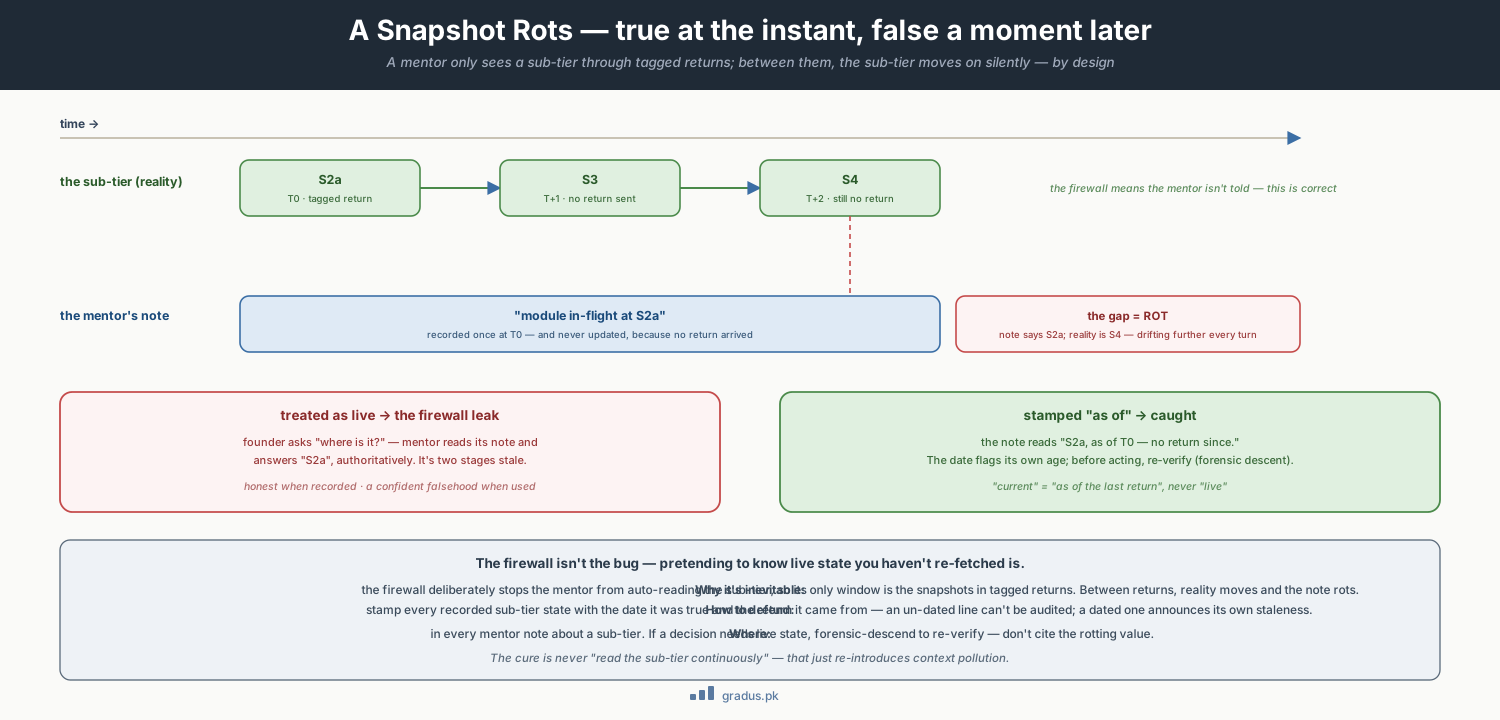
A tagged return is true the instant it's taken. The sub-tier then advances silently (the firewall working) while the mentor's note stays frozen — the growing gap is rot. Cited as live, it's a confident falsehood; stamped "as of <date>" and re-verified before acting, it's caught.
The failure it prevents
This is the inverse of hallucination. The mentor did not fabricate anything — it recorded exactly what a tagged return said. The defect is purely temporal: the recording was accurate at time T and is being used at time T+N as though nothing changed.
Why it is structurally inevitable without the discipline: the firewall deliberately prevents the mentor from auto-reading the sub-tier's live state. So the mentor's only window into the sub-tier is the snapshots that arrive via tagged returns. Between returns, the sub-tier moves on silently. A mentor that forgets the snapshot has an expiry date will:
- Make decisions on a state the sub-tier left behind days ago.
- Surface that stale state to the founder while sounding authoritative.
- Compound the error — each turn restates the rotting snapshot as if freshly confirmed.
The firewall is not the bug here; it is the design. The bug is pretending to know live state you have not re-fetched.
What violating it looks like
Example 1 — A ledger that froze in time
A Mentor-1 receives a tagged return: Billing is at stage S2a, expect two more days. It writes into LEDGER.md:
Three days later the founder asks where Billing is. The mentor reads its ledger and answers "Billing is at S2a." Reality: Billing reached S4 yesterday. The mentor is authoritatively wrong, and the founder makes a plan on a state two stages stale.
Example 2 — The worktree that drifted under the work
A Mentor-2 operates on a substrate worktree checked out yesterday. Mid-cycle, the substrate's main branch advanced. The mentor ratifies a slice as "matches latest substrate" — but it matches the worktree, which is now stale. The ratification is against a snapshot, not against reality.
Example 3 — A snapshot surfaced as live to the founder
In conversation, a mentor says "the Reporting compass is at v0.1.2." That value came from session memory of a return that was in flight when the session crashed before push. Disk says v0.1.1. The "current" claim is a snapshot that was never even durable.
How it's enforced
The "as of last tagged return" rule
A mentor tracks only the granularity it owns (state-tracking scope), and every note about sub-tier state carries three things: the value, the timestamp it was true, and the tagged return it came from. The phrasing is not optional decoration — it is the detection mechanism.
A correct LEDGER.md entry:
## Sub-tier state (as of last tagged return)

| Sub-tier | Last return | What they said | Tag |
|---|---|---|---|
| Mentor-2-Billing   | 2026-05-26 14:00 | S2a started; ~2 days | [[MENTOR-2→MENTOR-1 · Billing · S2a-started]] |
| Mentor-2-Reporting | 2026-05-26 18:30 | S5 close imminent     | [[MENTOR-2→MENTOR-1 · Reporting · S5-WIP]] |
Wrong (the leak): Billing at S2a. Right: Billing last-known S2a, as of 2026-05-26 per tag — no return since.
The answer discipline
When the founder asks "where is Billing now?", the disciplined answer is:
"Last tagged return said S2a-started on May 26; no return since. I can request an interim update from the Mentor-2 if you need live state."
Not "Billing is at S2a." The first answer is honest about what is knowable; the second silently promotes a rotting snapshot to a live fact. This one linguistic habit is the primary defense.
Forensic descent before action
If a decision actually requires live sub-tier state — not just a status report — the mentor performs a forensic descent: a deliberate, narrow, transient read across the firewall to re-verify, exactly as the firewall permits for escalation and exit-study. The descended read is used for the decision and not mirrored back into the mentor's canonical state (mirroring it would just create the next stale snapshot). For substrate state, "re-verify" means reading the frozen blob at the relevant tag, not the drifted worktree.
Detection lives in the grammar
The reason CompassAlpha insists on as of <date> framing is that it makes staleness visible. A ledger line with no timestamp cannot be audited for rot; a ledger line stamped as of 2026-05-26 flags itself the moment someone reads it on June 9. The discipline turns an invisible temporal bug into a self-announcing one.
Detection and recovery
Detection. Scan mentor notes for any sub-tier state lacking an as of <date> stamp — that is an un-auditable line and a leak candidate. A stamped line whose date is old relative to the cycle's pace is a leak waiting to be cited. The failure-modes index lists this as the firewall-leak class.
Recovery. Re-stamp the offending notes with explicit "as of" framing. Before acting on any sub-tier state, forensic-descend to re-verify or request an interim tagged return. Re-anchor any decision that was made against the stale value. The cure is never "read the sub-tier folder continuously" — that re-introduces context pollution. The cure is to know the snapshot's age and refuse to treat it as live.
Remember this
- A snapshot of someone's work is only true at the moment you took it. Treating it as live later is the failure this guardrail catches.
- Stamp every note about a teammate's state with when it was true and where it came from. An unstamped note can't be audited for rot.
- When asked "where are they now?", say what you last heard and when — never promote an old snapshot to a live fact.
- Need live state? Go look again (a "forensic descent") rather than trusting the old note — but don't start reading their work continuously, or you trade one problem for another. If the idea of safe boundaries between tiers is new, start with the mental model.
How this connects to other axioms and guardrails
- Firewall + state-tracking scope defines the snapshot-vs-live discipline this guardrail enforces; the leak is the named pathology that axiom exists to prevent.
- Hallucination defense handles the fabricated claim; this page handles the honestly-recorded-but-rotted claim. Both end in the founder hearing a confident falsehood.
- Pollution containment is the opposing constraint: the fix for staleness must not become continuous auto-reading, which pollutes.
- Provenance law supplies the worktree-vs-frozen-blob rule that defeats the drifted-worktree variant.