Codebase Coherence
One canonical way to do each thing — enforced against the doctrine, not left to each agent's discretion. The codebase stays uniform as it grows, across sessions and across teams.
This is CompassAlpha's flagship — AI-powered code coherence. Everything else in the framework exists to make it possible: a codebase that stays coherent as it grows, because an AI-agent federation builds every layer against one doctrine.
New here? This page explains how CompassAlpha keeps a codebase tidy and consistent when many AI agents (and many people) are all editing it — so the same job always gets done the same way, instead of everyone inventing their own version.
TL;DR
In plain terms: when lots of contributors touch one codebase, they tend to solve the same problem in slightly different ways, and the code slowly turns into a mess. CompassAlpha stops that by making "the one right way to do each thing" an enforced rule, not a polite suggestion.
The hard problem in multi-agent (and multi-team) software work is not writing code — it is keeping a growing codebase coherent: one canonical way to do each thing, used everywhere, instead of N near-duplicate, subtly-divergent ways. CompassAlpha treats coherence as a first-class property — enforced two ways: by construction (the federation builds every layer against one doctrine and cites substrate, so it can't quietly invent a second way) and mechanically, wherever you wire the conformance gate — a fail-closed check that blocks a commit or merge violating the rules you declare. Coherence by construction, made mechanically enforceable where it counts. The doctrine layer — the Charter, its Invariants, Primitives, and per-component Compasses — is the single source of truth; the federation reasons and builds against it, and the provenance law forbids acting on memory instead of substrate. Doctrine → coherent code.
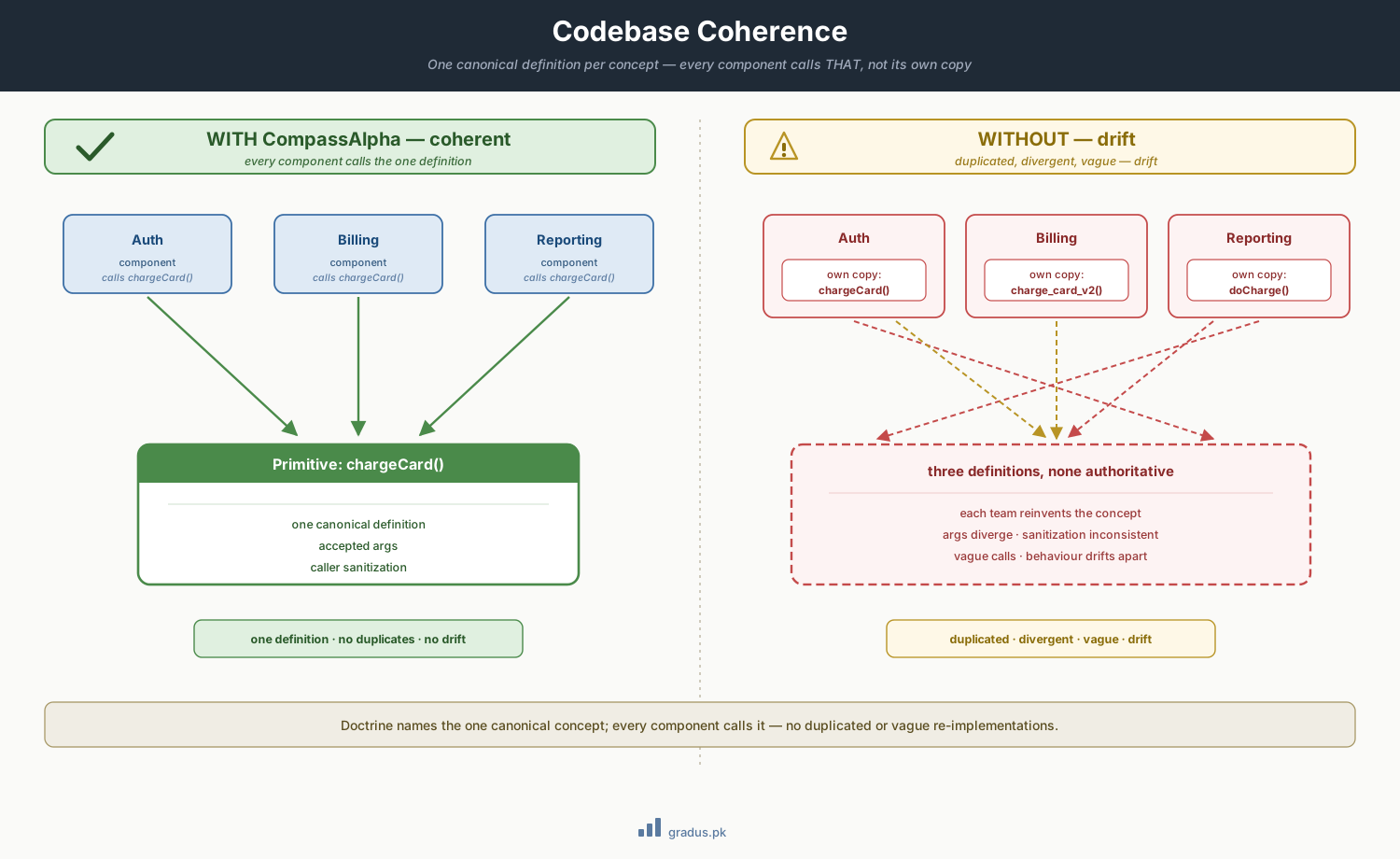
The single source of truth in practice: one canonical definition per concept, called by every component (left) — instead of divergent, duplicated copies that drift apart (right).
Why this is a distinction
Hand several capable agents — or several teams — the same growing codebase with no shared source of truth, and each will, in good faith, solve the same problem its own way. Within weeks you have three charge functions, two date helpers, four subtly different auth checks — each correct in isolation, collectively a maintenance swamp. The agents' intelligence does not prevent this; nothing was telling them what the one canonical way is.
CompassAlpha's distinction is that it does tell them — structurally, on disk, every time — and refuses to let them guess. Coherence stops being a code-review afterthought and becomes a property the doctrine provisions up front.
The coherence surface (what the doctrine provisions)
For any shared concept, the doctrine provisions — and the federation enforces — the whole surface, not just "what to build":
| The coherence question | Where the answer is provisioned |
|---|---|
| Which canonical routine / primitive must be used for this concept? | a Primitive — the one blessed definition, reused, never re-implemented |
| Where and when it is used (and where it must not be) | the relevant Compass (30K mechanics · 10K schema/routes) |
| What arguments it accepts — the contract | the Primitive's signature, fixed in doctrine |
| What caller-side sanitization is required before the call | the Primitive's contract + the applicable Invariants |
| What must never vary anywhere in the codebase | the Invariants — the non-negotiables |
The outcome: one canonical way per concept — no duplicated implementations, no vague "close enough" calls to the same idea. Uniformity by construction.
From a 60K vision to bit-level — how a Compass is grown
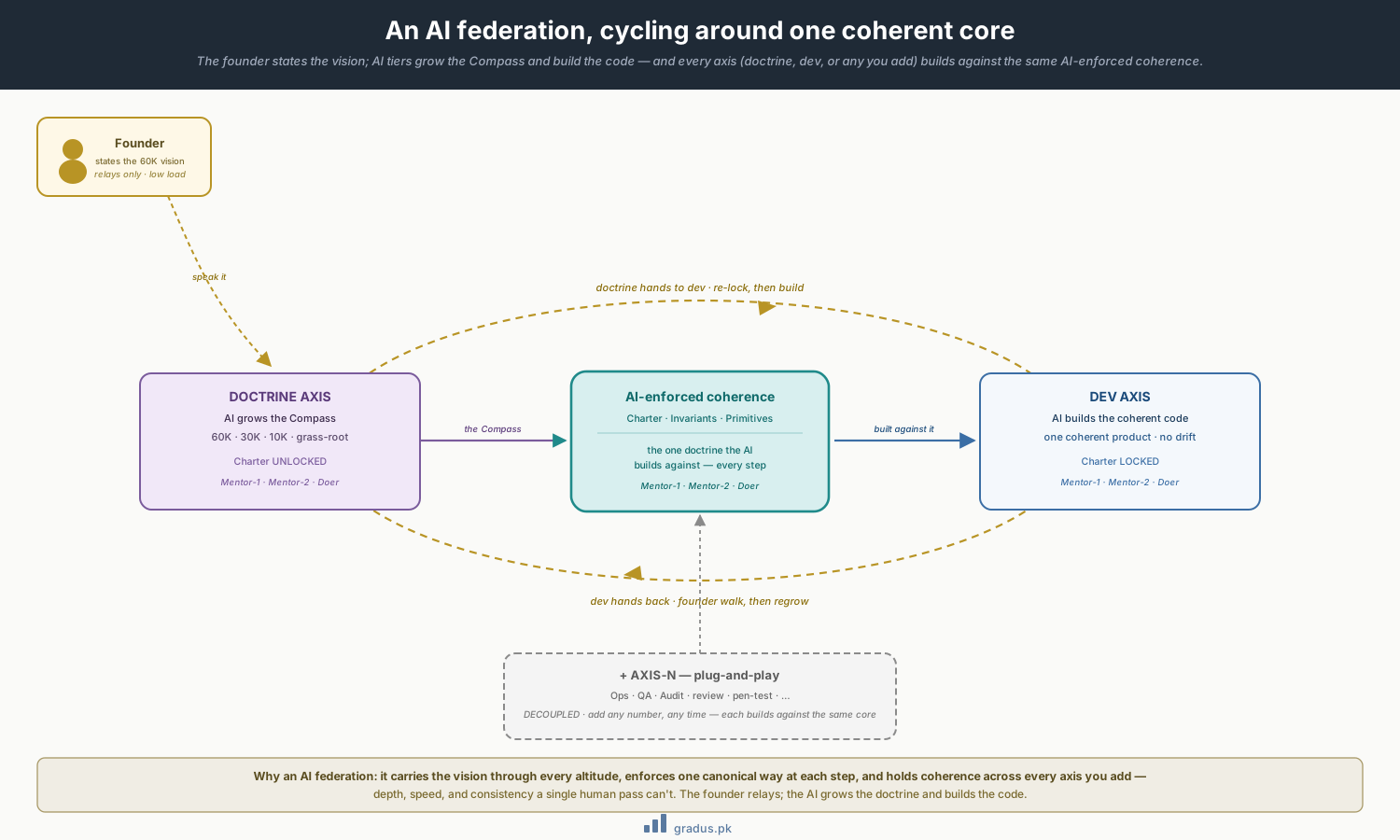
This is the part you can demo. (Throughout, "60K", "30K", "10K" and "grass-root" are altitudes — think of zooming in from a high-level view of the whole product down to the individual lines of code.) You supply the 60K ideology in plain words — the vision, the principles, why the domain matters — and the federation elaborates it downward, one altitude at a time, each layer bound to the one above:
- 60K — Ideology — your stated vision: principles, named theses, why this domain matters.
- 30K — Mechanics — state machines, lifecycles, primitives, and invariants, derived from the ideology.
- 10K — Schema, routes, engine, events — the concrete implementation surface.
- Grass-root — bit-level grounding and evidence, all the way down to code.
Both axes are run by the AI tier-federation (Mentor-1 · Mentor-2 · Doer), alternating cycle after cycle (the charter posture switch): the doctrine axis grows the Compass — turning the vision into the layered, coherent doctrine — and the dev axis then builds that Compass into coherent code, the product. At every step the AI builds against the one doctrine, so coherence is enforced, not hoped for — which is exactly the case for letting an AI federation do the work. Doctrine and dev are the two default axes, but the same coherence core anchors any further axis you declare (ops, QA, audit, and beyond) — the model is not limited to two.
Because every altitude derives from the single doctrine, the same concept is rendered once, in its true essence, at every layer — no gap between what was envisioned and what was built, and no duplicated implementations of the same idea. Say the vision; get a coherent codebase grown from it.
How CompassAlpha enforces it
- Doctrine is the single source of truth. One Charter; Primitives are the canonical contracts; Compasses localize each component's design under that Charter. There is exactly one place each concept is defined.
- The Doer builds against doctrine, not memory. The provenance law requires every load-bearing claim to cite substrate. An agent cannot quietly invent a second way, because it must point at the one definition on disk before acting.
- Primitives lock the definition; Compasses localize use. A genuinely new shared concept is lifted into a Primitive (see LIFT-WATCH) so every component reuses it — rather than each component growing its own copy.
- Toolings and audit mechanize the check. Toolings and specialised agents automate conformance — flagging a call that bypasses the canonical routine or a sanitization that's missing — so drift is caught, not discovered later. The conformance gate is the concrete, fail-closed floor: encode the machine-checkable rules from your Charter and a violation blocks the commit or merge, rather than relying on discipline alone.
You don't need a "coherence architect"
The instinct is to appoint one smart owner to sweep every Compass at each cycle's end and keep things tidy. CompassAlpha has none — by design. One owner of all coherence is a bottleneck and a single point of failure.
The job is split across mechanisms that don't tire or queue:
| The architect's job | Who does it instead |
|---|---|
| Fix the Compasses a change touches | the doctrine axis — its close is the fix |
| Push a charter change into every Compass | each team's delta re-run (amendment protocol) — per-team, no queue |
| Catch bad patterns / uncited claims | the conformance gate — fail-closed, every commit |
| Spot drift or bloat | the convergence mirror |
The one piece left — a final check that no Compass still uses something the new Charter dropped — is best as a gate, not a person.
The federation is the hygiene architect: distributed, mechanical, no single neck to break.
Why it compounds across teams
When many human teams build under the one Charter (see the doctrine substrate), coherence is exactly what keeps their segments from diverging. Every team reuses the same Primitives; a cross-cutting change flows through a charter-level bump, never an ad-hoc per-team reinvention. Physical federation without enforced coherence is just distributed drift — the coherence layer is what makes the distribution safe.
Coherence over time
Coherence is not only a point-in-time property; it has to survive the codebase's evolution. New requirements, new modules, and new rules enter through the doctrine cycle rather than ad hoc, so that today's canonical way stays canonical tomorrow. (A formal intake pipeline for keeping doctrine and code coherent as both grow is on the roadmap.)
Coherence reaches past the source — to what's derived from it
Source code is not the only thing built from a Primitive or a schema. A change to a canonical definition also has to reach everything derived from it that lives downstream of the source text: generated API clients and SDKs, cached or denormalized data, a trained or fine-tuned model that learned the old schema, an ETL or analytics pipeline shaped to the old contract. These artifacts don't recompile when you edit doctrine — they lag it silently, and that lag is coherence drift wearing a different coat. The codebase reads coherent while a downstream model still answers by yesterday's schema.
So a doctrine change to a Primitive or schema carries a propagation obligation, not just an edit:
- Enumerate the derived artifacts the changed definition feeds — name them in the Compass, the same way source dependencies are named.
- Decide the propagation for each: regenerate (clients/SDKs), backfill or re-migrate (data), retrain or re-version (models), or declare an explicit compatibility window during which old and new coexist.
- Don't close the cycle until the derived artifacts are reconciled or the window is recorded. A Primitive change whose downstream artifacts still reflect the old contract is an open coherence gap, even though every source file is consistent.
The rule is the same one coherence always enforces — one canonical way, everywhere it's used — extended honestly to the places a definition is used by being derived from, not only the places it's called.
How this connects
- Primitives & Invariants — the canonical definitions and the non-negotiables coherence is built on.
- Provenance law — cite-by-substrate; the mechanism that forbids reinventing a concept from memory.
- The doctrine substrate — one Charter, Compasses, axis annexes; the single-source-of-truth shape.
- Invariants, toolings & specialised agents — the mechanized conformance checks.
Remember this
- Coherence means: one right way to do each thing, used everywhere — not many near-duplicate versions that slowly drift apart.
- The doctrine on disk is the single source of truth. Agents must build against it and cite it, so they can't quietly invent a second way of doing the same thing.
- Say the vision in plain words; get a coherent codebase grown from it — the AI federation fills in every layer down to the code, all bound to that one vision.
- New to the bigger picture? Start with the mental model to see where coherence fits among CompassAlpha's core ideas.