Axis Declarations — defining your own work axes
An axis is a thin declaration: four fields + three tier roles. Everything substantive is inherited from the master.
[TUNABLE]
An axis is just one "lane of work" your team runs — like a lane for writing code, or a lane for writing the rules. This page shows you how to add a new lane without rewriting anything: you fill in a short form, and the lane borrows all the shared rules automatically.
TL;DR
In plain terms: there's one shared rulebook (the master), and each lane of work (an axis) is a tiny form that points back to that rulebook instead of repeating it. Adding a lane means filling in the form — not rewriting the rules.
A CompassAlpha federation is structured by inheritance: one master protocol holds every substantive rule, and each work axis is a thin declaration that names its tiers and a handful of settings, then inherits everything else. The default federation ships with two axes — build (produces code) and doctrine (produces governing documents). Adding a third axis (review, ops, AI-training, pen-test, …) is mechanical: name three tier roles, fill the declaration template, inherit the rest. You author no parallel rule sections. This page is the customization surface for declaring axes.
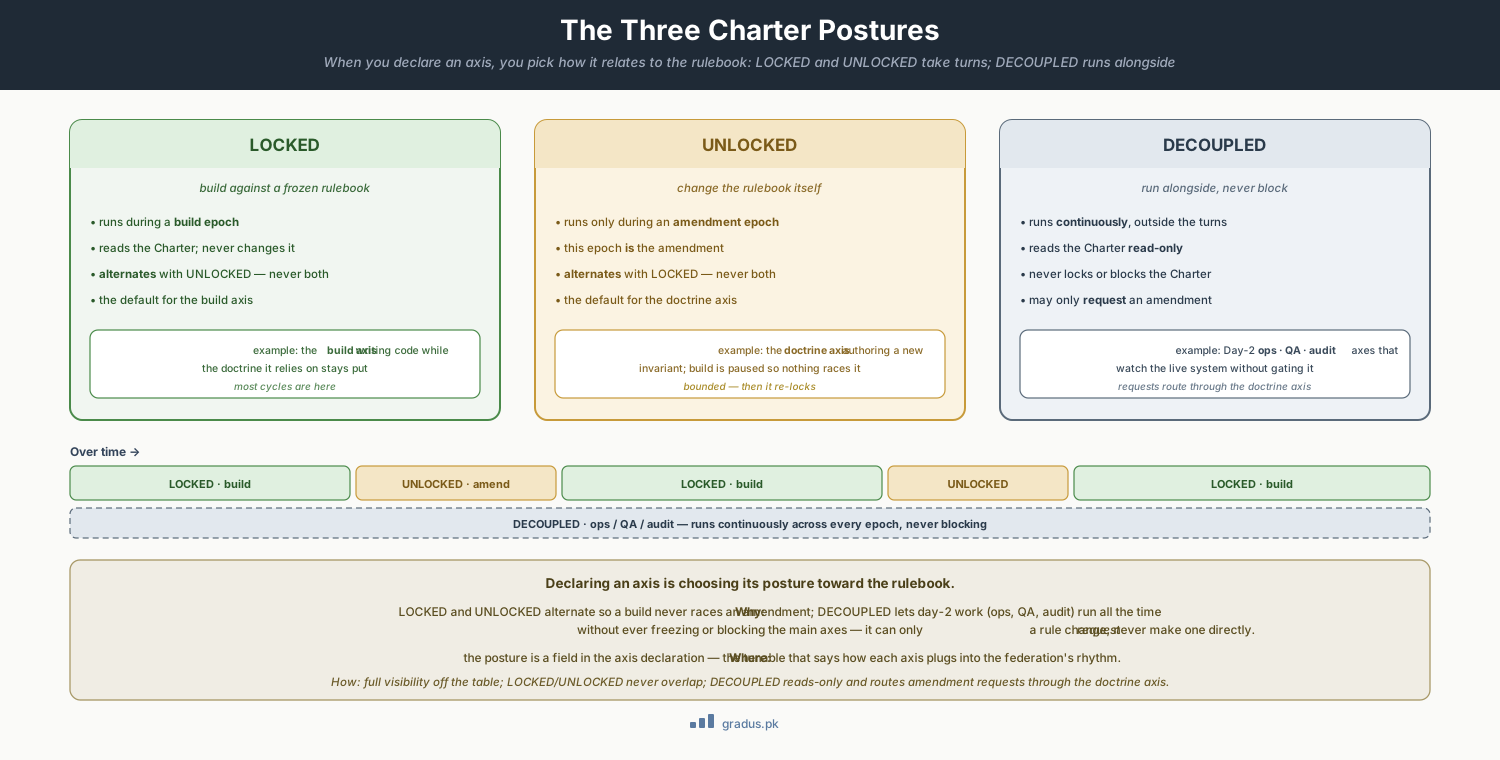
Declaring an axis chooses its posture toward the rulebook. LOCKED and UNLOCKED take turns, so a build never races an amendment; DECOUPLED day-2 axes (ops, QA, audit) run continuously, read the Charter read-only, and can only request a change — never make one directly.
The dial
Most projects start with one axis (build) and add a second (doctrine) once the rhythm is proven. Some never need more than one. Some grow to four. The dial is how many axes you declare and what each one produces — every axis inherits the same firewall, bus, hard-labour, and persistence rules from the master, so the marginal cost of an axis is a declaration, not a rewrite.
The inheritance model
                        MASTER PROTOCOL
                 (every substantive rule, once)
                              ▼
            ┌─────────────────┼─────────────────┐
            ▼                 ▼                 ▼
        BUILD AXIS       DOCTRINE AXIS      FUTURE AXIS
       (declaration)    (declaration)     (declaration)
The master holds each rule once, axis-agnostic, with tier-variable substitution. When a rule changes, it changes in the master; every axis picks it up automatically. When you add an axis, the master is unchanged — the new axis is a new declaration file.
Why inheritance, not duplication. Parallel per-axis rule sections produce three costs: duplication (the same firewall stated twice with role names swapped), update burden (every refinement touches both copies), and cognitive load (which section applies?). Inheritance collapses all three.
The declaration template
Each axis declares — explicitly, in writing — these fields. Everything else is inherited.
AXIS NAME:               <e.g. "build", "doctrine", "review", "ops">
PURPOSE:                 <one-paragraph summary of what this axis produces>
TIER ROLE NAMES:
  Mentor-1:              <name>      ← ratifies completion; surfaces founder-calls
  Mentor-2:              <name>      ← orchestrates one unit of work; slices for the Doer
  Doer:                  <name>      ← the only tier that touches substrate
DELIVERABLE TYPE:        <e.g. "code", "governing document + primitives", "audit findings">
CYCLE GRANULARITY:       <unit of work + stage sequence>
                         <e.g. "module dispatch · CP1 → CP2 → CP3 → close">
                         <e.g. "entity dispatch · S1 → S2a → S2b → S3a → S3b → S4 → S5 → close">
CHARTER POSTURE:         <LOCKED | UNLOCKED | DECOUPLED>
CYCLE ACTIVATOR:         <what fires a new cycle on this axis>
RATIFICATION PATTERN:    <per-dispatch sub-bump / per-unit sub-bump / cycle-end major bump>
LOCALITY:                <where each tier physically lives — host, paths>
                         (defaults to host-of-substrate; override if needed)
The five declarable dimensions
These are the choices an axis declaration actually makes. The first four are the load-bearing ones; locality is a deployment detail.
1. Deliverable type
What the axis produces. Code, a governing document, audit findings, a test plan, a migration script. The deliverable type determines the axis's exit-gate definition (what "complete" means) and whether the document-structure doctrine (the 60K/30K/10K tiering) applies.
2. Cycle granularity
The unit of work plus its stage sequence. A build axis works in module dispatches with CP1 → CP2 → CP3. A doctrine axis works in entity dispatches with S1 → S2a → S2b → S3a → S3b → S4 → S5. The granularity sets what a single dispatch covers and how its lifecycle is staged. See Stage taxonomies for the full vocabulary.
3. Charter posture
Whether the axis runs while the Charter is LOCKED, UNLOCKED, or is DECOUPLED from Charter state entirely.
- LOCKED — runs only while the Charter is locked (the build axis: code is written against stable doctrine).
- UNLOCKED — runs only during an amendment epoch (the doctrine axis: it is the amendment).
- DECOUPLED — runs independently of Charter state, continuously, never entering the LOCKED↔UNLOCKED alternation. It consumes the Charter read-only, never locks or blocks it, and may only request a Charter amendment through the doctrine axis. (A Day-2 review / audit / ops axis.)
LOCKED and UNLOCKED axes alternate — they do not run concurrently, because that would race the amendment (Charter primitives could change mid-build). DECOUPLED axes may run alongside whatever is active, with the rule that they do not gate the main axes.
4. Cycle activator
What fires a new cycle on this axis. The build axis is fired by a module dispatch trigger (founder-initiated). The doctrine axis is fired by a founder walk plus sufficient deferral-queue depth. A review axis might be fired on a schedule or on a release tag.
5. Lanes (work granularity)
Which of the four work-granularity lanes the axis enables — Doctrine Cycle, Phase 3, Polish, Surgical Strike. Most axes host the heavier lanes; the build axis additionally hosts the light lanes (Polish, Surgical) for day-to-day requests. Lane availability is a per-preset tunable.
The two reference axes
| Field | Build axis | Doctrine axis |
|---|---|---|
| Deliverable type | code | governing document + primitives/invariants |
| Tier roles (generic) | Mentor-1 / Mentor-2 / Doer | Mentor-1 / Mentor-2 / Doer |
| Cycle granularity | module dispatch · CP1 → CP2 → CP3 | entity dispatch · S1 → S5 |
| Charter posture | LOCKED | UNLOCKED (amendment epoch only) |
| Cycle activator | module dispatch trigger | walk + deferral-queue depth |
| Ratification | per-module tag (<module>-v<x.y>) |
per-entity sub-bump + cycle-end major bump |
The generic tier vocabulary is Mentor-1 / Mentor-2 / Doer. Each axis is free to give its tiers project-specific names; the rules always speak in the generic vocabulary and each reader substitutes their own.
Adding a third axis (worked sketch)
Suppose you want a review axis that audits closed modules:
AXIS NAME:            review
PURPOSE:              Independent audit of closed build-axis modules against
                      declared invariants; produces findings, not fixes.
TIER ROLE NAMES:
  Mentor-1:           Audit-Lead
  Mentor-2:           Audit-Orchestrator
  Doer:               Auditor
DELIVERABLE TYPE:     audit findings (report + finding tally)
CYCLE GRANULARITY:    module-audit dispatch · RECON → CHECK → REPORT → close
CHARTER POSTURE:      DECOUPLED (audits don't gate build/doctrine alternation)
CYCLE ACTIVATOR:      a module reaches FROZEN on the build axis
RATIFICATION PATTERN: per-audit tag (audit-<module>-v<x.y>)
LOCALITY:             host-of-substrate (default)
That declaration is the entire axis. The firewall, bus protocol, hard-labour rule, persistence law, dual validation, status grids, and flush triggers all apply automatically by inheritance.
Incorporating an axis (the gate)
Adding an axis is cheap, but it is recorded — a small, deliberate act, not an ad-hoc spawn:
- Declare — author the declaration above (the fields + three tier roles).
- Review — the founder and the doctrine axis's Mentor-1 review the declaration at a cycle seam (never mid-cycle): it must violate no axiom, and if
DECOUPLED, it must gate nothing. - Register — record the axis in the federation's
AXESmanifest (the list of every declared axis + its declaration), committed to the reviewer-state repo. The axis becomes an annex under the one Charter — see the doctrine substrate.
Because incorporation is additive and read-only against existing state, a new axis (axis-N) can be added at any stage of a running project without disturbing in-flight work — the integrity of the current state is preserved. A DECOUPLED axis can begin immediately; a LOCKED / UNLOCKED axis takes its turn in the alternation.
Defaults
| Setting | Default | Notes |
|---|---|---|
| Number of axes at adoption | 1 (build) |
Add doctrine once rhythm is proven. |
| Generic tier vocabulary | Mentor-1 / Mentor-2 / Doer | Always 3 tiers; names are tunable per axis. |
| Charter posture for first axis | LOCKED | Build against stable doctrine. |
| Locality | host-of-substrate | Override only if a tier must run elsewhere. |
How to choose
- Start with one axis. Don't declare axes you won't run in your first cycle.
- Add the doctrine axis when deferred structural changes accumulate faster than a single build axis can absorb them.
- Add a DECOUPLED axis when you need work that shouldn't gate the main alternation (independent audit, ops, security review).
- Keep tier counts at three. Two under-contains pollution; four multiplies relay surface for marginal benefit. (This part is
[INVARIANT]— see Tier grammar.)
How this connects
- Tier grammar (axiom) fixes the three-tier structure every axis inherits.
- Stage taxonomies is where an axis declares its cycle-stage vocabulary.
- Work granularity lanes is where an axis declares which lanes it enables.
- The full parameter matrix lists the axis-level tunables alongside project, operational, cultural, and tech-stack ones.
Remember this
- An axis is one lane of work (writing code, writing doctrine, auditing, …). You can have one lane or several.
- You never copy the rules into a new lane. There's one shared rulebook (the master), and every lane inherits it — so adding a lane is filling in a short form, not rewriting the framework.
- The form makes only a handful of real choices: what the lane produces, how its work is staged, when it runs relative to the Charter, and what kicks off a new round. Everything else is borrowed.
- Start with one lane and add more only when you actually need them. If the lanes feel like new "roles," it helps to revisit the mental model.