Stage Taxonomies
The lifecycle vocabulary each axis and lane uses. The words your status grids speak.
[TUNABLE — stage names per axis + per lane]
This page is the list of named steps a piece of work moves through — from "just started" to "done and locked" — and it explains why letting each kind of work name its own steps (while keeping the same ending) keeps everyone agreeing on where things stand.
TL;DR
The short version: every kind of work gets its own short list of named steps it passes through, but they all finish the same way — freeze, check, tag, archive.
Each axis and lane declares its own lifecycle stage vocabulary — the named states a unit of work passes through from launch to FROZEN. These stages drive Tier-2 status grids, inbox file naming, ratification-gate definitions, and the audit trail. The build axis uses CP1 → CP2 → CP3; the doctrine axis uses S1 → S5; Polish and Surgical lanes use slim taxonomies. Project-specific stage names are [TUNABLE]; the framework requires only three structural properties: monotonic progression, a defined freeze-to-tag tail, and a terminal FROZEN state. The stage taxonomy is one of the most important things a new project authors at adoption.
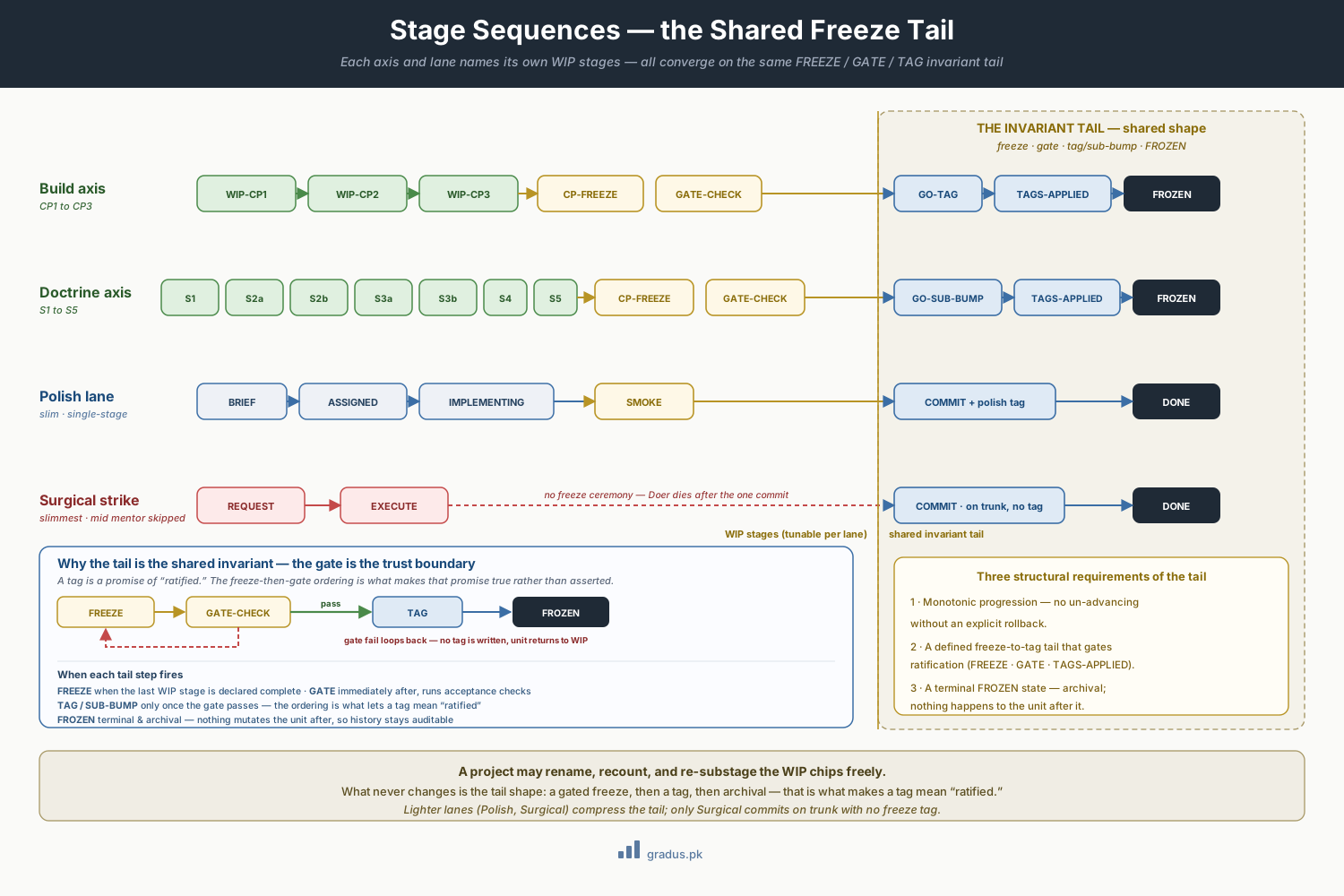
Each lane runs its own stages but ends the same way: the freeze → gate → tag tail is the shared invariant shape.
The dial
Stage names, counts, and sub-stages are yours to choose per axis and per lane. What's fixed is the shape — a monotonic march toward a gated freeze, then a tag, then archival. You fill in the names that fit your deliverable.
Why stages exist
Stages are the federation's shared clock. They let every artifact agree on "where is this work":
- Status grids (see Status grids reference) tag every item with its current stage.
- Inbox file names encode the stage (
from-<sender>-<stage>-<event>.md), so a return is self-describing. - Ratification gates are defined relative to stages (gates check at GATE-CHECK; tags apply at TAGS-APPLIED).
- The audit trail reconstructs a unit's full lifecycle from its stage transitions in the git log.
Build axis · Phase 3 dispatch stages
PRE-STAMP → STAMPED → LAUNCHED → WIP-CP1 → WIP-CP2 → WIP-CP3 →
  CP-FREEZE → GATE-CHECK → GO-TAG → TAGS-APPLIED → CLOSED → FROZEN
| Stage | Meaning |
|---|---|
PRE-STAMP |
Top mentor composing the stamp; nothing fired yet. |
STAMPED |
Stamp authored + launch relay pushed. |
LAUNCHED |
Orchestrator session booted via bus relay. |
WIP-CP1 |
Planning + premise check (baseline re-measure; charter inheritance; founder-calls surfaced). |
WIP-CP2 |
Implementation, slice by slice; invariant enforcement; per-stage substantive review. |
WIP-CP3 |
Exit-report assembly + audit reconciliation. |
CP-FREEZE |
Orchestrator finished slices; freeze candidate (leftover onboarding). |
GATE-CHECK |
Top mentor triages the exit gates green. |
GO-TAG |
Top mentor authorizes tag-apply. |
TAGS-APPLIED |
Orchestrator applied the exit tag + refspec-pushed + verified. |
CLOSED |
Dispatch closed; close-record committed; stand-down acknowledged. |
FROZEN |
Judicial folder archived per firewall (final). |
Doctrine axis · entity dispatch stages
PRE-STAMP → STAMPED → LAUNCHED → WIP-S1 → WIP-S2a → WIP-S2b → WIP-S3a → WIP-S3b → WIP-S4 → WIP-S5 →
  CP-FREEZE → GATE-CHECK → GO-SUB-BUMP → TAGS-APPLIED → STAND-DOWN-ACK → FROZEN
| Stage | Meaning |
|---|---|
WIP-S1 |
Substrate recon + the top-altitude ideology section; cite-by-substrate. |
WIP-S2a |
Higher-altitude mechanics — the entity at altitude. |
WIP-S2b |
Mechanics with explicit sibling cross-references. |
WIP-S3a |
Schema + lifecycle / state machines. |
WIP-S3b |
Routes + engine + events. |
WIP-S4 |
Glossary walks + evidence gathering for cross-cutting promotion. |
WIP-S5 |
Close package + reconciliation. |
CP-FREEZE → FROZEN |
Same freeze-to-archive tail as the build axis, with a per-entity sub-bump instead of a single tag. |
The S1 → S5 altitudes map to the document-structure doctrine (60K ideology / 30K mechanics / 10K schema-routes-events). For axes whose deliverable is code, that document tiering doesn't apply — substitute the deliverable's own structure.
Polish Lane stages
| Stage | Meaning |
|---|---|
BRIEF |
Founder request received and triaged to Polish. |
ASSIGNED |
Top mentor stamps a slim orchestrator or routes direct to the Doer. |
IMPLEMENTING |
Doer executes the bounded change. |
SMOKE |
Smoke test + UX-critic review pass (no full audit). |
COMMIT |
Doer commits via commit discipline + lightweight polish tag. |
DONE |
Founder receives confirmation; loop closes. |
No CP sub-stages — the whole lane is single-stage execution.
Surgical Strike stages
| Stage | Meaning |
|---|---|
REQUEST |
Founder one-liner request lands in the top mentor's inbox. |
EXECUTE |
Top mentor stamps a one-paragraph brief to a fresh Doer; Doer pulls, edits. |
COMMIT |
Doer commits via commit discipline (no tag; commit on trunk). |
DONE |
Founder pinged; loop closes. |
The mid mentor is skipped entirely; the Doer dies after the one commit.
Cycle-level stages (shared across axes)
These wrap the per-dispatch stages: a cycle is ENGAGED, runs a DISPATCH-LOOP of per-unit dispatches, assembles an AMENDMENT-PKG (doctrine cycles only), is RATIFIED by the founder, then CLOSED with a bump tag.
Cycle-tail acceptance (a tunable on the freeze tail)
How the freeze-to-tag tail handles incomplete items is itself a dial:
- Strict (default) — every item in the dispatch must close before the tag applies. Maximum predictability of what a tag means.
- Liberal (N-of-M) — a tag may apply with N of M items closed and the rest onboarded as leftovers. Faster cycle close, less predictable tag semantics.
Strict trades speed for predictability; liberal trades the reverse. This is the cycle-tail acceptance parameter in the full matrix.
The three structural requirements (the invariant shape)
A project may rename, recount, and re-substage freely, provided the taxonomy satisfies:
- Monotonic stage progression — state cannot un-advance without an explicit rollback.
- A defined freeze-to-tag tail — a
CP-FREEZE → GATE-CHECK → TAGS-APPLIEDsequence that gates ratification. - A terminal FROZEN state — signals archival; nothing happens to the unit after it.
Beyond those, stage vocabulary is fully tunable.
Defaults
| Setting | Default | Range |
|---|---|---|
| Build-axis stages | CP1 / CP2 / CP3 | project-defined (≥1 WIP stage) |
| Doctrine-axis stages | S1 → S5 | project-defined |
| Cycle-tail acceptance | strict (all close) | strict / liberal (N-of-M) |
| Freeze-to-tag tail | required | [INVARIANT] shape |
How to choose
- Author your stage taxonomy at adoption, alongside the axis declarations. It's load-bearing from the first dispatch.
- Fewer stages for simpler deliverables. A code axis with no document-tiering needs fewer WIP stages than a doctrine axis.
- Keep the freeze-to-tag tail intact — it's what makes a tag mean "ratified."
- Stay strict on cycle-tail acceptance for regulated work; go liberal only when speed outranks predictable tag semantics.
Remember this
- A stage is just a named step a piece of work is currently sitting in — like "being implemented" or "frozen." The list of those steps is the stage taxonomy.
- You get to name and count the steps to fit your kind of work, but every list must end the same way: freeze, gate-check, tag, then a final FROZEN state. That shared ending is what makes a tag mean "this was ratified."
- These stage names aren't decoration — status grids, inbox file names, and the audit trail all read them to answer "where does this work stand?"
- Stages are part of the wider customization story; if the big picture is fuzzy, revisit the mental model.
How this connects
- Axis declarations — an axis declares its cycle granularity, i.e. its stage sequence.
- Work granularity lanes — each lane runs a different taxonomy (heavy vs slim).
- Status grids — consume stage markers to render where work stands.
- Full parameter matrix — cycle-tail acceptance and stage choices listed as tunables.