Axiom 3: Persistence Law (the trust anchor)¶
Flush before disclose. State on disk + at origin BEFORE it is discussed with the founder. Nothing load-bearing in chat.
[INVARIANT]
New here? This page explains the one habit that lets a human safely trust a team of AI agents: nothing important is "real" until it's saved to a file and confirmed — never just spoken in the chat. Get this, and you understand why the human running the show can relax instead of double-checking everything.
TL;DR¶
In plain terms: an AI agent isn't allowed to tell you "I did it" until the change is actually saved, backed up, and re-read to confirm it stuck. Talk is cheap; the file is the truth.
Every load-bearing state change must be written to disk + pushed to origin + read back before it is discussed with the founder. This is the trust anchor — what lets the founder step back to a relay+lost+found role instead of micromanaging every interaction.
If state isn't on disk, it doesn't exist.
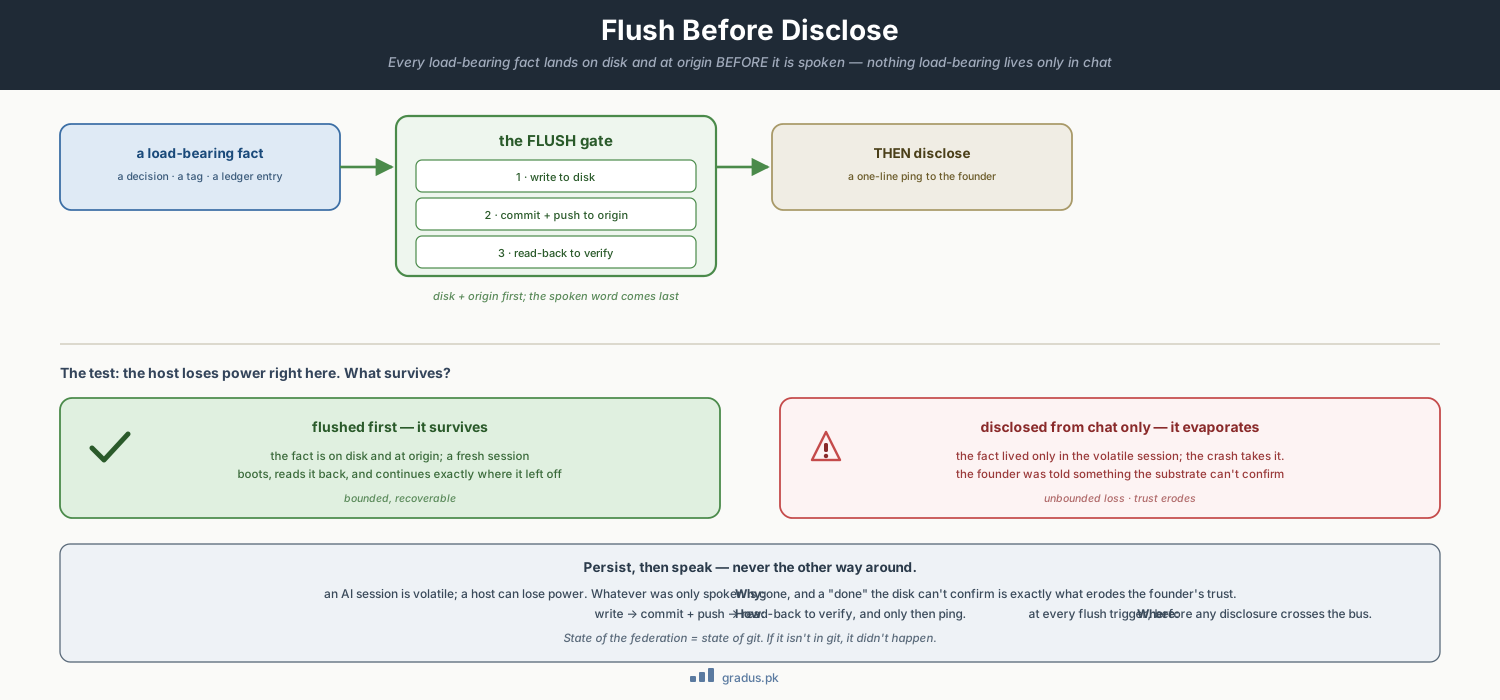
Persist, then speak. A load-bearing fact is written to disk, pushed to origin, and read back to verify — only then is it disclosed. If the host loses power, a flushed fact survives in git; one that lived only in chat evaporates, and a "done" the disk can't confirm is what erodes trust.
The rule¶
Flush-before-disclose¶
State is on disk + at origin BEFORE it is discussed/disclosed to the founder. Nothing load-bearing in chat.
Layer A — Persistence validation (every flush)¶
A write is not "done" until:
1. WRITE the change to the canonical file.
2. READ-BACK the affected fields from disk.
3. CONFIRM the read matches intent.
A flush that has not been read back is treated as not flushed.
Layer B — Handover validation (every cutover)¶
When tiers rotate (Mentor-N → Mentor-N+1), a two-party cross-check is required:
1. INCOMING tier self-administers the grounding battery
   (from LEDGER.md §"grounding answers") + must surface ≥1 ORIGINAL non-parroted observation.
2. OUTGOING tier scores against live artifacts + certifies no unflushed state.

Release only after BOTH pass. Logged in HANDOVER_LOG.md.
Flush = write + commit + push + read-back¶
On hosts with abrupt power-down risk, flush means git commit + push to the state-of-record remote, not just file-write. Local disk is volatile; the remote is durable.
Single-live-writer¶
Only the current live tier-holder writes the state-of-record repo while holding jurisdiction. A rotation transfers jurisdiction. Any out-of-jurisdiction overlap writer fetches before push and never clobbers the live writer.
Why this is the trust anchor¶
The founder needs to trust the federation's state. Specifically, the founder needs to trust that:
- What they see on disk is what's true
- What an AI tier says is consistent with what's on disk
- They can be away from the keyboard without missing critical state changes
Without flush-before-disclose, these trust assumptions break:
- AI tier says "I did X" but X is only in chat, not on disk → founder reboots → X is lost → founder discovers the loss later → trust eroded
- AI tier makes a decision that's never persisted → founder makes a follow-up decision on a different assumption → conflict
- Founder steps away during a long conversation → comes back → AI tier's claims about "current state" don't match disk → confusion
With flush-before-disclose:
- AI tier says "I did X" only AFTER X is on disk + at origin + read back → founder can verify by checking disk → trust preserved
- Founder can step away during a turn and resume; state is guaranteed durable
- Power-down on the AI tier's host loses at most the current in-flight turn
The persistence law is what makes the founder's narrow role possible. Without it, the founder would need to be the persistence layer themselves.
What violating this looks like¶
Violation 1: AI tier reasons in chat, doesn't flush¶
A tier discusses a complex decision across 10 conversation turns, draws a conclusion, but never writes the conclusion to LEDGER.md. Then the session ends.
Result: the next tier session has no record of the decision. The reasoning is gone. Trust eroded.
Violation 2: Tier writes locally, doesn't push¶
A tier writes a change to local disk. Host power-cycles before push. The change is lost.
Worse: the tier said "done" to the founder before push. The founder believes it's done; only later discovers it's gone.
Violation 3: Tier asserts state without verifying disk¶
A tier says "the Billing compass is at v0.1.2" based on session memory. Founder asks "are you sure?" Tier confirms.
Reality: disk says v0.1.1; the v0.1.2 update was in-flight but the tier session crashed before push. Tier's confirmation was based on session memory, not disk verification.
Fix: tier should git log / git show to verify against disk before asserting.
Implementation details¶
The flush trigger taxonomy (T0-T7)¶
| # | Trigger | Action |
|---|---|---|
| T0 | Boot | Read canonical state artifacts; verify mutual consistency; print START Status Grid; GH-sync check |
| T0e | Session end / standby-into-cutover | Print END Status Grid; final disk==understanding certification |
| T1 | State change — GO relayed, checkpoint frozen, founder-call ruled, dispatch advanced | Flush to LEDGER.md + read-back |
| T2 | Triage return — after handing back ratification/GO/freeze | Flush resulting state before standby |
| T3 | End-of-turn sweep | Before ending any turn that advanced state, confirm the ledger reflects it. Unflushed state = incomplete turn. |
| T4 | Context-health signal | Flush everything, initiate cutover prep |
| T5 | Cutover / onboarding | Full Layer-B dual validation; append to HANDOVER_LOG.md |
| T6 | Doctrine change | Update master / axis declaration / templates; version-bump |
| T7 | CP-freeze | Onboard every leftover to LEFTOVERS.md BEFORE reporting freeze as ratification-ready |
Commit-discipline at the git layer¶
git commit + push is not enough by itself. The framework specifies:
- Use
GIT_INDEX_FILE(per-session staging index) - Use
git commit-tree(avoidgit commitplain) - Use explicit refspec push (
git push origin main:main) - Run
git pull --ff-onlybefore every push (fetch-before-push)
→ Git foundations axiom — these are the technical mechanics enabling persistence law.
Read-back verification¶
After every write, the session must read back the change from disk:
# Pseudo-code
write_change(file, content)
disk_content = read_from_disk(file)
assert disk_content == content, "Flush not confirmed"
log_to_ledger(file, "flushed at " + timestamp)
A session that writes without read-back has not flushed. End-of-turn (T3) requires confirming all writes are read-back-verified.
Variations / tunables on top¶
| Tunable | Default | Range |
|---|---|---|
| Flush cadence | every flush trigger pushes | every-trigger / batched-end-of-turn |
| Power-down resilience model | volatile local; durable origin | volatile-local / durable-local |
| Read-back stringency | every write | every-write / sampled / disabled (anti-pattern) |
| HANDOVER_LOG depth | full | full / summarized after N rotations |
→ Context patterns for related tunables on audit verbosity.
How this connects to other axioms¶
- Tier grammar establishes that each tier has state; persistence law makes that state authoritative.
- Firewall establishes who owns what state; persistence law ensures that state is durable.
- Provenance law is a higher form of persistence law — not just durability but verifiability.
- Git foundations are the mechanical implementation of the persistence law.
The "trust anchor" framing¶
Why call it the trust anchor specifically?
The founder must extend trust to the federation. They must trust:
- That tier rotations don't lose state
- That what an AI tier says is true
- That decisions made yesterday are durable
- That power-downs don't corrupt the federation
This trust is not free. It's purchased by strict adherence to flush-before-disclose.
If the founder ever observes a violation — a claim that doesn't match disk, a state that wasn't pushed, a decision that evaporated — the trust contract is broken. The founder must then either:
- Re-establish trust (requires repeated faithful demonstrations)
- Withdraw the narrow-role posture and start micromanaging
- Abandon the framework
Option 2 is what most AI-collaboration projects end up doing — and is exactly the cognitive load CompassAlpha is designed to spare the founder.
The persistence law is the contract that earns the trust.
Remember this¶
- If it isn't on disk, it didn't happen. A claim that lives only in chat is not real state — and an agent must not report it as done.
- Flush means write + push + read-back. Saving locally isn't enough; the change goes to the durable remote, then gets re-read to confirm it actually landed.
- This is what frees the human. Because state is always durable and verifiable, the founder can step away and trust the federation instead of micromanaging it.
- New to the whole picture? See the mental model for how this law fits the rest of the framework.