Multi-Team Federation
Several teams, each owning a different component, all building one coherent codebase under one Charter — staged team-by-team, with no big-bang and no single person turning into the bottleneck.
In plain terms: most real adoptions aren't one person or one team — they're several teams, each responsible for a different part of the product, who somehow have to not drift apart. This page shows what CompassAlpha looks like at that scale: distinct teams, distinct components, one shared rulebook, git as the thing that keeps them coherent. It answers the question a manager asks first — "can I roll this out across my teams without it becoming chaos, or without every decision routing through me?"
New here? Start with the mental model, then codebase coherence — this page assumes both.
The setup: four teams, four components, one Charter
We reuse the Northwind example — but instead of one team building four modules, picture four separate teams, each owning one component as its own sub-project:
| Team | Owns (its component / sub-project) | Its Compass |
|---|---|---|
| Team Identity | Auth — accounts, sessions, roles, SSO | auth |
| Team Revenue | Billing — subscriptions, invoices, payments | billing |
| Team Insights | Reporting — dashboards, exports, warehouse | reporting |
| Team Reach | Notifications — email/SMS/in-app delivery | notifications |
Each team runs its own federation tiers (Mentor-1 / Mentor-2 / Doer) and its own cycles on its own Compass. What binds them into one codebase rather than four drifting ones is the layer above them:
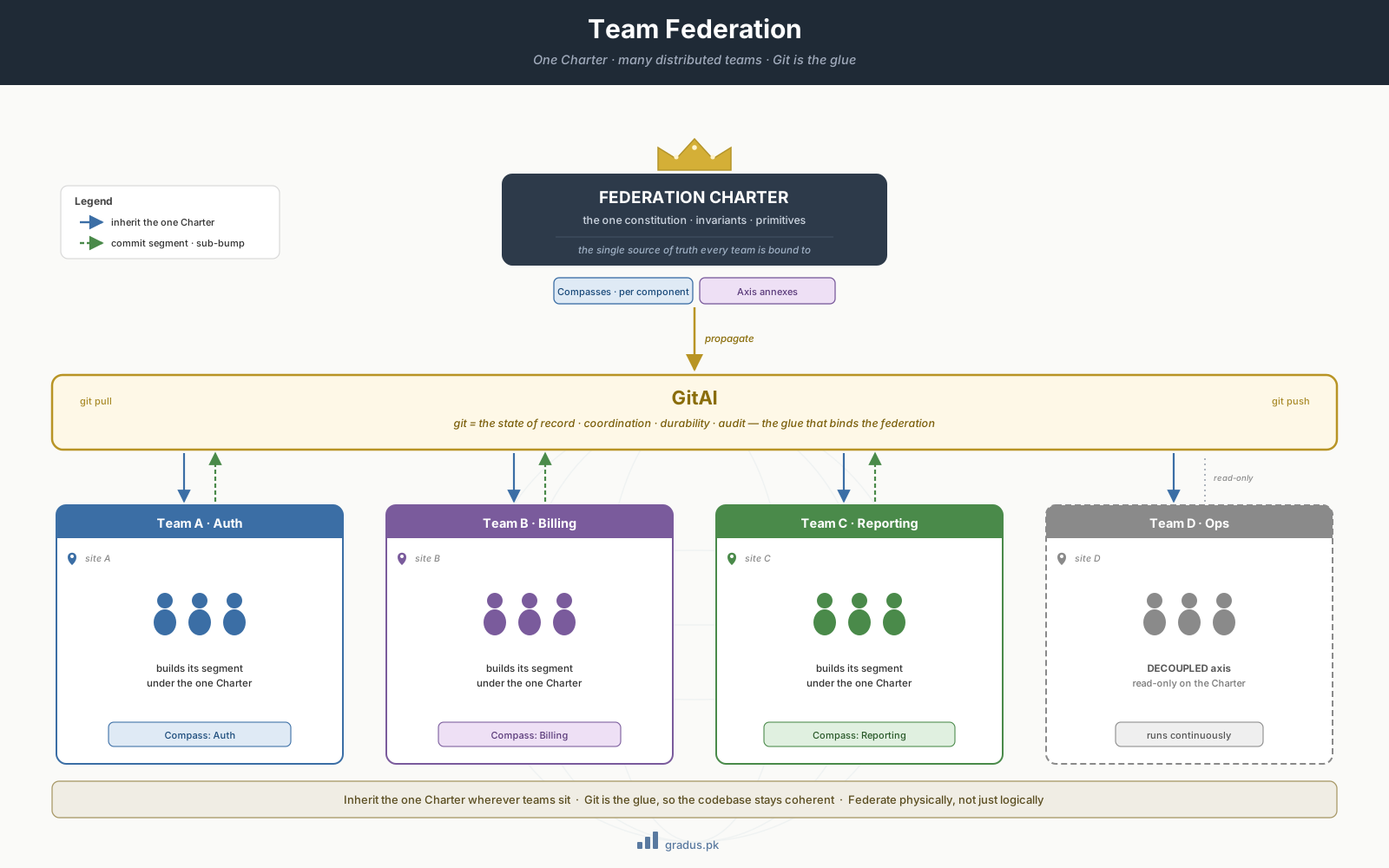
One Charter at the top; each team builds its component beneath it; git is the glue. The teams are independent in their day-to-day, identical in the rules they're bound to.
What keeps four teams coherent (and not four codebases)
Three things, all from the doctrine substrate:
- One Charter, not one per team. Every team is bound to the same federation Charter — the same invariants (rules that must hold everywhere) and the same primitives (the one canonical definition of each shared concept). Team Revenue and Team Insights both reuse the same
Moneyprimitive and the sameAccountdefinition — they can't each invent their own, because there's one canonical place each is defined. - Each component is a Compass under that Charter. A team has full design latitude inside its own Compass, and zero latitude to redefine a shared concept. Tight at the center, flexible at the edges.
- Git is the glue. Every team's state — decisions, cycles, frozen tags — lives in git, so coherence is verifiable across teams the same way it is within one: cite by substrate, not by what some team says it did.
The result is the thing that's almost impossible to hold by hand at multi-team scale: physical distribution without divergence. Without the shared Charter, several teams is just distributed drift; the Charter is what makes the distribution safe.
The bottleneck question — answered
The most common multi-team fear is "if I'm the relay, do I become the bottleneck — N teams, N× the decisions through me?" The framework's answer is no, and structurally so:
- Within-team decisions never reach you. Each team's Mentor-1 owns its own cycles and arbitrates its own component-level calls. A choice that lives entirely inside Billing is settled inside Team Revenue — it never lands on the founder's desk.
- You relay, you don't arbitrate. The founder is a low-cognitive-load relay — one-liner pings and a lost-and-found backstop — not a per-decision authority. (This is an axiom, not a style choice.)
- So your load scales with cross-team coupling, not team count. The only things that need you are (a) a hand-off between two teams and (b) a GO-UP-BUMP — a charter-level change that affects everyone. The one Charter + shared primitives are designed to minimize exactly that coupling. Ten loosely-coupled teams generate less founder traffic than two tangled ones.
If you find yourself in every decision, that's a signal the work is mis-sliced (components too entangled), not that the framework demands it — the fix is cleaner component boundaries, not more of your time.
Teams can sit on different rungs at the same time
Onboarding is not synchronized. Because adoption is per-unit, each team climbs the adoption ladder at its own pace:
- Team Identity is mature — running multiple axes (build + a Day-2 QA axis): Rung 3, Federate.
- Team Revenue stood up its first federation last month: Rung 2, Bootstrap.
- Team Reach is a legacy module still being brought in non-destructively: pre-Rung-2, on the parallel track.
All three coexist under the one Charter, indefinitely. A team graduates a rung when it's ready — there is no estate-wide cutover, and no team is held back by another.
Worked moment: a cross-team change
Team Revenue discovers that invoice line-items and Reporting's exports need a shared TaxRule concept — today each is about to grow its own. That's a cross-cutting change, so it does not get solved twice, ad hoc, inside two teams:
- The need is surfaced as a doctrine concern, not a build task — a candidate new primitive for the Charter.
- A doctrine cycle runs:
TaxRuleis defined once, the Charter is amended, and the change closes with a GO-UP-BUMP (charter-v<n+1>). - Both Team Revenue and Team Insights now inherit the one
TaxRuledefinition and build against it. Neither invented a private version; the codebase stays coherent.
Contrast the without-CompassAlpha path: each team ships its own TaxRule, the two subtly diverge, and six months later a tax change has to be made — differently — in two places. The GO-UP-BUMP discipline is what prevents "someone had an idea and shipped it" from fracturing a multi-team codebase.
Who fills the tiers — humans, AI, or a mix
The framework cares about positions, not persons. A "team" here is a set of tier roles, and each role can be filled by a human, an AI session, or a combination:
- A team might be one human lead + AI sessions playing Mentor-2 and Doer.
- Or several humans splitting the tiers, with AI assisting the Doer.
- The founder/relay is usually one human (or a small group acting as one role) across all teams.
Nothing in this page changes based on that choice — the coordination, the Charter, and the bus work identically whether a tier is a person or a session. That's what lets a federation scale across many human teams without changing its shape.
Remember this
- One Charter, many teams. Each team owns its component's Compass; all are bound to the same invariants and primitives — that shared center is what keeps the codebase coherent across teams.
- You won't become the bottleneck. Teams settle their own internal decisions; you relay only cross-team hand-offs and charter-level changes — so your load tracks coupling, not headcount.
- Teams climb independently. Different teams sit on different rungs at the same time; there is no big-bang.
- Cross-cutting changes go through a GO-UP-BUMP, defined once at the Charter, never reinvented per team.
- Positions, not persons — a tier can be a human or an AI session; the structure is identical either way.