First Dispatch
Running your first piece of work end-to-end through the bus: Mentor-1 → Mentor-2 → Doer and back. Flush-before-disclose at every step, gates at every seam. This is the federation's heartbeat.
In plain terms: this page walks you through getting one small task done by the AI team for the very first time — who hands work to whom, where the code gets written, and how every step is saved to git before anyone says a word about it. Do it once and the whole rhythm clicks.
You've booted a clean session (first boot). Now you move a real piece of work all the way through the federation and watch state land on disk + at origin before anyone discusses it. By the end you'll have one completed dispatch and a working mental model of the whole rhythm.
We'll use the small first dispatch you chose during setup — say, scaffold an auth/ module skeleton in the substrate.
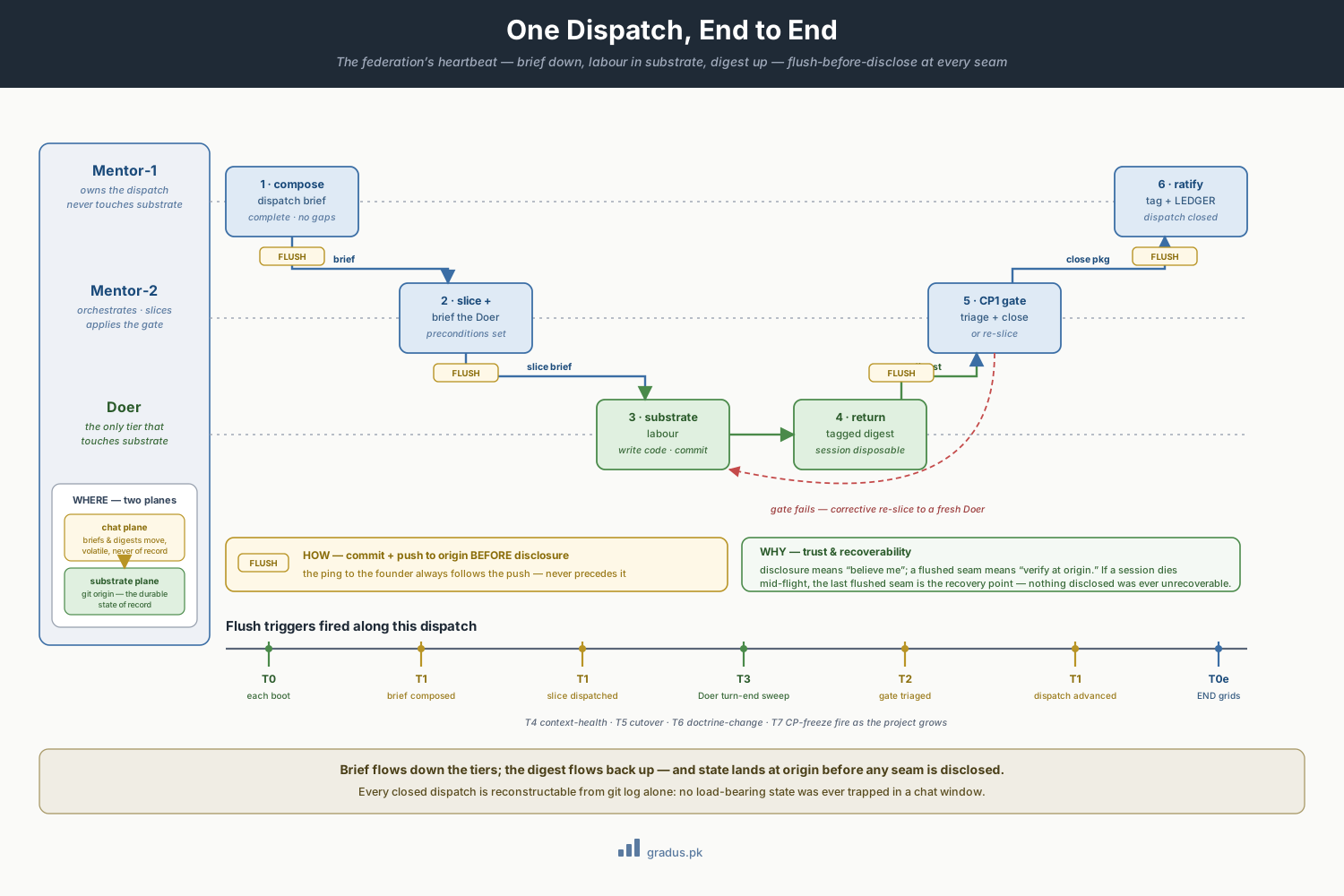
The federation's heartbeat: brief flows down, labour happens in substrate, the digest flows up — and state lands at origin before any seam is disclosed.
The cast
| Tier | In this dispatch | Touches substrate? |
|---|---|---|
| Mentor-1 | Decides the dispatch is worth doing; composes the dispatch brief; ratifies the close. | Never |
| Mentor-2 | Orchestrates this one dispatch; slices it; triages the Doer's return; applies gates. | Never |
| Doer | Reads its slice brief; writes the actual code; commits to substrate; returns a tagged digest. | Only this tier |
| Founder | Spawns each session; relays one-line pings. Carries zero content. | No |
The flow, end to end
Mentor-1 ──brief──▶ Mentor-2 ──slice brief──▶ Doer
                                                │
                                          (writes code,
                                       commits to substrate)
                                                │
Mentor-1 ◀──close pkg── Mentor-2 ◀──tagged digest──┘
Each arrow is a bus message — the federation's word for one unit of hand-off. In practice it's just a file: written into the recipient's inbox, committed and pushed to reviewer-state (the shared git repo the tiers coordinate through), then followed by a one-line founder ping. The real content never travels in chat. See the bus protocol.
Step 1 — Mentor-1 composes the dispatch brief
The booted Mentor-1 decides what to dispatch and writes a complete brief into Mentor-2's inbox. Complete means no placeholders for the founder to fill — the dispatching tier owns the fill (brief completeness).
Write to tier-1-mentor/tier-2-orchestrator/inbox/from-mentor1-auth-brief.md:
[[MENTOR-1→MENTOR-2 · auth · dispatch-brief]]

DISPATCH: scaffold the auth/ module skeleton.
SCOPE:    create auth/ package dir + an empty entrypoint + a placeholder test.
          Do NOT implement auth logic — skeleton only.
CHARTER:  v0.1 LOCKED. No Charter-touching changes.
DELIVERABLE: code on a feature branch; one slice expected.
GATE:     CP1 (skeleton compiles / lints) → close.

[[/MENTOR-1→MENTOR-2]]
Then Mentor-1 flushes and publishes — flush before disclose:
First, sync your local copy of reviewer-state with origin (the canonical copy on the server). -C /path/to/reviewer-state runs the command in that repo without changing directory; --ff-only means only accept changes that fast-forward cleanly — if someone else's work would collide, git stops rather than guessing. This guarantees you build on top of the latest shared state.
Stage every change in the repo (-A = all: new, modified, and deleted files) so git knows exactly what goes into the next snapshot. Here that's the brief file you just wrote into Mentor-2's inbox.
Record the staged changes as a permanent, timestamped snapshot (a commit) in the local history. -m supplies the commit message inline — a short label describing what this snapshot is.
Upload your local commit to origin so the rest of the team can see it. main:main pushes your local main branch to the remote main branch. The comment reminds you to confirm the GH-sync indicator reads 0/0 afterwards — meaning nothing is left un-pushed.
Only after the file is on disk and at origin does Mentor-1 ping the founder: "ready for Mentor-2." The founder relays: "pull + read your inbox."
Step 2 — Mentor-2 boots, slices, and briefs the Doer
The founder spawns a fresh Mentor-2 session in tier-1-mentor/tier-2-orchestrator/. It boots (T0), then:
git -C /path/to/reviewer-state pull --ff-only— picks up the new brief.- Reads its inbox; finds
from-mentor1-auth-brief.md. - Slices the dispatch. This one is small — a single slice,
s1. - Composes a complete Doer brief with operational preconditions, written to the Doer's inbox at
tier-2-orchestrator/s1/inbox/from-mentor2-s1-brief.md:
[[MENTOR-2→DOER · auth/s1 · slice-brief]]

YOU ARE: a Doer for auth/s1. The only tier that touches substrate.

OPERATIONAL PRECONDITIONS:
  branch:          feat/auth-s1-skeleton
  base HEAD:       <cycle-tip-SHA>
  GIT_INDEX_FILE:  /path/to/substrate/.work-tmp/auth/s1/index
  worktree:        /path/to/substrate/.work-tmp/auth/s1/wt

YOUR SLICE:
  - create auth/ package dir
  - add an empty entrypoint file
  - add one placeholder test that asserts the module imports

RETURN: tagged digest into Mentor-2's inbox (control plane).
COMMIT DISCIPLINE: worktree + commit-tree + refspec push; NEVER mix planes.

[[/MENTOR-2→DOER]]
- Flush + push reviewer-state (as in step 1). Ping founder: "ready for the auth/s1 Doer."
Step 3 — The Doer does the labour
The founder spawns a fresh Doer session. It boots from its composed brief, then works under strict git foundations discipline. The Doer keeps two planes apart and never crosses them: the data plane (the substrate repo, where the actual code lands) and the control plane (reviewer-state, where the team's messages and status go). One git command never reaches into both.
Data plane — the deliverable goes to substrate:
Point git at a private staging area (the index) just for this slice. The index is git's scratchpad of "what will go into the next commit"; by setting GIT_INDEX_FILE to a slice-specific path, this Doer's staging never collides with anyone else's. export makes the setting apply to the git commands that follow in this shell.
Create an isolated working folder (a worktree) checked out at <cycle-tip-SHA> — the exact commit the dispatch is built on. A worktree lets you edit files for this slice in their own directory without disturbing the main checkout, so parallel work stays cleanly separated.
This is a placeholder comment, not a command — it marks where you actually write the slice's files (the auth/ directory, its entry point, and a placeholder test) inside the worktree you just created.
git --work-tree=/path/to/substrate/.work-tmp/auth/s1/wt update-index --add auth/__init__ auth/entrypoint auth/test_imports
Stage the three new files into this slice's private index. --work-tree=... tells git to read the files from your slice worktree, and update-index --add records each named path as ready to commit. Naming the files explicitly keeps the commit tight — only intended files get in.
Freeze the staged content into a tree object — git's immutable snapshot of the directory layout — and save its identifier in the shell variable TREE. The $( ) captures the command's output so the next steps can reference it.
Build a commit from that tree without touching any branch. -p <cycle-tip-SHA> sets the parent (so history links back to the dispatch base) and -m gives the message; the resulting commit's identifier is stored in COMMIT. This low-level approach is what keeps the two planes from accidentally mixing.
Point the branch feat/auth-s1-skeleton at the commit you just created. update-ref writes the branch pointer directly, making the new commit the tip of that feature branch.
Upload the feature branch to origin so the deliverable lands in the shared substrate. The local:remote form pushes your feat/auth-s1-skeleton branch to a remote branch of the same name, where Mentor-2 can later review it.
Control plane — the return goes to reviewer-state (a separate git -C, never mixed with the above):
Write tier-2-orchestrator/inbox/from-doer-s1-digest.md:
[[DOER→MENTOR-2 · auth/s1 · digest]]

DELIVERABLE: auth/ skeleton on feat/auth-s1-skeleton @ <commit-SHA>.
DONE: package dir + entrypoint + placeholder import test. Test passes.
GATE CP1: skeleton imports + lints clean. READY.
OPEN: none.

[[/DOER→MENTOR-2]]
Sync reviewer-state with origin before writing to it, accepting only clean fast-forward updates, so your digest goes on top of the latest shared state.
Stage all changes in reviewer-state — here, the digest file you just wrote into Mentor-2's inbox — so they're queued for the next commit.
Snapshot the staged digest into reviewer-state's history with a descriptive message, making the hand-off a permanent, auditable record.
Upload that commit to origin so Mentor-2 can pull and read the digest. Note this is a separate git -C on reviewer-state, never combined with the substrate commands above — that separation is what keeps the control plane and data plane apart.
Delete the temporary slice worktree now that its work is committed and pushed. The slice's commit lives safely in git history, so the scratch folder is no longer needed — removing it keeps the substrate tidy.
Ping founder: "auth/s1 done, ready for Mentor-2." The Doer session is now disposable — it is never reused for another slice.
Step 4 — Mentor-2 triages and applies the gate
A fresh (or the same in-tenure) Mentor-2 pulls, reads the digest, and applies the CP1 gate: does the deliverable meet the slice brief? Here, the skeleton imports and the test passes — gate closed. Mentor-2 then writes a close package into Mentor-1's inbox (tier-1-mentor/inbox/auth/from-mentor2-close.md), flushes + pushes, pings the founder.
If the gate had failed (skeleton didn't import), Mentor-2 would compose a corrective slice brief for a fresh Doer instead — the loop repeats until the gate closes.
Step 5 — Mentor-1 ratifies and tags
Mentor-1 pulls, reads the close package, ratifies the dispatch, and applies the immutable tag that marks the close — the federation's ratification artifact:
Attach a permanent, named marker (an annotated tag, -a) to the exact commit that closed the dispatch. Unlike a branch, a tag never moves — it pins a fixed point in history. -m records why this point matters, giving the close a durable label anyone can find later.
Upload the tag to origin (tags are not pushed by branch pushes, so this is a separate step) so the ratification marker is visible to the whole team, not just locally.
Mentor-1 updates the LEDGER (the dispatch is now closed), flushes + pushes reviewer-state, and prints an END status grid. Your first dispatch is complete — and every piece of it is reconstructable from git log.
Flush-before-disclose, restated
At every step above, the pattern is identical and non-negotiable:
State on disk and at origin BEFORE it is disclosed to the founder.
The ping always comes after the push. The founder's clipboard carries zero substantive content — just one-line triggers. This is the persistence law, and it's what makes rotation, recovery, and audit trivial: there is never load-bearing state trapped in a chat window.
The gates that protect a dispatch
Work advances through flush triggers T0–T7. The ones you exercised in this dispatch:
| Trigger | Fired when | Action |
|---|---|---|
| T0 | Each session boots | Read artifacts, verify consistency, print START grid, GH-sync check |
| T1 | A state change (brief composed, gate ruled, dispatch advanced) | Flush to LEDGER.md + read back |
| T2 | A return is triaged (Mentor-2 hands back a ruling) | Flush resulting state before standby |
| T3 | End-of-turn sweep | Confirm the ledger reflects what the turn did — unflushed state = incomplete turn |
| T7 | A checkpoint freezes with pending items | Onboard every leftover to LEFTOVERS.md before reporting the freeze as ratification-ready |
(T4 context-health, T5 cutover, T6 doctrine-change round out the set — you'll meet those as the project grows.)
First-dispatch checklist
[ ] Mentor-1 composed a COMPLETE brief (no placeholders); flushed + pushed BEFORE pinging
[ ] Mentor-2 booted, sliced, composed a complete Doer brief with operational preconditions
[ ] Doer used worktree + GIT_INDEX_FILE + commit-tree + refspec push (no plain git add/commit)
[ ] Doer kept the two planes separate (substrate vs reviewer-state) — never one git command across both
[ ] Doer returned a tagged digest; worktree cleaned up; session not reused
[ ] Mentor-2 applied the CP1 gate (close or corrective re-slice)
[ ] Mentor-1 ratified, tagged the close, updated LEDGER, printed END grid
[ ] every ping followed a push — flush before disclose, every time
You now have a working federation with one closed dispatch behind it. From here, repeat the rhythm — and for a brownfield team, walk the revertible cutover.
Remember this
- Work flows down, the result flows up. A brief goes Mentor-1 → Mentor-2 → Doer; the finished code and a short digest come back the same path. That loop is the whole job — everything else is detail. See the mental model.
- Only the Doer touches the code. The mentors decide and check; the Doer writes. Keeping the two planes separate is what keeps the audit trail clean.
- Save first, talk second. Every hand-off lands on disk and at origin before anyone is pinged — so nothing important ever lives only in a chat window.
- One dispatch teaches the rhythm. Once you've run this small task end to end, every later one is the same beats, repeated.