Sample Day-2 Ops axis — deploying and watching the release
A DECOUPLED Day-2 axis with two cadences: per-release (continuous) and per-incident. This walkthrough deploys the QA-approved scheduled-exports release and stands up the monitoring that will catch the next problem.
New here? This page follows one team as they put a finished, tested feature live in production and set up alarms to watch over it. If you want to see what "shipping and then keeping an eye on it" looks like under CompassAlpha, start here.
A quick word on terms used below. An axis is one independent line of work; Ops is the axis that handles going live and monitoring. DECOUPLED means it runs in parallel with other work without fighting over shared state. A cadence is a rhythm of work (some happens on every release, some only when something breaks). And the bus is the shared message channel the team uses to hand work off to each other. Each of these is explained again where it first matters.
This is the worked example for the Ops axis — the Day-2 axis that takes a verified release and gets it running in production, then keeps watching it. Like QA, Ops runs DECOUPLED: parallel to Build and Doctrine, sharing the bus protocol and persistence law, competing for no Charter state.
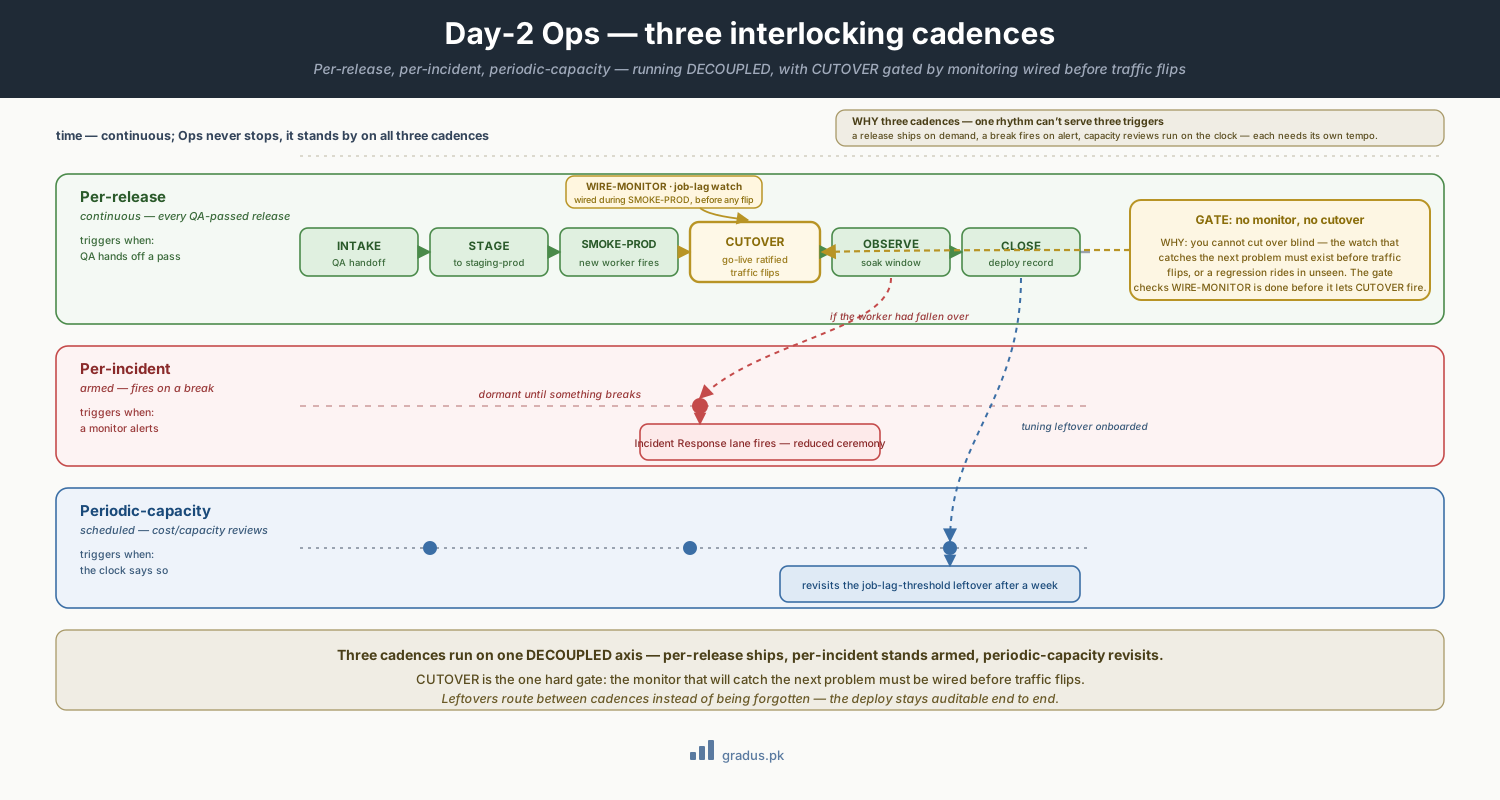
Ops runs three intersecting cadences — per-release, per-incident, periodic-capacity — with cutover gated on monitor wiring.
The Ops axis tiers + cadences
| Generic tier | Northwind Ops role | Does |
|---|---|---|
| Mentor-1 | SRE Lead | owns deploy policy; ratifies go-live; surfaces founder-calls |
| Mentor-2 | Platform Engineer | orchestrates one deploy or one capacity review; triages telemetry |
| Doer | Deploy / Config Editor | applies the deploy; edits config; wires monitors |
Ops runs on three cadences:
- Per-release (continuous) — every QA-passed release gets deployed and watched. (This example.)
- Per-incident — when something breaks, the Incident Response lane fires.
- Periodic capacity — scheduled capacity/cost reviews.
Setup
The QA axis just tagged qa-reporting-v1.3-pass (conditional pass on scheduled exports). The Ops axis now deploys it.
- Deliverable: the release running in production + monitoring + a deploy record.
- Cadence: per-release.
- Tag plan:
ops-reporting-v1.3-deployedon the deploy record.
Ops declares its own stage taxonomy — Northwind uses INTAKE → STAGE → SMOKE-PROD → CUTOVER → OBSERVE → CLOSE.
Stage-by-stage walkthrough
INTAKE — QA handoff
QA's status grid NEXT line said "hand to Ops." That handoff arrives as a bus message into the SRE Lead's inbox:
/path/to/reviewer-state/ops/tier-1-lead/inbox/from-qa-handoff.md
  [[FROM-QA-MENTOR1→TO-OPS-MENTOR1 · reporting-v1.3 · deploy-handoff]]
  qa-reporting-v1.3-pass (conditional). Approved to ship CRUD + runner.
  Watch-item: the runner's new background job — first time we run a scheduled worker in prod.
  [[/FROM-QA-MENTOR1→TO-OPS-MENTOR1]]
STAGE → SMOKE-PROD — Platform Engineer prepares
The SRE Lead stamps a Platform Engineer (Mentor-2) for this deploy. A fresh Doer (Deploy Editor) deploys to staging-prod and runs a production smoke check — including the new surface (the scheduled-export worker):
/path/to/reviewer-state/ops/tier-2-platform/reporting-v1.3/s1/inbox/from-platform-brief.md
  [[FROM-OPS-MENTOR2→TO-DOER · reporting-v1.3/s1 · brief]]
  Deploy reporting-v1.3 to staging-prod. Run migration. Smoke: app boots, export worker starts,
  one test schedule fires and delivers. Wire a monitor on the export-worker job-lag metric BEFORE cutover.
  [[/FROM-OPS-MENTOR2→TO-DOER]]
The monitoring is wired before cutover — the SRE Lead's deploy policy requires a watch in place before traffic flips.
CUTOVER — go-live ratified
The Platform Engineer reports the staging smoke is green and surfaces the go-live decision. The SRE Lead ratifies CUTOVER and the Deploy Editor flips production:
# Deploy record committed to substrate (data plane)
git -C /path/to/substrate add ops/deploys/reporting-v1.3.md
This stages the deploy record file — the written account of this cutover — so git is ready to save it. The -C /path/to/substrate tells git to act inside the substrate (the git repository that stores the team's shared state), no matter where you run the command from. Staging means "mark this file to be included in the next save."
This saves the staged file as a permanent, timestamped snapshot in the repository's history (a "commit"). The -m flag attaches a short message describing what the snapshot is, so anyone reading the history later knows this commit recorded the production cutover.
This uploads the new commit from your local copy to the shared remote repository (origin) so the rest of the team sees it. main:main means "send my main branch to the remote's main branch" — the branch being the primary line of work everyone shares.
This puts a named bookmark (a "tag") on the deploy commit so it can be found instantly later without hunting through history. The -a makes it an annotated tag (one that carries its own message and author), and -m sets that message.
This uploads the tag to the shared remote so everyone else can see the bookmark too — tags are not sent automatically by the earlier push, so they need their own upload.
OBSERVE — the continuous part
This is what makes Ops continuous rather than a one-shot. The Platform Engineer watches the new monitors for the agreed soak window. The export-worker job-lag metric stays nominal; one transient spike self-recovers and is logged but not escalated.
OBSERVE log (soak window):
  export-worker job-lag: nominal (peak 4s, threshold 60s)
  delivery success rate: 99.8%
  one transient lag spike @ 03:14 — self-recovered, no action
CLOSE — deploy record finalized
The Platform Engineer finalizes the deploy record and the SRE Lead closes the per-release cycle. Any watch-items that need ongoing attention are onboarded to LEFTOVERS.md (T7 discipline).
What the Ops status grid shows at close
STATUS GRID — 2026-06-09 · END · Ops-Mentor-1 · MODE: RELAY · axis OPS (DECOUPLED) · stage CLOSE
GATE        no Charter state (DECOUPLED) · deploy LIVE · monitors GREEN
DISPATCH    none — last: ops-reporting-v1.3-deployed
LEFTOVERS   1 open  (top: tune job-lag threshold after first full week)
NEXT        soak complete; per-release cycle closed; standby for next release/incident
DISK        2 state artifacts · read-back ✓ · no unflushed state · GH-sync 0/0 @ f51d0a3
How the cadences interlock
The per-release cycle just closed cleanly. But the Ops axis doesn't stop — it stands by on its other two cadences:
- Periodic capacity will revisit the job-lag threshold leftover after a week of real traffic.
- Per-incident is armed: if that export worker had fallen over, the Incident Response lane would have fired with reduced ceremony.
This is the deploy that went right. The next example is the one that goes wrong at 02:00 — and shows how Ops handles a real incident.
Outcome
reporting-v1.3is live, deployed through a gated CUTOVER, with monitoring wired before traffic flipped.- The deploy is auditable: handoff, brief, deploy record, and tag are all on disk.
- A tuning leftover was tracked for the periodic-capacity cadence instead of being forgotten.
- Ops ran DECOUPLED — no Charter contention, coordinated entirely through bus handoffs from QA.
Remember this
- Going live is gated, not a single button. The release moves through clear stages, and someone has to sign off on the cutover before traffic flips.
- Watch before you ship. Monitoring is wired before the switch is flipped, so if something breaks you find out right away rather than from angry users.
- Ops doesn't stop after launch. It keeps watching for an agreed window, and small follow-up tasks get written down (in a leftovers list) instead of forgotten.
- It all runs alongside other work without collisions — handoffs travel over the shared message channel, which is the heart of the mental model.