The Adoption Ladder
Start on the rung that fits you today. Climb when — and only when — your project tells you to.
A common worry on first contact with CompassAlpha is "this looks like a lot — is it all-or-nothing?" It is not. Adoption is a ladder you climb at your own pace, one rung at a time, and you start wherever your project actually is right now. Each rung is a complete, safe place to stand: you get real value there, and you only climb when a concrete signal tells you the next rung will pay for itself.
This page is your map: find your rung, see what it gives you, and know the single signal that means it's time for the next one. The same framework runs all the way up — climbing means adopting more of it, never switching to a different product.
The five rungs at a glance
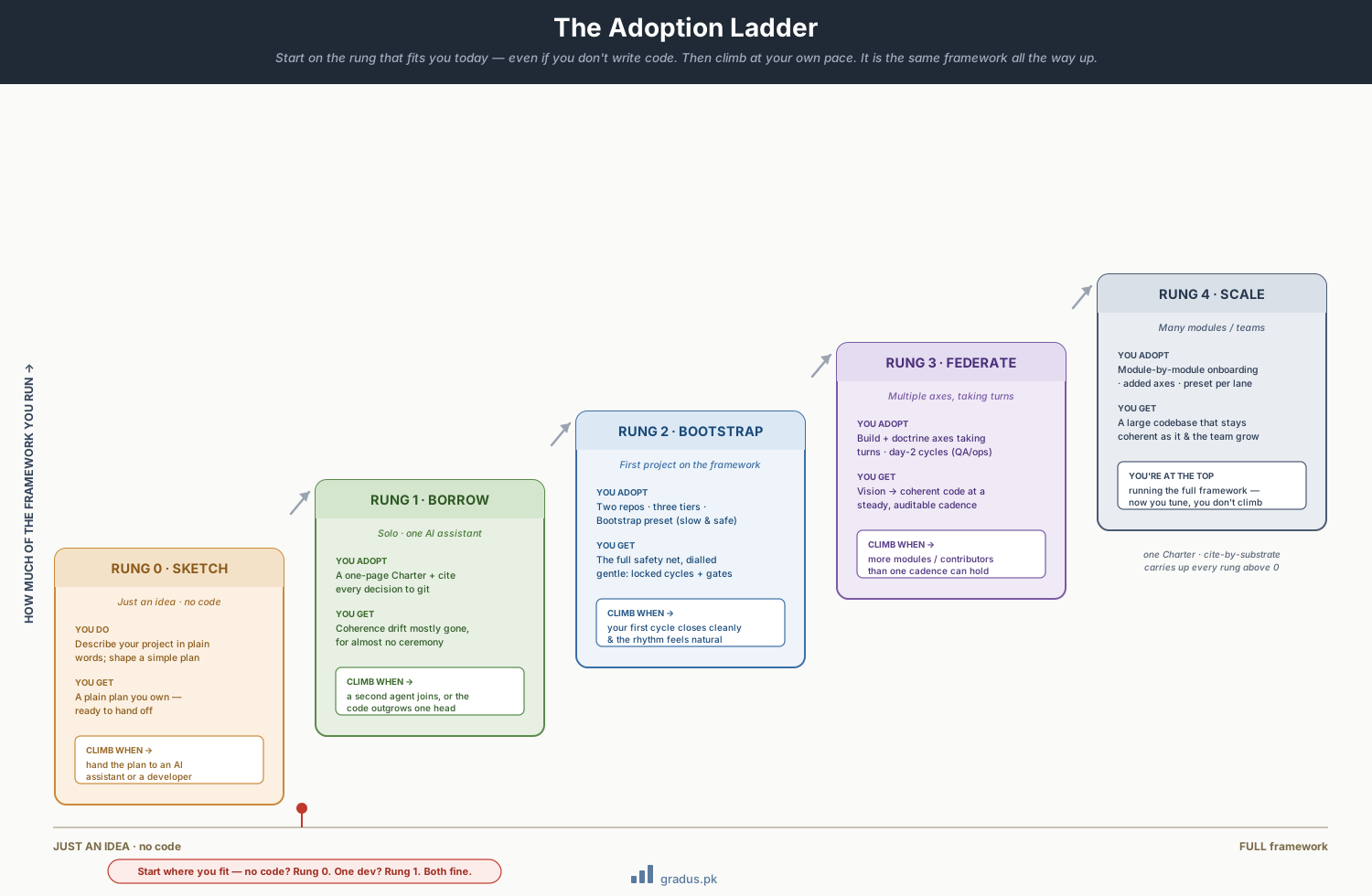
Left to right is "just an idea, no code" → full-framework. You don't skip rungs and you don't have to reach the top — most adopters get lasting value partway up. The one thread that runs through every building rung: keep a Charter and cite decisions to git.
Find your rung
Read down this table and stop at the first row that sounds like you today:
| If this is you… | You're on | What changes when you climb |
|---|---|---|
| You have only an idea and you don't write code | Rung 0 — Sketch | You hand your plan to an AI assistant or a developer, who stands it up |
| Solo, one AI assistant, a small or one-off project | Rung 1 — Borrow | A second agent or a growing codebase makes coherence hard to hold in one head |
| Ready to run your first real project on the framework, want it gentle | Rung 2 — Bootstrap | Your first cycle closes cleanly and the rhythm feels natural |
| Running build and doctrine work, want a steady cadence | Rung 3 — Federate | More modules or contributors than one cadence can hold |
| A multi-module estate, a brownfield system, or several contributors | Rung 4 — Scale | You're running the full framework — now you tune, you don't climb |
Nobody is turned away — not even someone who doesn't write code. There's no shame in a low rung: many builders start at Rung 1, and non-technical idea-owners start at Rung 0, and plenty get everything they need without ever reaching the top.
Rung 0 — Sketch
Just an idea · no code · non-technical.
The ground floor. You have a project in your head and you can describe it, but you don't build software yourself. You don't touch git, a repo, or a terminal here. You do the one part only you can do — shape the idea into a plain-language plan — and then hand that plan to someone (or something) that does the technical part.
What you get: a clear plan you own — the vision, the parts, and the rules — written in your own words, so you can read it, change it, and explain it.
Climb when: you hand the plan off — to an AI assistant (with a ready-made kickoff) or to a developer (with a one-line brief), who stands the project up for you.
→ This rung is written for you, step by step, with no code anywhere: Start with just an idea.
Rung 1 — Borrow
Solo · one AI assistant · no federation.
The lightest possible start. You don't stand up any of the federation machinery — no second repo, no tiers. You borrow the two ideas that do the most work and apply them by hand:
- Keep a Charter — one short document that records the one canonical way to do each recurring thing in your project. (A Charter is the project's rulebook; here it's a single page you grow as you go.)
- Cite by substrate — let decisions live in git (commits, files), not in a chat window you'll lose. The state of your project is the state of your repo.
What you get: most coherence drift — the slow sprawl of three slightly-different ways to do the same thing — disappears, for almost no ceremony.
Climb when: a second agent joins, or the codebase grows past what one person can keep coherent in their head.
→ This rung is fully written up, step by step: Borrow CompassAlpha (solo). New to the vocabulary? Read the mental model first.
Rung 2 — Bootstrap
Your first real project on the full framework — tuned slow and safe.
Here you stand up the actual framework: two repos (one for code, one as the state-of-record) and the three tiers (a senior planner, a coordinator, and the hands-on builder). You run it under the Bootstrap preset — the leanest posture, not a stripped-down framework. It's the full setup with every dial turned to slow-and-safe so nothing moves faster than you can follow.
Coming from Rung 1? Take it as two small, safe steps — not one big one.
The full setup adds two new things — but you don't add them at the same time. You do one, get comfortable, then the other. And neither one can touch or break your actual code, so you can try each and undo it with nothing lost.
- Step 1 — give your decisions their own home. (safe · reversible) You're already jotting down "the way we do this" by hand. Now those notes get their own separate place, kept by git. Your code isn't touched — this is a second notebook sitting next to it, not inside it. Git keeps every version, so you can always go back. If it doesn't suit you, you delete a folder and you're exactly where you started.
- Step 2 — let a few helpers share the work. (you stay in charge) Instead of one assistant doing everything, the work splits across three simple roles: one plans, one organizes, one builds. This is added safety, not added risk — more checking before anything lands, and you're still the person who says "go." You switch this on only after Step 1 feels natural, and you run it on the slowest, gentlest setting while you find your feet.
Nobody does both steps in one sitting, and nothing here is a one-way door. The mental model explains the ideas; greenfield setup walks each step on its own.
What you get: the complete safety net, dialled gentle — cycles that lock the rulebook while code is written, and gates that check work before it lands.
Climb when: your first cycle closes cleanly and the alternating rhythm (settle the rules → lock → build) feels natural rather than effortful.
→ Stand it up with greenfield setup (new project) or brownfield onboarding (existing codebase); choose your posture in operating presets.
Rung 3 — Federate
Multiple axes, taking turns.
Now more than one track of work runs — a build axis (writes code) and a doctrine axis (changes the rulebook) alternating in bounded cycles, and you can add day-2 axes like QA or ops. The tiers coordinate across them; the bus carries the hand-offs; git records every step.
What you get: vision → coherent code at a steady, auditable cadence — the framework's core promise, running for real.
Climb when: you have more modules or contributors than a single cadence can comfortably hold.
→ See it work end-to-end in the sample doctrine cycle and the day-2 cycles.
Rung 4 — Scale
A multi-module estate · brownfield systems · several contributors.
The top of the ladder. You onboard modules one at a time, add axes as new kinds of work appear, and run a different posture per lane (a heavyweight doctrine change and a one-line fix don't deserve the same ceremony — see work-granularity lanes).
What you get: a large codebase that stays coherent as both it and the team grow — the thing that's almost impossible to hold by hand at scale.
You're at the top: from here you tune, you don't climb. The remaining surface is the tunables and toggles.
→ For existing large systems, the safe path in is cutover from a pre-AI project — non-destructive, parallel-track, revertible. Coordinating several teams across several components? See multi-team federation — including how the relay avoids becoming a bottleneck and how teams sit on different rungs at once.
The thread that runs up every rung
Notice that Rung 1's two habits never leave you: a Charter and cite-by-substrate are still the spine at Rung 4 — the higher rungs add federation, axes, and tiers around that same core. That's why borrowing them solo is a genuine first rung and not a throwaway: you're already doing the most load-bearing part of CompassAlpha, just by hand. Climbing automates and enforces what you were already doing. (Rung 0 sits below that thread: there you produce the plain-language plan the Charter and the parts are later grown from — the thinking the whole spine rests on.)
Remember this
- Adoption is a ladder, not a cliff — start on the rung that fits your project today.
- Each rung is a complete place to stand — real value, not a half-installed version of the next one.
- Climb on a signal, not a schedule — each rung names the one concrete thing that means it's time.
- It's the same framework all the way up — climbing adds more of it; it's never a different product.
- The lowest rung is real — a Charter + cite-by-substrate is the spine that carries all the way to the top.