Sample Phase 3 dispatch — scheduled exports for Reporting¶
The build axis at full ceremony. A single-module substantive change runs CP1 → CP2 → CP3, freezes, gate-checks, and tags. This walkthrough adds scheduled exports to Northwind's Reporting module.
New here? This page follows one real feature — adding scheduled report exports to a sample app — from first plan to final tagged release, so you can see how a substantial piece of work moves through the framework's checkpoints. Think of it as a recorded demo of the full process.
A quick orientation before the jargon arrives. Phase 3 is the framework's name for a chunky-but-contained piece of work: one module gets something genuinely new (a database table, new endpoints, a background job). The work passes through three review checkpoints — CP1 (plan it), CP2 (build it), CP3 (report on it) — and then a closing ritual where the work is locked, checked against a set of gates (pass/fail quality checks), and given a git tag (a permanent version label). Tiers like Mentor and Doer are simply roles: planners/reviewers above, the hands-on builder below. With that map in hand, the walkthrough below should read cleanly.
This is the worked example for the Phase 3 lane (see Work Granularity Lanes) — the heaviest build-axis lane, used for substantive single-module work: a new schema, new routes, a multi-stage rollout. It is the build-axis sibling of the doctrine cycle: same three tiers, same freeze/gate/tag tail, but the deliverable is code, not doctrine, so §19 compass structure doesn't apply.
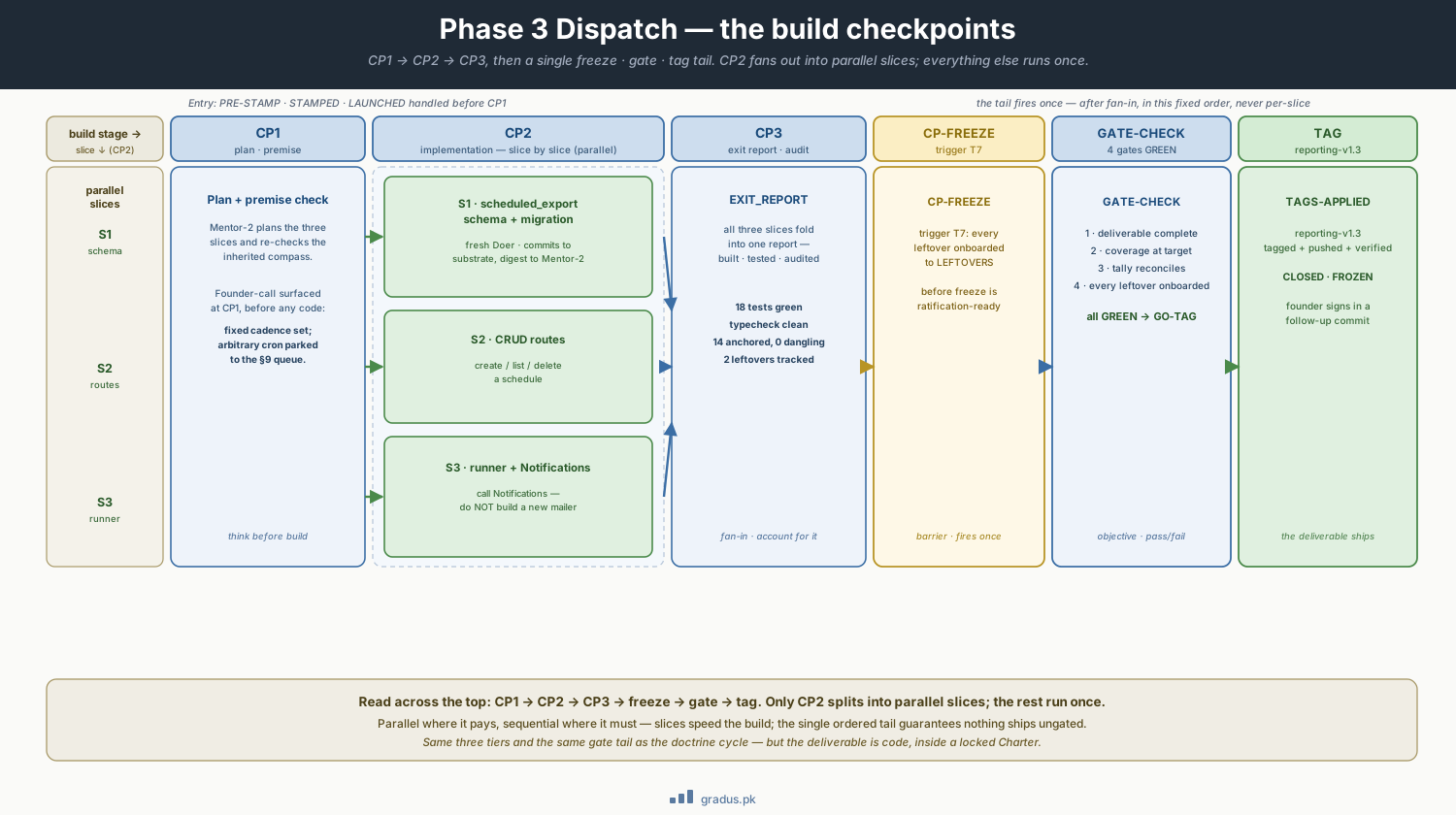
Parallel slices fan out through the checkpoints and fan back in to a single freeze-gate-tag close.
Setup¶
Northwind's Reporting module can render dashboards live but can't deliver them on a schedule. The founder wants scheduled exports: users pick a report + a cadence, and the system emails a CSV at that cadence. This is a new schema (a scheduled_export table), new routes, and a background runner — squarely Phase 3.
- Charter posture: LOCKED (build axis active — the doctrine cycle already closed; Reporting's compass is the inherited reference).
- Tiers in play (build axis): Mentor-1 · Mentor-2 (this dispatch) · Doer (fresh-per-slice).
- Deliverable: working scheduled-export feature in
/path/to/substrate/reporting/**, passing typecheck + tests + audit. - Tag plan:
reporting-v1.3on the gated commit.
Northwind uses the default build stage taxonomy: PRE-STAMP → STAMPED → LAUNCHED → WIP-CP1 → WIP-CP2 → WIP-CP3 → CP-FREEZE → GATE-CHECK → GO-TAG → TAGS-APPLIED → CLOSED → FROZEN (see Stage taxonomies).
Stage-by-stage walkthrough¶
PRE-STAMP → STAMPED → LAUNCHED¶
Mentor-1 composes the dispatch stamp and writes it into Mentor-2's inbox (trigger T1 flush), then the founder relays one ping.
/path/to/reviewer-state/tier-2-orchestrator/reporting-exports/inbox/from-mentor1-launch.md
  [[FROM-MENTOR1→TO-MENTOR2 · reporting-exports · launch]]
  Dispatch: scheduled exports for Reporting. Scope: schedule CRUD + background runner + CSV email.
  Inherit Reporting compass (reporting-compass-v0.2) + Charter v0.6.
  Reuse Notifications for delivery — do NOT build a new mailer.
  [[/FROM-MENTOR1→TO-MENTOR2]]
Mentor-2 boots: stage LAUNCHED.
CP1 — Planning + premise check¶
CP1 is think before build. Mentor-2 plans the slices, re-checks the premise against the inherited compasses, and surfaces founder-calls before any code is written.
/path/to/reviewer-state/tier-1-mentor/inbox/reporting-exports/from-mentor2-cp1-founder-call.md
  [[FROM-MENTOR2→TO-MENTOR1 · reporting-exports · cp1-founder-call]]
  FOUNDER-CALL: cadence options — daily/weekly/monthly only, or arbitrary cron?
  Recommend: fixed set (daily/weekly/monthly) for v1; cron deferred to §9.
  Slice plan: S1 schema+migration · S2 CRUD routes · S3 runner+Notifications wiring.
  [[/FROM-MENTOR2→TO-MENTOR1]]
The founder rules "fixed set for v1" (relayed through Mentor-1's inbox). Cron support is parked in the §9 queue for a future doctrine cycle. CP1 closes.
CP2 — Implementation, slice by slice¶
Each slice is a fresh Doer (fresh-per-slice — see Tier Grammar). Mentor-2 briefs slice S1; the Doer works in a worktree and returns tagged.
/path/to/reviewer-state/tier-2-orchestrator/reporting-exports/s1/inbox/from-mentor2-brief.md
  [[FROM-MENTOR2→TO-DOER · reporting-exports/s1 · brief]]
  Add scheduled_export table + migration. Columns: id, user_id, report_id, cadence(enum),
  next_run_at, last_run_at, status. Anchor to Reporting compass 10K schema section.
  [[/FROM-MENTOR2→TO-DOER]]
The Doer commits to substrate (data plane), then writes a digest into Mentor-2's inbox (control plane) — two separate git operations, never cross-committed:
# Data plane (substrate)
git -C /path/to/substrate add reporting/migrations/ reporting/models/scheduled_export.ts
This stages the new files — the migration and the model — for the next commit. git add tells git which changed files to include; -C /path/to/substrate just means "run this in that directory" so you don't have to move there first.
This records the staged files as a permanent, labelled snapshot in the project's history. The -m text is the commit message — a short note saying what changed, so anyone reading the history later knows why.
This uploads the new commit to the shared remote copy of the project (origin) so the rest of the team can see it. main:main means "send my main branch to the remote's main branch."
Mentor-2 triages the return (stage TRIAGING), applies per-stage substantive review, then briefs S2, then S3. The S3 Doer is told explicitly to call Notifications, not to build a mailer — enforcing the Federation Contract from the inherited compass.
CP3 — Exit-report assembly + audit reconciliation¶
Mentor-2 assembles the EXIT_REPORT: what was built, what was tested, what audit checks ran, and the finding tally.
/path/to/reviewer-state/tier-2-orchestrator/reporting-exports/EXIT_REPORT.md
  Built: schema (S1), CRUD routes (S2), runner + Notifications wiring (S3).
  Tests: 18 added, all green. Typecheck: clean. Route-coverage audit: 100% of new routes.
  Findings: 14 anchored, 0 dangling.
  Leftovers: cron-cadence (§9), retry-on-email-failure (build leftover).
Freeze → gate-check → tag¶
At CP-FREEZE, trigger T7 onboards every leftover to LEFTOVERS.md before freeze is declared ratification-ready.
Mentor-1 runs the four gates (see Guardrails):
| Gate | Check | Result |
|---|---|---|
| 1 · Deliverable COMPLETE | feature passes typecheck + tests + audit | GREEN |
| 2 · Coverage at target | all three slices done + substance review | GREEN |
| 3 · Finding tally self-reconciles | 14 anchored, 0 dangling | GREEN |
| 4 · Every non-closed item onboarded | 2 leftovers tracked | GREEN |
Gates GREEN → GO-TAG. Mentor-2 applies the exit tag and verifies it landed:
This attaches a permanent version label, reporting-v1.3, to the current commit. A tag is a named bookmark for a specific point in history; -a makes it an "annotated" tag that also stores the -m message, so the release has a description you can read back later.
This uploads the new tag to the shared remote (origin). Tags aren't sent automatically with a normal push, so you name the tag explicitly to make the release label visible to everyone.
This checks that the tag actually arrived on the remote. ls-remote --tags origin lists every tag the remote knows about, and grep reporting-v1.3 filters that list down to just the line you're looking for — if it prints, the tag landed.
Stage advances GO-TAG → TAGS-APPLIED → CLOSED. Mentor-1 sends the STAND-DOWN ack; Mentor-2's judicial folder is archived (FROZEN).
The founder's signature lands in a follow-up commit after the tag — it's decoupled judgment, not a gate (see §13 tag-vs-close-record convention).
What the status grid shows at close¶
STATUS GRID — 2026-06-09 · END · Mentor-1 · MODE: RELAY · cycle stage CLOSED
GATE        Charter v0.6 LOCKED · gates closed · 1/1 dispatch done
DISPATCH    none — last: reporting-v1.3
LEFTOVERS   2 open  (top: cron-cadence §9, retry-on-email-failure)
NEXT        hand reporting-v1.3 to QA axis for release verification
DISK        3 state artifacts · read-back ✓ · no unflushed state · GH-sync 0/0 @ a71e0bd
Outcome¶
- Scheduled exports shipped as
reporting-v1.3: schema, routes, runner, all gated. - The Federation Contract held — delivery went through Notifications instead of a duplicate mailer.
- A scope question (arbitrary cron) was surfaced at CP1 and parked cleanly, not silently dropped.
- The dispatch is now ready to hand to the QA axis for release verification and the Ops axis for deployment.
Compared to the doctrine cycle: same tier count, same gate tail — but no 60K/30K/10K altitude structure and no Charter unlock. The build axis runs inside a locked Charter. The next two examples relax the ceremony further.
Remember this¶
- Phase 3 is the heavy lane for building, not deciding. It runs inside an already-settled Charter (the rules don't change here) — the deliverable is working code, gated and tagged.
- CP1 → CP2 → CP3 means plan, build, account. Open questions get surfaced early (at CP1) and either answered or parked on a queue — never silently dropped.
- The closing ritual is the safety net. Freeze, four gates (all must be GREEN), then a version tag. A feature only "ships" once every gate passes and every loose end is tracked.
- Roles map to a simple hierarchy. If "Mentor" and "Doer" still feel abstract, the mental model lays out who does what and why the layers exist.